

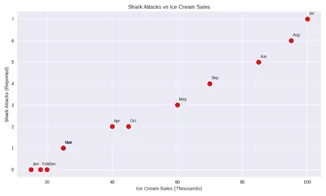
Do ice cream sales cause shark attacks? This may seem like an absurd question, but it’s one that has been debated for years. The idea that these two seemingly unrelated events could be connected is a classic example of confusing correlation with causation. While it’s true that both ice cream sales and shark attacks increase during the summer months, this does not mean that one causes the other.
Before we delve into the details of this debate, let’s first understand what correlation and causation actually mean. Correlation refers to a relationship or connection between two variables. In other words, when one variable changes, the other variable also tends to change in a similar way. On the other hand, causation refers to a direct cause-and-effect relationship between two variables. This means that one variable directly causes the other to change.
Now, let’s take a closer look at the supposed correlation between ice cream sales and shark attacks. According to a study published in the Journal of the American Medical Association, there is a clear correlation between these two events. The study found that both ice cream sales and shark attacks increase during the summer months, with the highest number of shark attacks occurring in July and August, which also happens to be the peak season for ice cream sales.
This finding has led many to believe that there is a direct link between the two. Some have even gone as far as to suggest that the increase in ice cream consumption somehow attracts sharks to the shores. However, this is simply not true. The truth is that there is no causal relationship between ice cream sales and shark attacks. In fact, there is no evidence to suggest that sharks are attracted to the smell or taste of ice cream.
So why do these two events increase together during the summer months? The answer lies in a third variable – warm weather. The summer months bring warmer temperatures, which make people more likely to go to the beach and indulge in ice cream. At the same time, warm water temperatures also attract more sharks to the coast. Therefore, it’s not the ice cream that causes the shark attacks, but rather the warm weather that leads to both events.
This confusion between correlation and causation is not limited to the ice cream and shark attack debate. In fact, it’s a common mistake that people make when looking at data. Just because two events are correlated, it does not mean that one causes the other. There could be a number of other factors at play that are responsible for the observed correlation.
So why is it important to understand the difference between correlation and causation? Well, for one, it helps us avoid making false assumptions and drawing incorrect conclusions. In the case of ice cream and shark attacks, assuming a causal relationship could lead to unnecessary fear and panic. It could also result in misguided policies and actions, such as banning ice cream sales near beaches.
Moreover, understanding the difference between correlation and causation is crucial for making informed decisions. In the field of social sciences, where data and statistics are often used to inform policies and interventions, it’s important to accurately interpret the data and avoid falling into the trap of confusing correlation with causation.
In conclusion, the increase in ice cream sales and shark attacks during the summer months is simply a coincidence and not a cause-and-effect relationship. It’s important to remember that just because two events are correlated, it does not mean that one causes the other. We must be careful not to jump to conclusions and always consider other factors that may be at play. As the saying goes, “correlation does not imply causation.”
