

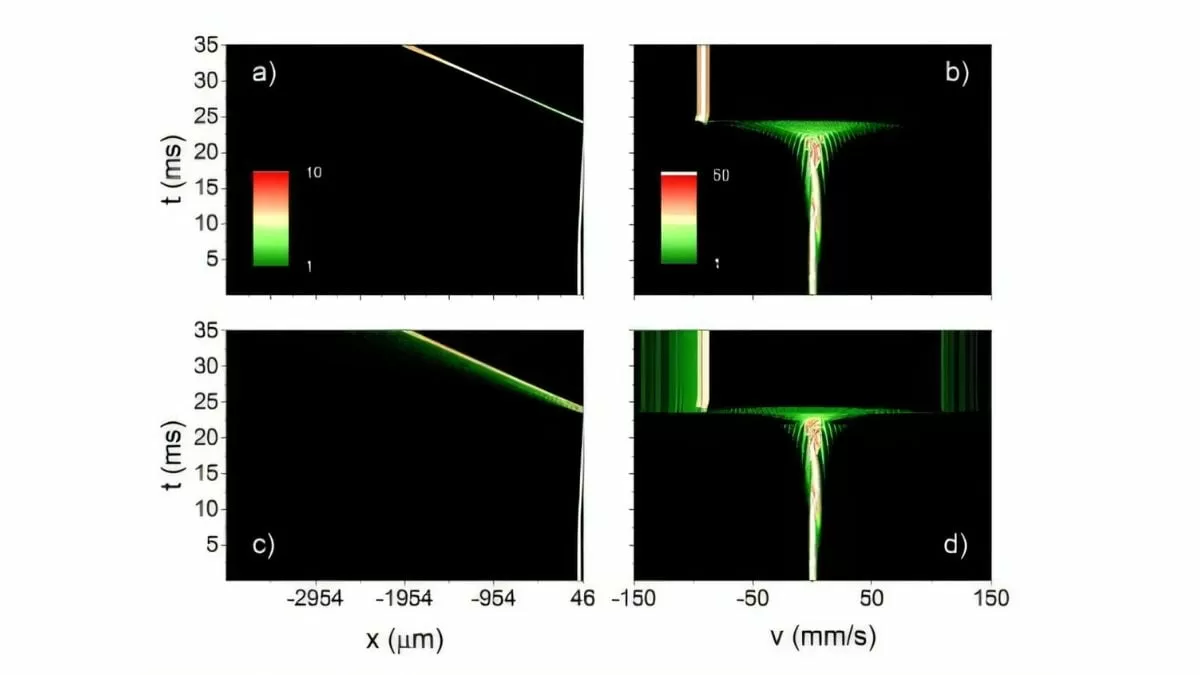
Scientists have made a groundbreaking discovery in the field of particle physics. They have successfully recreated Fermi acceleration in a laboratory using ultracold atoms and movable optical barriers, simulating the process by which cosmic rays gain energy in space. This achievement, developed by teams from the University of Birmingham and the University of Chicago, marks a major advance in the study of high-energy astrophysics and opens doors to new possibilities in quantum technology.
Fermi acceleration, first proposed by Italian physicist Enrico Fermi in 1949, is a mechanism by which particles gain energy by bouncing back and forth between magnetic fields. This process is believed to be responsible for the high energy levels observed in cosmic rays, which are high-speed particles that originate from outside our solar system. Understanding and recreating this phenomenon has been a long-standing challenge in particle physics.
The team of scientists from Birmingham and Chicago tackled this challenge by using ultracold atoms, which are atoms cooled to temperatures close to absolute zero. This extreme cooling creates a quantum gas whose properties can be precisely controlled and manipulated. By using these ultracold atoms, the team was able to recreate a miniature version of Fermi acceleration in a controlled laboratory environment.
The key to their success was the use of movable optical barriers, which mimic the role of magnetic fields in space. These barriers were able to confine the ultracold atoms and accelerate them to high speeds through repeated interactions. The team was able to observe and measure the acceleration of these atoms, providing valuable insights into the process of Fermi acceleration.
This groundbreaking experiment not only recreates a fundamental astrophysical process in a lab setting but also opens up exciting new possibilities for high-energy astrophysics research. By studying how particles gain energy in space, scientists can gain a deeper understanding of the universe and its origins. This could potentially lead to new discoveries about the nature of dark matter and the mysterious sources of cosmic rays.
Moreover, this achievement has significant implications for quantum technology. The ability to manipulate and control ultracold atoms could pave the way for the development of new quantum technologies, such as quantum computers. This could have a transformative impact on various fields, from healthcare to finance, by providing faster and more efficient computing power.
The success of this mini Fermi accelerator is a testament to the power of collaboration between different scientific disciplines. The team from Birmingham and Chicago combined their expertise in ultracold atoms and particle physics to achieve this groundbreaking feat. This highlights the importance of interdisciplinary research in pushing the boundaries of scientific knowledge.
The implications of this achievement are far-reaching and have the potential to revolutionize our understanding of the universe and our technological capabilities. This is a significant step forward in the field of particle physics and is sure to inspire further research and experimentation in this area.
In conclusion, the successful recreation of Fermi acceleration in a laboratory using ultracold atoms and movable optical barriers is a major breakthrough in the world of particle physics. This achievement not only deepens our understanding of the universe but also has the potential to drive technological advancements in the future. The team from Birmingham and Chicago have opened new doors for high-energy astrophysics research and quantum technology, and their work will undoubtedly inspire and motivate scientists around the world to continue pushing the boundaries of scientific discovery.
