

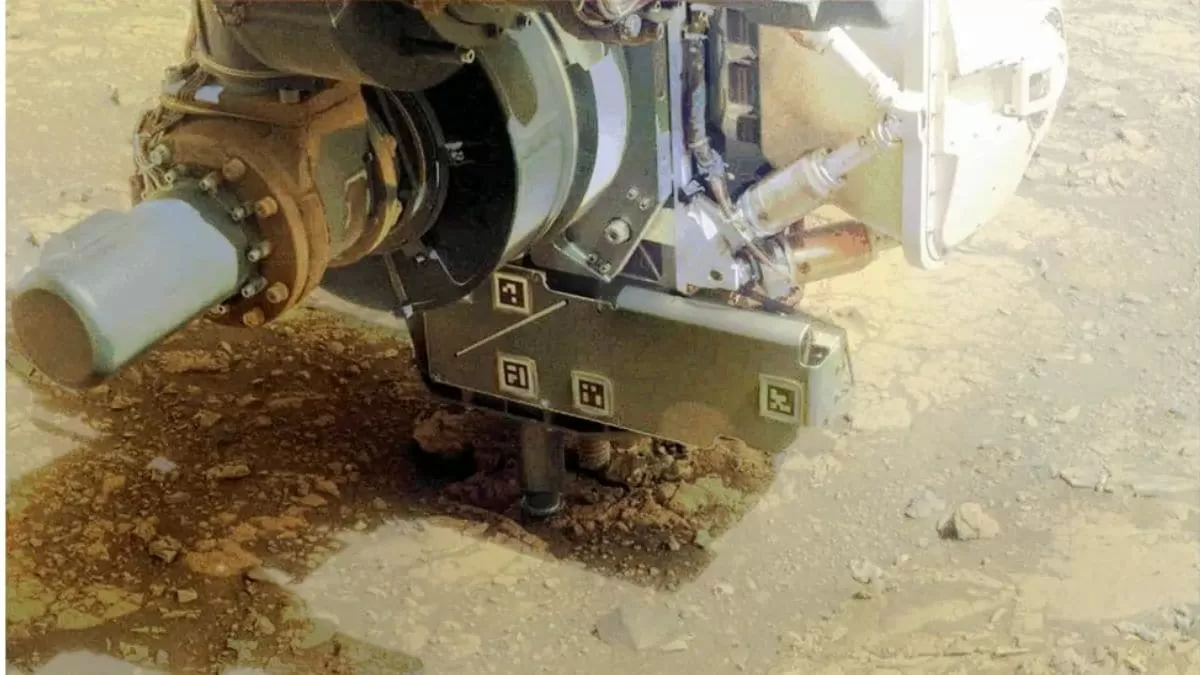
NASA’s Perseverance rover is making groundbreaking discoveries as it continues its mission on the red planet. The latest development is the rover’s focus on a peculiar Martian rock known as Kenmore. This rock has caught the attention of scientists due to its potential for preserving signs of ancient life on Mars. The Perseverance rover is now grinding into this rock to study its inner makeup and unlock the secrets of early Mars.
Kenmore is a unique rock that has never been studied in detail before. It is located in an area called Jezero Crater, which was once a lake on Mars. The presence of this rock in such a location suggests that it may have been formed through water-related processes. And water is a key ingredient for life to exist.
The Perseverance rover has been equipped with advanced instruments and tools to carry out detailed analysis of Kenmore. The rover’s robotic arm has a powerful drill that can grind into the rock’s surface and collect samples. These rock samples are then fed into the rover’s onboard laboratory for further investigation.
The initial results from the analysis of Kenmore have already surprised scientists. The rock has yielded clay and feldspar, minerals that are known to form in the presence of water. This provides strong evidence that water was once present in Jezero Crater, making it a promising location for finding signs of ancient life on Mars.
But the most exciting discovery from Kenmore is the presence of manganese hydroxide. This is the first time this mineral has been found on Mars, and it is a significant indicator of water-related processes. Manganese hydroxide is formed when water interacts with manganese-bearing minerals, and it is commonly found in Earth’s oceans and lakes. Its presence on Mars further supports the theory that there was once a habitable environment on the red planet.
The Perseverance rover’s mission on Mars is not just about finding signs of ancient life. It is also about understanding the planet’s past and present environment. By studying rocks like Kenmore, scientists can gain insights into the planet’s geology and how it has evolved over time. This information is crucial in our quest to learn more about the red planet and its potential for future human exploration.
The Perseverance rover’s journey to Kenmore has not been an easy one. The rover had to navigate through treacherous terrain, including sand dunes and rocky cliffs, to reach the rock. But the rover has lived up to its name and has persevered through all challenges to reach this significant milestone in its mission.
NASA’s Perseverance rover is not alone in this groundbreaking exploration of Mars. It is accompanied by the Ingenuity helicopter, which has captured stunning aerial images of the Martian landscape. Together, these two robotic explorers are expanding our knowledge of the red planet and paving the way for future missions.
The findings from Kenmore have reignited the excitement and anticipation for what other secrets Mars holds. The Perseverance rover will continue its journey, exploring other areas of Jezero Crater and collecting more samples for analysis. Scientists are hopeful that these samples will provide even more evidence of water-related processes and signs of ancient life on Mars.
The success of NASA’s Perseverance rover in studying Kenmore and other rocks on Mars is a testament to human ingenuity and our relentless pursuit of knowledge. With each discovery, we are getting closer to understanding the mysteries of the red planet and our place in the universe.
As we continue to explore and study Mars, we are also laying the groundwork for potential human missions to the planet in the future. The data and insights gathered by the Perseverance rover will be crucial in planning and preparing for such missions.
In conclusion, the Perseverance rover’s mission to study Kenmore has yielded groundbreaking results and provided a glimpse into the planet’s past. The discovery of clay, feldspar, and manganese hydroxide in this Martian rock has given us hope that Mars was once a habitable environment. It is a testament to the power of human curiosity and determination, and it motivates us to continue exploring the wonders of the universe.
