

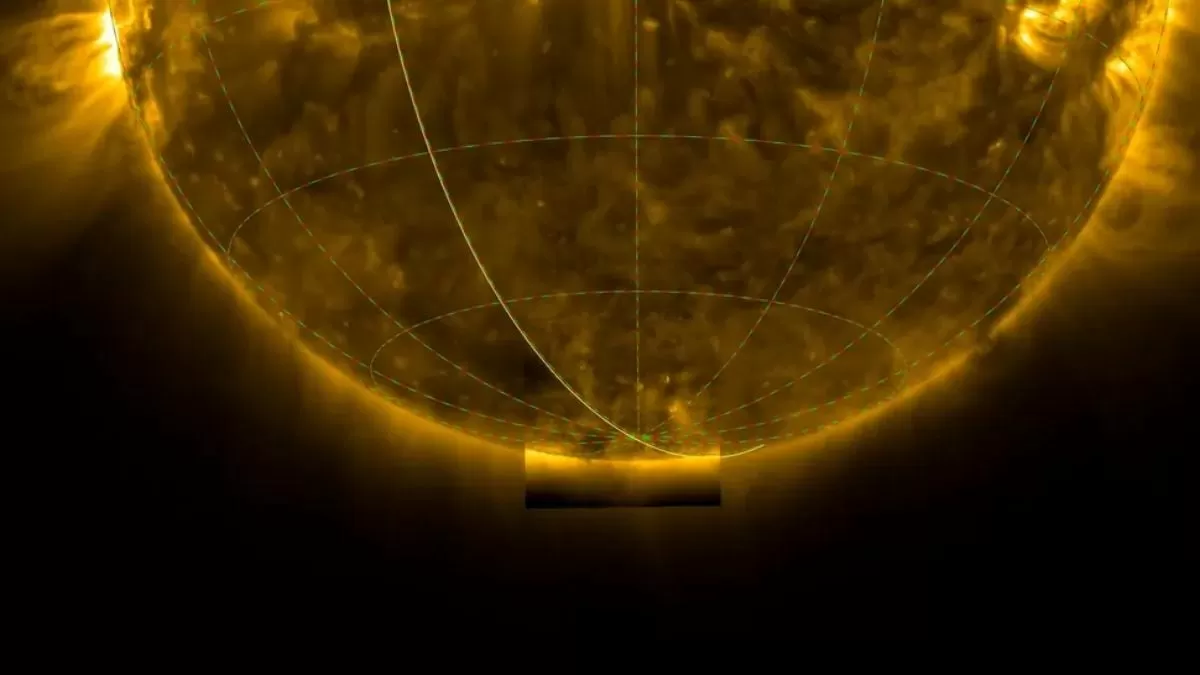
In a breakthrough moment for space exploration, the European Space Agency’s Solar Orbiter has captured the first-ever image of the Sun’s elusive south pole. This achievement marks a significant milestone in our understanding of the Sun and its impact on Earth’s environment.
Launched in February 2020, the Solar Orbiter is a joint mission between the European Space Agency (ESA) and NASA. Its primary goal is to study the Sun’s polar regions and how they influence space weather, which can affect our planet’s technology and astronauts in space.
After a journey of more than a year, the Solar Orbiter has finally reached its intended orbit around the Sun, providing us with a view of the star’s south pole that has never been seen before. The image captured by the spacecraft reveals a complex web of magnetic fields and solar winds, which play a crucial role in shaping the Sun’s atmosphere and determining its 11-year solar cycle.
The Sun’s polar regions have long been a mystery to scientists, as most of the previous solar missions have focused on the equatorial region. This has left a significant gap in our understanding of the star’s overall behavior. With this latest achievement, the Solar Orbiter is filling in that gap and providing us with crucial insights into the Sun’s polar regions.
The image captured by the Solar Orbiter shows a tangle of magnetic field lines, also known as coronal loops, extending from the Sun’s surface. These loops are responsible for the Sun’s dynamic activity, such as solar flares and coronal mass ejections, which can have a significant impact on Earth’s space environment.
The Solar Orbiter’s unique position in its orbit allows it to capture these images with an unprecedented resolution, providing scientists with a better understanding of the Sun’s behavior and its impact on our planet. This information is crucial in predicting and preparing for potential space weather events that can disrupt satellite communications, GPS systems, and even power grids on Earth.
In addition to capturing images of the Sun’s polar regions, the Solar Orbiter has also made other significant observations. It has detected bursts of high-energy particles, known as solar flares, which can pose a threat to astronauts and technology in space. The spacecraft has also measured the Sun’s magnetic field, revealing its complex and ever-changing nature.
This mission is a testament to the power of international collaboration in space exploration. The Solar Orbiter is equipped with ten science instruments, four of which were contributed by NASA. This joint effort has allowed us to see the Sun like never before and gain a better understanding of our closest star.
The Solar Orbiter’s success is a result of years of hard work and dedication by the teams at ESA and NASA. It also showcases the advancements in technology that have made this mission possible. The spacecraft’s heat shield is designed to withstand temperatures of up to 520 degrees Celsius, allowing it to get as close as 42 million kilometers to the Sun’s surface.
Furthermore, the Solar Orbiter’s orbit is highly elliptical, taking it closer to the Sun than Mercury, the closest planet to our star. This unique trajectory will allow the spacecraft to capture images from different angles, providing us with a more comprehensive view of the Sun’s polar regions.
The Solar Orbiter’s mission is far from over, and we can expect more groundbreaking discoveries in the years to come. The spacecraft will continue to study the Sun’s polar regions and its dynamic activity, providing us with vital information about space weather and its influence on Earth.
In conclusion, the Solar Orbiter’s first image of the Sun’s south pole is a momentous achievement in our quest to understand our solar system. This mission marks a major leap in our understanding of space weather and the Sun’s 11-year solar cycle. With this new information, we can better prepare for and mitigate the impacts of solar activity on our planet. The Solar Orbiter’s success is a testament to the endless possibilities of space exploration and the determination to push the boundaries of our knowledge.
