

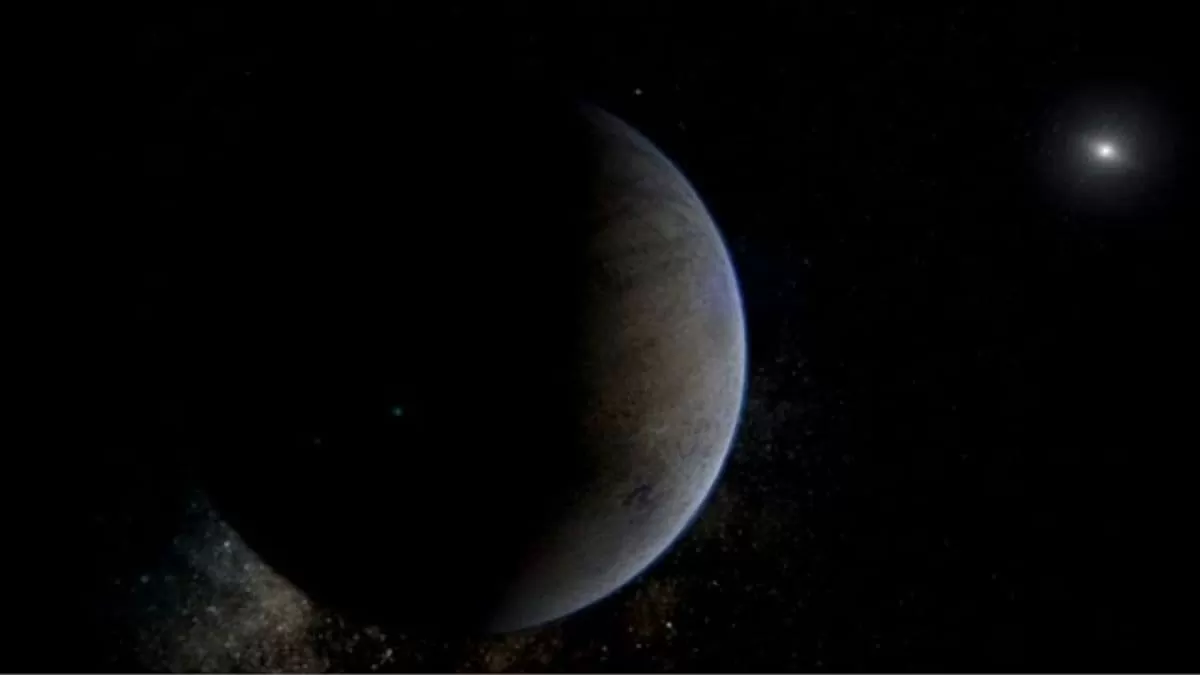
In a major breakthrough, scientists have discovered a potential dwarf planet, 2017 OF201, in the farthest reaches of our solar system. This discovery has reshaped our understanding of space and has sent shockwaves through the scientific community. With a highly elongated orbit and a large size, 2017 OF201 presents a challenge to the widely accepted Planet Nine hypothesis, which predicted orbital clustering among distant objects. This finding not only calls into question the existence of a ninth planet in our solar system but also suggests that our current understanding of the outer solar system may be incomplete.
The discovery of 2017 OF201 was made by a team of researchers at the Carnegie Institution for Science, led by astrophysicist Scott Sheppard. The dwarf planet was first spotted using the Dark Energy Camera on the Blanco telescope at the Cerro Tololo Inter-American Observatory in Chile. Further observations using the Magellan telescope in Chile and the Subaru telescope in Hawaii confirmed the presence of this distant object.
One of the most intriguing aspects of 2017 OF201 is its highly elongated orbit, which takes it from a distance of 67 astronomical units (AU) from the Sun at its closest point to a whopping 1,000 AU at its farthest. To put this into perspective, Pluto, which was once considered the ninth planet in our solar system, has an average distance of only 39 AU from the Sun. This makes 2017 OF201 one of the farthest known objects in our solar system.
The size of 2017 OF201 is also noteworthy. Initial estimates suggest that it has a diameter of around 400 kilometers, making it comparable in size to some of the largest objects in the Kuiper Belt, such as Pluto and Eris. This size is much larger than what was predicted by the Planet Nine hypothesis, which suggested that objects in the outer solar system would be relatively small.
The existence of 2017 OF201 challenges the Planet Nine hypothesis, which was put forward in 2016 by astronomers Konstantin Batygin and Mike Brown. This theory proposed the existence of a ninth planet, about ten times the mass of Earth, in the outer reaches of our solar system. The gravitational influence of this hypothetical planet was said to be responsible for the unusual orbits of some of the distant objects in the Kuiper Belt.
However, the discovery of 2017 OF201, with its highly elongated orbit, contradicts this theory. If Planet Nine were to exist, it would be expected to have a more circular orbit, causing the distant objects in the Kuiper Belt to have a similar orbital alignment. But the presence of 2017 OF201, with its highly elliptical orbit, suggests that there may be other forces at play in the outer solar system that we have yet to discover.
The discovery of 2017 OF201 not only raises questions about the existence of a ninth planet but also opens up new avenues for research. Scientists will now have to go back to the drawing board to understand the dynamics of the outer solar system and the forces that shape the orbits of these distant objects.
This finding also has implications for our understanding of the formation and evolution of the solar system. The discovery of 2017 OF201 suggests that there may be other large objects beyond the Kuiper Belt that we have yet to discover. This could potentially change our understanding of the early stages of the solar system and how it evolved to its current state.
Moreover, the discovery of 2017 OF201 is a testament to the advancements in technology that have enabled us to make these groundbreaking discoveries. The Dark Energy Camera and other state-of-the-art telescopes have revolutionized our ability to scan the outer solar system and uncover these distant objects.
In conclusion, the discovery of 2017 OF201, a potential dwarf planet with a highly elongated orbit, has reshaped our understanding of space and challenged our current theories about the outer solar system. It not only questions the existence of a ninth planet but also presents us with new opportunities to explore and understand the vast expanse of our solar system. As we continue to uncover new mysteries, our understanding of the universe will only continue to expand, and the possibilities for future discovery are endless.
