

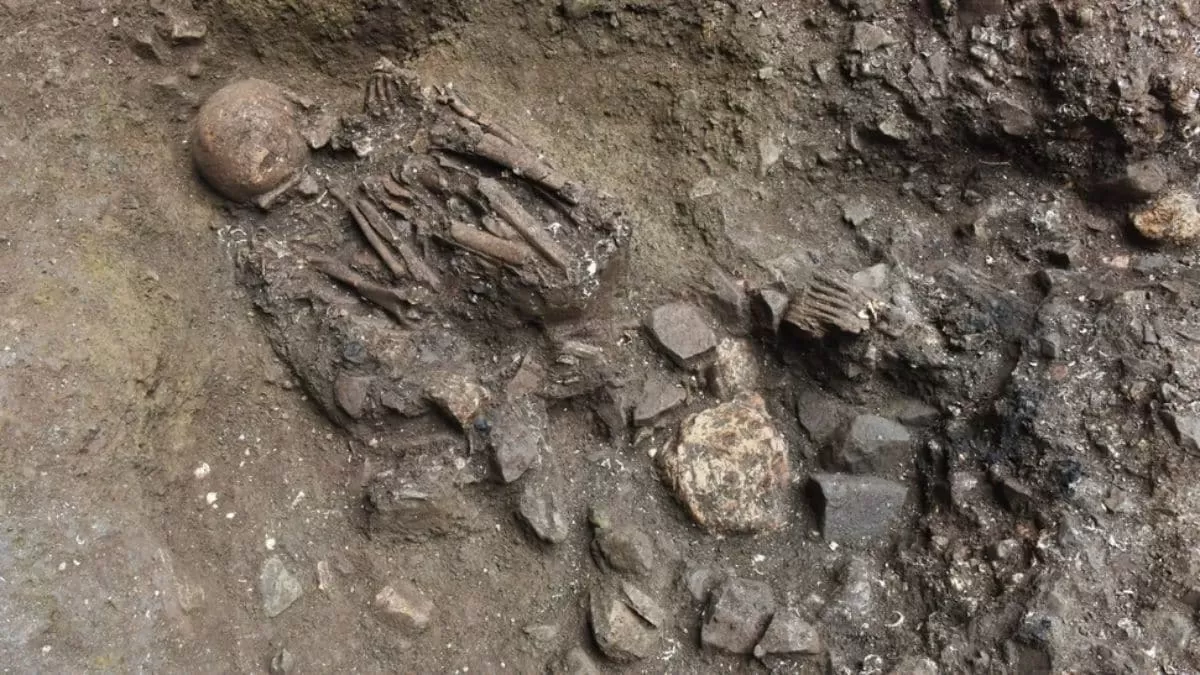
A groundbreaking study of a 7,100-year-old skeleton found in Yunnan, China, has revealed a “ghost” human lineage that was previously unknown. This discovery has shed new light on the history of human evolution and has the potential to change our understanding of ancient human populations.
The skeleton, named Xingyi_EN, was discovered in a cave in Yunnan province in 2018. It is believed to belong to a woman who lived during the Neolithic period, around 7,100 years ago. The discovery was made by a team of researchers from the Chinese Academy of Sciences and the Max Planck Institute for the Science of Human History.
What makes this discovery so significant is that Xingyi_EN belonged to a deeply divergent group called the Basal Asian Xingyi lineage. This group is believed to have split from other human populations around 40,000 years ago, making it one of the oldest known lineages in East Asia. Until now, this lineage was only known through genetic inference, but the discovery of Xingyi_EN’s skeleton has provided concrete evidence of its existence.
The study, published in the journal Nature, reveals that Xingyi_EN’s genetic makeup is distinct from other ancient and modern human populations. This suggests that the Basal Asian Xingyi lineage may have contributed to the genetic diversity of modern humans, particularly in the Tibetan population.
The Tibetan Plateau, also known as the “Roof of the World,” is a high-altitude region that has been inhabited by humans for thousands of years. The harsh environment and extreme altitude have posed challenges for human survival, but the Tibetan people have adapted to these conditions and have thrived in this region. Previous studies have shown that Tibetans have a unique genetic makeup that allows them to live at high altitudes without experiencing the negative effects of low oxygen levels.
The discovery of Xingyi_EN’s skeleton has provided a missing link in the genetic history of Tibetans. It is believed that the Basal Asian Xingyi lineage may have interbred with other ancient human populations in the region, contributing to the genetic diversity of modern Tibetans. This could explain the unique genetic adaptations that allow Tibetans to thrive in high-altitude environments.
But the significance of this discovery goes beyond just the genetic history of Tibetans. It also provides a glimpse into the ancient human populations that inhabited East Asia thousands of years ago. The Basal Asian Xingyi lineage may have been a small and isolated group, but their existence has left a lasting impact on the genetic makeup of modern humans.
The study also revealed that Xingyi_EN’s genetic makeup is distinct from other ancient human populations in East Asia, such as the Han Chinese and the Japanese. This suggests that there were multiple waves of migration and interbreeding in the region, leading to the diverse genetic landscape we see today.
The discovery of Xingyi_EN’s skeleton has opened up new avenues for research and has the potential to change our understanding of human evolution. It also highlights the importance of studying ancient human remains to gain a better understanding of our past.
But the study also raises questions about the fate of the Basal Asian Xingyi lineage. What led to their disappearance? Did they interbreed with other populations or were they simply outcompeted by other groups? These are questions that researchers hope to answer in future studies.
The discovery of Xingyi_EN’s skeleton is a testament to the power of scientific research and the importance of preserving and studying ancient human remains. It has provided a glimpse into a “ghost” human lineage that was previously unknown and has the potential to change our understanding of human evolution. This groundbreaking study is a reminder that there is still so much to learn about our past, and every new discovery brings us one step closer to unlocking the mysteries of human evolution.
