

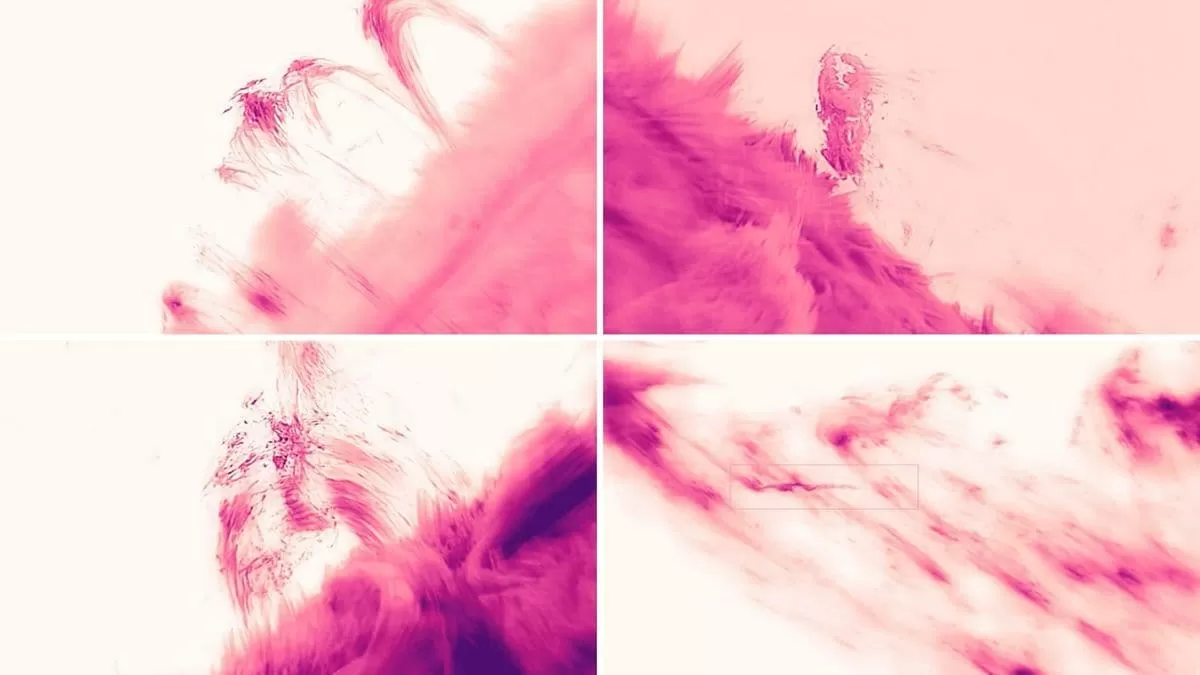
For the first time in history, scientists have captured stunningly detailed footage of the sun’s outer atmosphere, providing a never-before-seen glimpse into the mysteries of our closest star. This groundbreaking achievement was made possible by the use of adaptive optics, which allowed researchers to cut through Earth’s atmospheric interference and reveal structures that have never been observed before.
The new images, captured by the National Science Foundation’s Daniel K. Inouye Solar Telescope in Hawaii, show coronal rain and a never-before-seen plasma stream on the sun’s surface. These structures, which are constantly in motion, are crucial to understanding the sun’s behavior and its impact on our planet.
The sun’s outer atmosphere, also known as the corona, is a hot and dynamic region that extends millions of kilometers into space. It is here that the sun’s powerful magnetic fields interact with its superheated plasma, creating the iconic loops and arcs that we see during a solar eclipse. However, due to the sun’s extreme brightness, studying the corona has always been a challenge for scientists.
But thanks to the advanced technology of adaptive optics, scientists were able to overcome this challenge and capture images of the corona with unprecedented clarity. Adaptive optics works by using a deformable mirror to correct for the distortions caused by Earth’s atmosphere, allowing for sharper and more detailed images.
The result is a stunning video that shows the sun’s corona in a whole new light. We can see intricate details of the coronal loops and the plasma stream, which appears as a bright, ribbon-like structure flowing across the sun’s surface. This plasma stream, also known as a “coronal hole,” is a region of the corona where the magnetic field is open, allowing particles to flow out into space. Understanding the behavior of these coronal holes is crucial for predicting space weather and its potential impact on Earth.
These new images have already provided valuable insights into the sun’s complex magnetic fields and their role in shaping the corona. Scientists have also been able to study the dynamics of the coronal rain, which is a phenomenon where hot plasma cools and condenses, falling back to the sun’s surface in a spectacular display.
But the potential of these new images goes far beyond just aesthetic appeal. They could hold the key to unlocking some of the biggest mysteries of the sun, such as why the corona is so much hotter than the sun’s surface and how solar flares and other solar events are triggered.
The findings from this groundbreaking research could also have practical applications in space weather forecasting, which is crucial for protecting our technology and infrastructure from the effects of solar storms. With the help of these ultra-detailed images, scientists can better understand the processes that drive space weather and develop more accurate prediction models.
Moreover, the use of adaptive optics in solar telescopes could open up a whole new world of discoveries in the field of astronomy. By eliminating the distortions caused by Earth’s atmosphere, we can now see deeper into the universe and observe fainter objects with unprecedented clarity.
This achievement is a testament to the incredible advancements in technology and our never-ending quest to understand the world around us. It is a reminder that there is still so much to discover and explore, even in our own backyard.
As we continue to push the boundaries of science and technology, we can only imagine the incredible discoveries that await us. The new images of the sun’s corona are just the beginning, and we can look forward to many more groundbreaking discoveries in the future.
In conclusion, the ultra-detailed footage of the sun’s outer atmosphere captured by the Daniel K. Inouye Solar Telescope is a remarkable achievement that has the potential to revolutionize our understanding of the sun and its impact on our planet. With the help of adaptive optics, scientists can now study the sun’s corona in unprecedented detail, unlocking its secrets and enhancing our knowledge of the universe. This is a truly exciting time for solar research, and we can’t wait to see what new discoveries await us.
