

A recent study has revealed that Venus, our closest planetary neighbor, is still a geologically active planet. This groundbreaking discovery, made by a team of international scientists, has shed new light on the inner workings of Venus and has set the stage for upcoming missions by NASA and ESA to further explore this mysterious planet.
For decades, Venus has been known as Earth’s “evil twin” due to its similar size and composition. However, unlike Earth, Venus has a thick, toxic atmosphere and a surface temperature that can reach up to 864 degrees Fahrenheit, making it a seemingly inhospitable place for life to exist. But this new study has shown that beneath its harsh exterior, Venus is a dynamic and active planet.
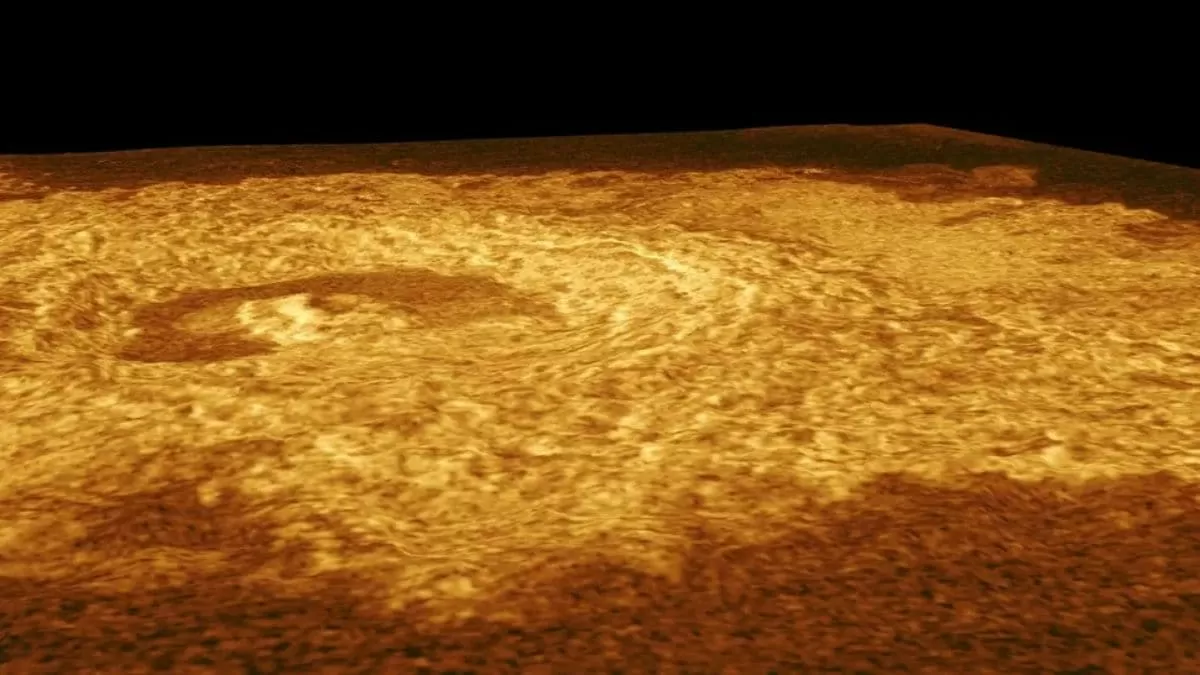
Using data from the European Space Agency’s Venus Express mission, scientists have discovered evidence of mantle plumes on Venus’ surface. These plumes, which are columns of hot rock rising from the planet’s interior, have created unique geological features known as coronae. These coronae, which are circular structures with raised rims and sunken centers, are thought to be the result of volcanic activity caused by the mantle plumes.
This discovery is significant because it provides strong evidence that Venus is still undergoing geological processes, similar to those that occurred on Earth billions of years ago. This challenges the long-held belief that Venus is a geologically dead planet. It also opens up new avenues for research and exploration, as scientists can now study Venus’ inner workings in more detail.
One of the upcoming missions that will benefit from this breakthrough is NASA’s VERITAS (Venus Emissivity, Radio Science, InSAR, Topography, and Spectroscopy) mission, set to launch in 2026. This mission will use advanced radar imaging to map Venus’ surface and gather data on its geological features, including the coronae. This will provide valuable insights into the planet’s geological history and help scientists understand its current state.
The European Space Agency also has plans to send a mission to Venus in the near future. The EnVision mission, expected to launch in 2032, will use a combination of radar and spectrometry to study Venus’ atmosphere, surface, and interior. This mission will build on the findings of the Venus Express mission and provide a more comprehensive understanding of the planet.
The discovery of mantle plumes on Venus is not only exciting for the scientific community, but it also has implications for our understanding of the formation and evolution of planets. By studying Venus, we can gain valuable insights into how Earth and other planets in our solar system may have formed and changed over time.
Furthermore, this discovery has reignited interest in Venus and its potential for future exploration. While previous missions to Venus have focused primarily on its atmosphere, these upcoming missions will allow us to delve deeper into the planet’s geology and potentially uncover more secrets about its past and present.
In addition to its scientific significance, this discovery also highlights the importance of international collaboration in space exploration. The study was a joint effort by scientists from the United States, France, and Japan, showcasing the power of teamwork and cooperation in pushing the boundaries of our knowledge.
In conclusion, the recent discovery of mantle plumes on Venus has revealed a whole new side to this enigmatic planet. It has shown that Venus is far from a lifeless world and has the potential to provide us with valuable insights into the formation and evolution of planets. With upcoming missions by NASA and ESA, we can look forward to unlocking more mysteries of Venus and expanding our understanding of our solar system.
