

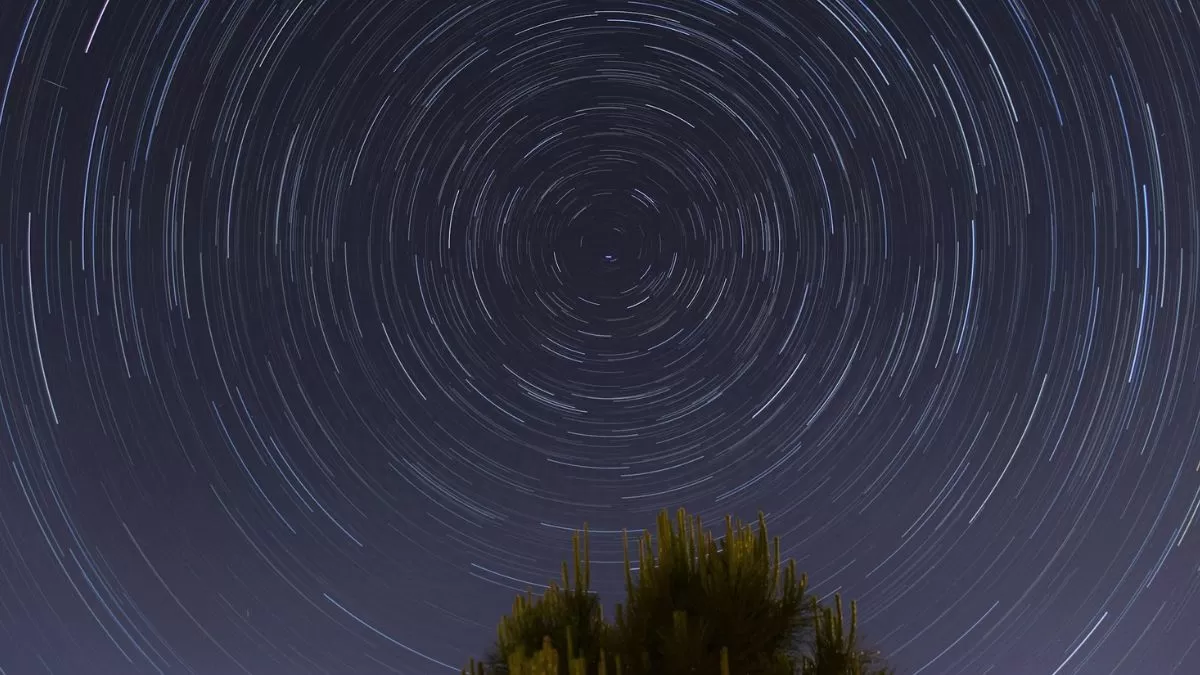
The night sky has always been a source of wonder and awe for humanity. For thousands of years, we have looked up at the stars and found guidance, inspiration, and a sense of belonging. But did you know that even the stars we rely on to navigate our way through the darkness are not completely constant? Earth’s 26,000-year axial precession, also known as the precession of the equinoxes, gradually shifts the celestial pole, leading to a change in the North Star over time.
This phenomenon is caused by the gravitational forces of the moon and the sun on Earth’s equatorial bulge. As our planet rotates on its axis, the axis itself also rotates, completing one full circle every 26,000 years. This means that the North Star, which is the star closest to the celestial pole, is not always the same. Over millennia, different stars have taken turns guiding humanity, and more will follow in the future.
One of the most well-known North Stars in history is Polaris, also known as the North Star. This bright star has been used for navigation and timekeeping since ancient times. However, Polaris was not always the North Star. In fact, it will eventually lose its title and give way to another star in the future.
Currently, Polaris is the closest star to the North Celestial Pole, making it the North Star. But in around 12,000 years, the Earth’s axis will have shifted enough for a different star to take its place. This has happened numerous times in the past, and it will continue to happen in the future, as long as Earth’s axial precession persists.
Stars like Thuban, Kochab, Errai, and Vega have all held the title of the North Star at different points in history. In ancient Egypt, Thuban, also known as Alpha Draconis, was the North Star, and it was used to align the Great Pyramid of Giza with true north. Later on, Kochab, also known as Beta Ursae Minoris, took its place. It was the North Star during the time of the ancient Greeks.
Errai, also known as Gamma Cephei, held the title of the North Star around 3000 BC, and it is believed that it was used by sailors for navigation. And in the future, around 14,000 years from now, Vega, also known as Alpha Lyrae, will be the North Star. This star is currently the fifth brightest star in the night sky, and it will be the brightest North Star in history when it takes over the title.
The fact that the North Star constantly changes may seem insignificant in the grand scheme of things, but it is a reminder of the ever-changing nature of our universe. It is a humbling realization that even something as seemingly constant as the night sky is in a state of perpetual motion.
The North Star has always been a symbol of guidance, and the fact that it changes over time is a powerful reminder that nothing in life is permanent. Just like the North Star, our lives are constantly evolving and changing, and it is up to us to adapt and find new sources of guidance and inspiration.
NASA has been studying Earth’s axial precession for decades, and their research has shed light on this fascinating phenomenon. It is a reminder that our planet is part of a much larger system, and we are all connected in a complex and beautiful way.
So, the next time you look up at the stars and find comfort in the familiar sight of the North Star, remember that it will eventually change, just like everything else in this ever-changing world. And take solace in the fact that there will always be a new North Star to guide us through the darkness, reminding us that we are part of something much bigger than ourselves.
