

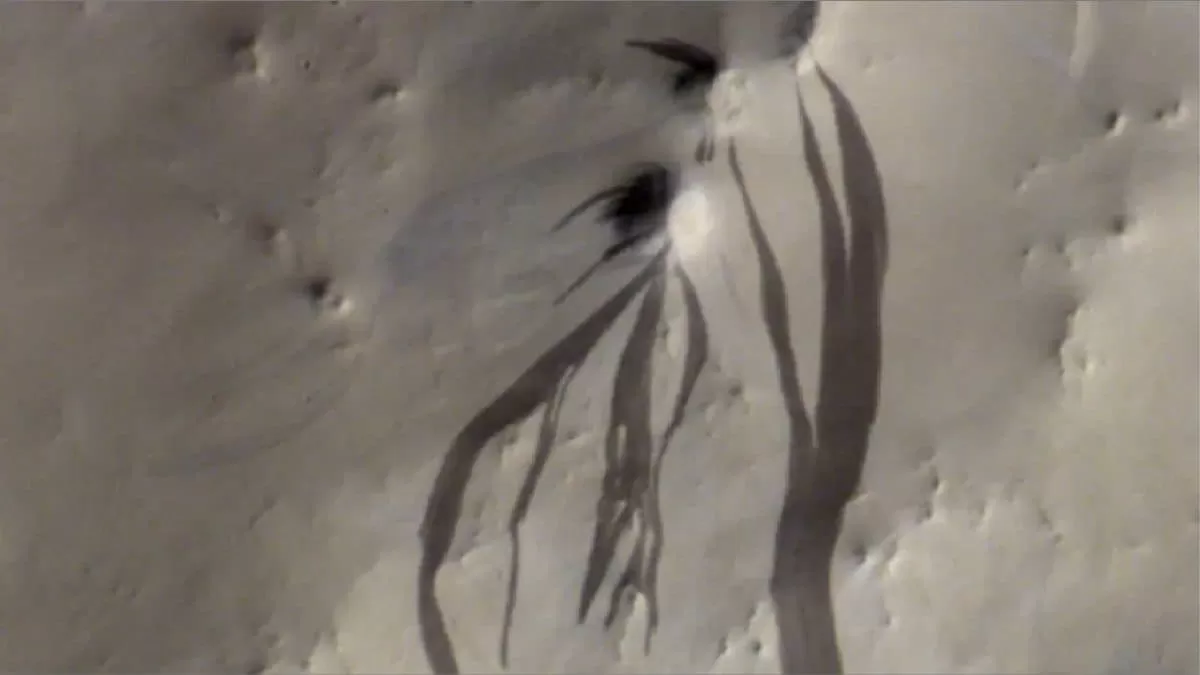
A new study conducted by researchers at Brown University and the University of Bern has challenged previous theories about the presence of liquid water on Mars. Using state-of-the-art machine learning technology, the team analyzed over 86,000 high-resolution images of the Red Planet and discovered that the dark streaks known as recurring slope lineae (RSLs) are not caused by liquid water, but rather by dry processes such as wind and dust movement.
This groundbreaking study, published in the journal Nature Communications, has shed new light on the geological processes at work on Mars and has opened up new possibilities for future exploration and research on the planet.
For years, scientists have been fascinated by the recurring slope lineae on Mars, as they were believed to be evidence of liquid water flowing on the planet’s surface. However, the new study has revealed that these dark streaks are actually formed by dry processes, which are much more common on Mars.
Using a machine learning algorithm, the researchers were able to analyze over 500,000 features on the surface of Mars, including RSLs, and map them in detail. This allowed them to identify patterns and characteristics that were previously unknown.
One of the key findings of the study is that RSLs are most likely caused by the movement of dust and sand on the surface of Mars. This is supported by the fact that these dark streaks are most commonly found on steep slopes, where the wind is more likely to cause erosion and movement of particles.
The team also discovered that RSLs are not limited to a specific region or season on Mars, as previously thought. They were able to identify these features in various locations and at different times of the year, indicating that they are a common occurrence on the planet.
This new understanding of RSLs has significant implications for our understanding of Mars and its potential for life. The presence of liquid water is considered a key factor in the search for extraterrestrial life, and the previous belief that RSLs were evidence of this has fueled the idea that Mars could potentially harbor life.
However, the new study suggests that the conditions on Mars may not be as favorable for life as previously thought. The dry processes that form RSLs are not conducive to the survival of living organisms, and this challenges the idea of liquid water being present on the planet.
But this does not mean that the search for life on Mars is over. In fact, this study opens up new avenues for exploration and research. By understanding the dry processes that form RSLs, scientists can now focus on other areas of the planet that may have more favorable conditions for life.
Moreover, the use of machine learning in this study has proven to be a powerful tool for analyzing large amounts of data and identifying patterns that may have gone unnoticed by human researchers. This technology can be applied to future studies on Mars and other planets, allowing us to uncover more secrets about our solar system and beyond.
The researchers behind this study are optimistic about the potential of their findings and the impact it may have on future Mars missions. With a better understanding of the planet’s geological processes, we can now plan and design missions that are more targeted and efficient.
In conclusion, the new study by Brown University and the University of Bern has challenged our previous understanding of Mars and its potential for life. By using machine learning to analyze high-resolution images, the researchers have revealed that recurring slope lineae are not evidence of liquid water, but rather dry processes. This discovery has opened up new possibilities for future exploration and research on the Red Planet and has demonstrated the power of technology in advancing our understanding of the universe.
