

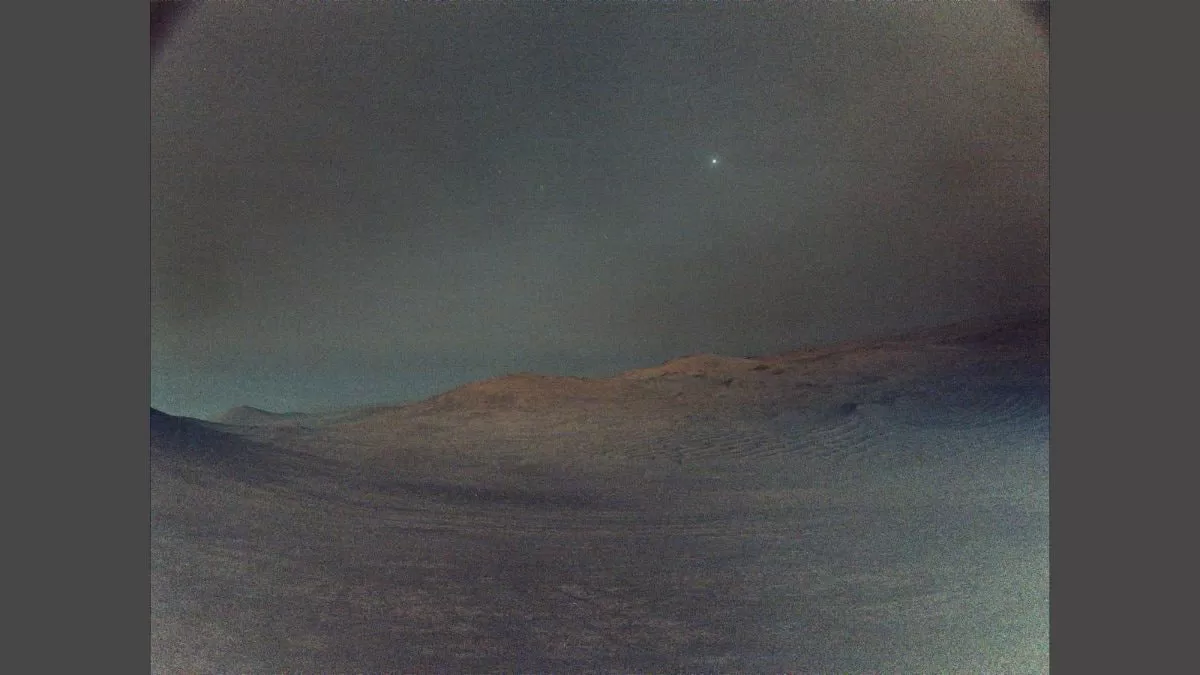
NASA’s Perseverance rover continues to amaze us with its incredible capabilities and discoveries on the red planet. On Sol 1433, the rover captured a stunning pre-dawn image of Mars’ moon Deimos, showcasing its expanding role in celestial observation beyond just its primary mission of searching for signs of ancient life on Mars.
The image, stitched together from 16 long-exposure shots, gives us a rare glimpse of Deimos against the backdrop of the Martian sky. Despite image noise and cosmic interference, the photo reveals the small moon, along with stars like Regulus and Algieba, and the unique conditions of the Martian atmosphere.
This is not the first time that Perseverance has captured images of Deimos. In fact, the rover has been regularly observing the Martian moons since its arrival on the planet in February 2021. However, this particular image stands out for its clarity and the amount of detail it captures.
Deimos, which means “dread” in Greek, is the smaller of Mars’ two moons, with a diameter of only 6.2 miles. It orbits the planet at a distance of about 14,500 miles, making it the farthest known natural satellite in the solar system. Due to its small size and distance, Deimos is often difficult to observe, making this image even more special.
The image also highlights the impressive capabilities of Perseverance’s Mastcam-Z, a pair of zoomable cameras that can capture high-resolution images and videos of the Martian surface and atmosphere. These cameras have already captured stunning images of the Jezero Crater, the landing site of the rover, and will continue to provide us with valuable insights into the Martian environment.
But Perseverance’s role in celestial observation goes beyond just capturing beautiful images. The rover is also equipped with a suite of scientific instruments that can study the Martian atmosphere and weather patterns. This includes the Mars Environmental Dynamics Analyzer (MEDA), which measures temperature, wind speed and direction, humidity, and dust levels, providing valuable data for future human missions to the planet.
In addition, Perseverance’s SuperCam, a remote-sensing instrument, can analyze the chemical composition of rocks and soil, helping scientists understand the geological history of Mars. This instrument has already detected the presence of hematite, a mineral that forms in the presence of water, in the rocks of the Jezero Crater, providing further evidence of the planet’s past habitability.
The rover’s expanding role in celestial observation is a testament to the incredible engineering and scientific capabilities of NASA and its partners. It also highlights the importance of continued exploration and research in our quest to understand the mysteries of the universe.
As we continue to receive more images and data from Perseverance, we can only imagine the incredible discoveries that lie ahead. The rover’s mission is expected to last at least one Mars year (about 687 Earth days), and we can’t wait to see what other wonders it will uncover.
In the meantime, let us marvel at this stunning image of Deimos, a small moon that has captured our imagination and continues to reveal its secrets to us through the lens of Perseverance. This is just one small step in our journey to unlock the mysteries of the red planet, and we can’t wait to see what other surprises await us in the vastness of space.
