

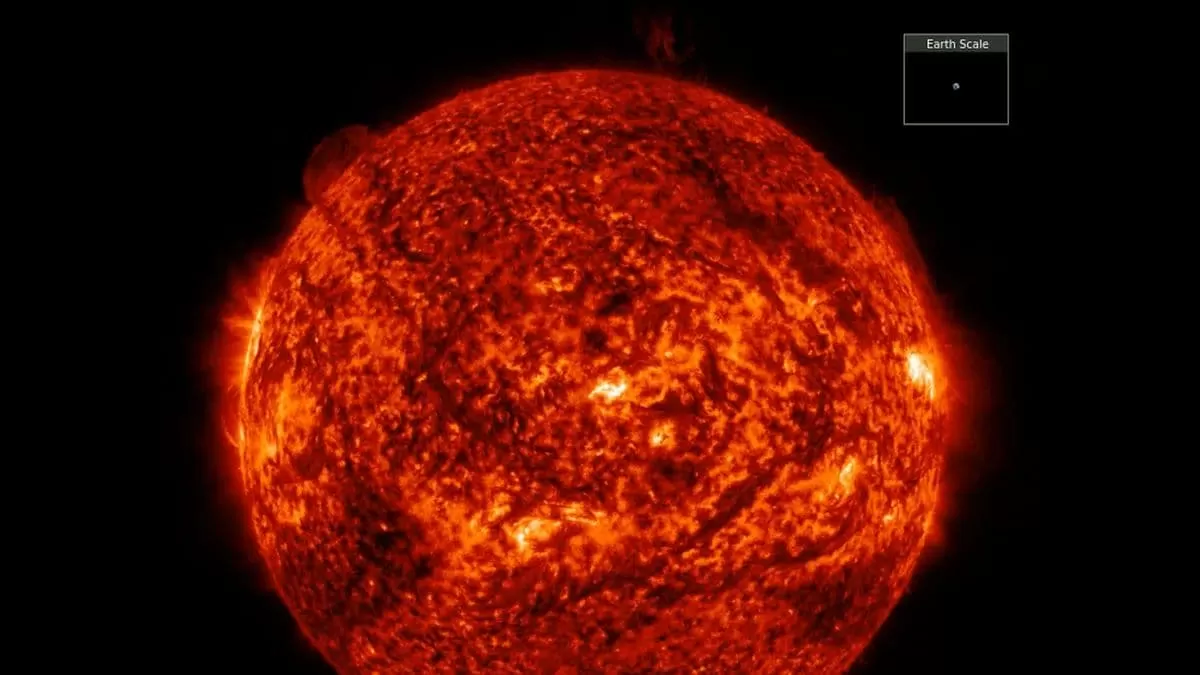
A Spectacular Solar Filament Eruption Reminds Us of the Sun’s Volatility
In a breathtaking display of the sun’s power and unpredictability, a 600,000-mile-long solar filament erupted off its surface, sending a fiery blast into space. The stunning event, captured on video by NASA’s Solar Dynamics Observatory, serves as a reminder of the sun’s constant activity and potential for more powerful outbursts ahead.
While the resulting coronal mass ejection (CME) is not expected to impact Earth, experts are closely monitoring the sun as it heads towards the peak of Solar Cycle 25. As the sun enters this phase, we can expect to see an increase in solar activity, which could lead to more intense solar storms.
The recent solar filament eruption is just one example of the sun’s ongoing volatility. These filaments are giant arcs of plasma that can stretch for hundreds of thousands of miles above the sun’s surface. They are held in place by the sun’s magnetic field, but when that field becomes unstable, the filaments can suddenly snap, releasing tremendous amounts of energy into space.
In this case, the solar filament erupted in a stunning display of fiery loops and arcs, sending a massive wave of charged particles hurtling into space. While this may seem like a cause for concern, it is actually a natural process that occurs regularly on the sun. In fact, these eruptions are a key part of the sun’s cycle and play a vital role in the dynamics of our solar system.
The sun operates on an 11-year cycle, during which it goes through periods of increased and decreased activity. We are currently in Solar Cycle 25, which began in late 2019 and is expected to peak in 2025. As we approach this peak, scientists are paying close attention to the sun’s behavior, as it can give us valuable insight into the workings of our star.
Solar Cycle 25 has been relatively quiet so far, with fewer sunspots and solar flares than previous cycles. However, as the sun’s activity ramps up towards its peak, we can expect to see more frequent and intense outbursts, such as the recent solar filament eruption.
These solar storms have the potential to disrupt satellite communications, cause power outages, and even pose a threat to astronauts in space. That’s why it’s vital for scientists to closely monitor the sun’s activity and provide early warning systems to protect our technology and infrastructure.
But these solar storms also have a positive side. They can create stunning auroras, also known as the Northern and Southern Lights, as the charged particles from the sun interact with Earth’s atmosphere. These dazzling displays of light are a reminder of the sun’s immense power and beauty.
The recent solar filament eruption serves as a reminder that while the sun may seem like a constant and unchanging presence in our lives, it is, in fact, a dynamic and ever-changing star. It is constantly emitting energy and particles into space, shaping our solar system and influencing our planet’s climate.
As we continue to study and learn about the sun, we gain a deeper understanding of our place in the universe and the forces that govern it. And while solar activity can have its challenges, it also offers us the opportunity to witness incredible events and marvel at the wonders of our solar system.
So let us appreciate the sun’s stunning display of power and volatility, and continue to monitor its activity as we move towards the peak of Solar Cycle 25. With the help of science and technology, we can prepare for any potential impacts and continue to unlock the secrets of our remarkable star.
