

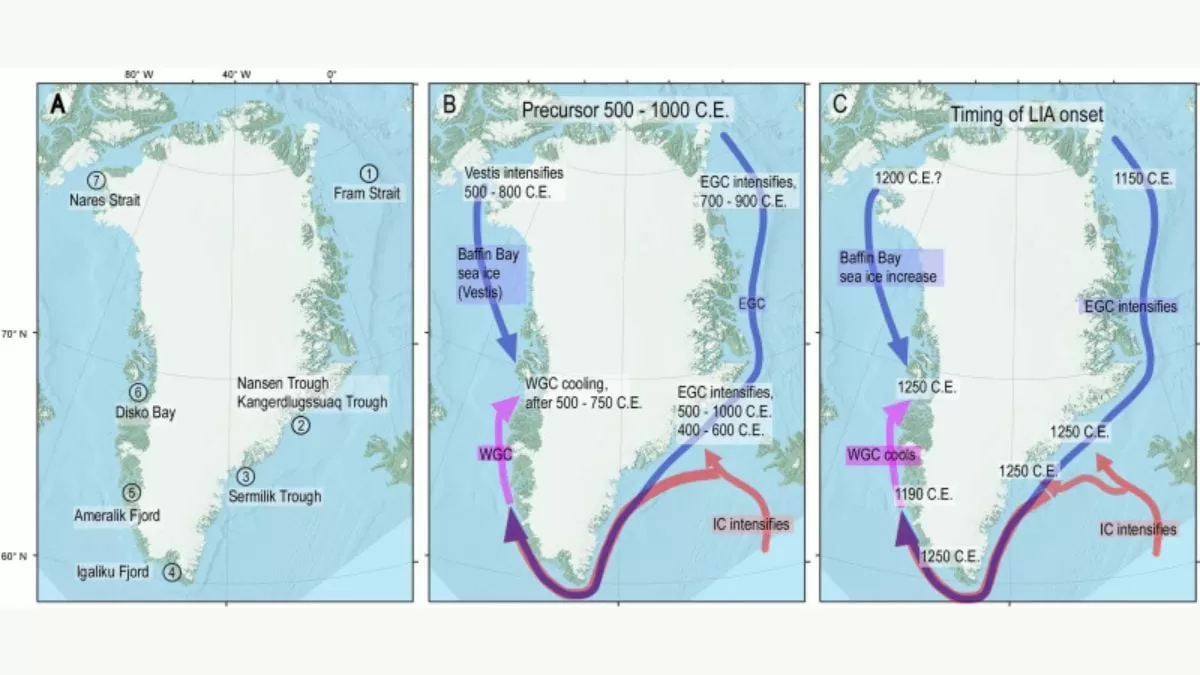
In recent years, climate change and its impact on our planet have become topics of global concern. Scientists and researchers from various fields have been working tirelessly to better understand our planet’s past climate patterns and predict future changes. In a groundbreaking study conducted by geologists Christopher Spencer, Ross Mitchell, and Thomas Gernon, ancient Greenland rocks embedded in Icelandic cliffs have been identified, shedding light on an important period in Earth’s history.
The study, which was published in the journal Nature Communications, reveals that these rocks, which were transported by icebergs over 1500 years ago, confirm the glacial expansion that occurred during the Late Antique Little Ice Age (LALIA). This period, which lasted from about 536 AD to 660 AD, was marked by a significant drop in global temperatures, resulting in extensive glacier expansion. The study’s findings provide concrete evidence of this phenomenon and offer key insights into past climate anomalies.
The team of researchers, led by Dr. Spencer, a professor of geology at the University of Leeds, used a combination of fieldwork, remote sensing techniques, and geochemical analysis to identify and trace the origin of the Greenland rocks in Iceland. They found that these rocks, which were once part of the Greenland landscape, were carried by giant icebergs and deposited along the Icelandic coast during the LALIA period.
Dr. Mitchell, a senior lecturer at Imperial College London, explains, “By analyzing the chemical composition of the rocks, we were able to match them to specific regions in Greenland. This allowed us to track their journey and confirm that they were transported during the LALIA period.”
This discovery is significant for two main reasons. Firstly, it confirms the widespread expansion of glaciers during the LALIA period, which had been previously hypothesized but lacked solid evidence. Secondly, it provides crucial data for future climate predictions and models as it offers a unique perspective on a period of global cooling.
Dr. Gernon, a research fellow at the University of Southampton, says, “Studying past climate events and their impacts on our planet is crucial in understanding and predicting future changes. The information we gain from these ancient rocks can help improve our climate models and inform policies to mitigate the effects of climate change.”
The team’s findings also have important implications for the current state of our planet. As we continue to see rising global temperatures and melting glaciers, this study serves as a stark reminder of the Earth’s sensitivity to climate change. It highlights the potential for significant and rapid changes to occur, even during periods of relative climate stability.
This study is a remarkable example of the power of interdisciplinary research. By combining expertise from different fields, the team was able to piece together a fascinating story of Earth’s past. It also demonstrates the importance of international collaboration in tackling global issues such as climate change.
As we look towards the future, this study serves as a reminder that our planet has undergone significant climate changes in the past, and it is up to us to take action to prevent further disruption. Dr. Spencer emphasizes, “We need to act now to reduce our carbon footprint and mitigate the impact of climate change. The evidence from this study serves as a wake-up call for governments, industries, and individuals to take urgent action.”
This groundbreaking study led by Dr. Spencer, Dr. Mitchell, and Dr. Gernon provides compelling evidence of glacial expansion during the LALIA period. It not only sheds light on Earth’s past climate but also serves as a crucial source of information for future climate predictions and action. It is a testament to the power of scientific research and collaboration in uncovering the mysteries of our planet’s history and guiding us towards a sustainable future.
