

Astronomers have recently made a groundbreaking discovery about the seventh planet in our solar system, Uranus. For the first time, they have been able to confirm the rotation period of Uranus using internal oscillation modeling. This is a significant achievement as it provides us with a better understanding of this mysterious gas giant and opens up new possibilities for future exploration.
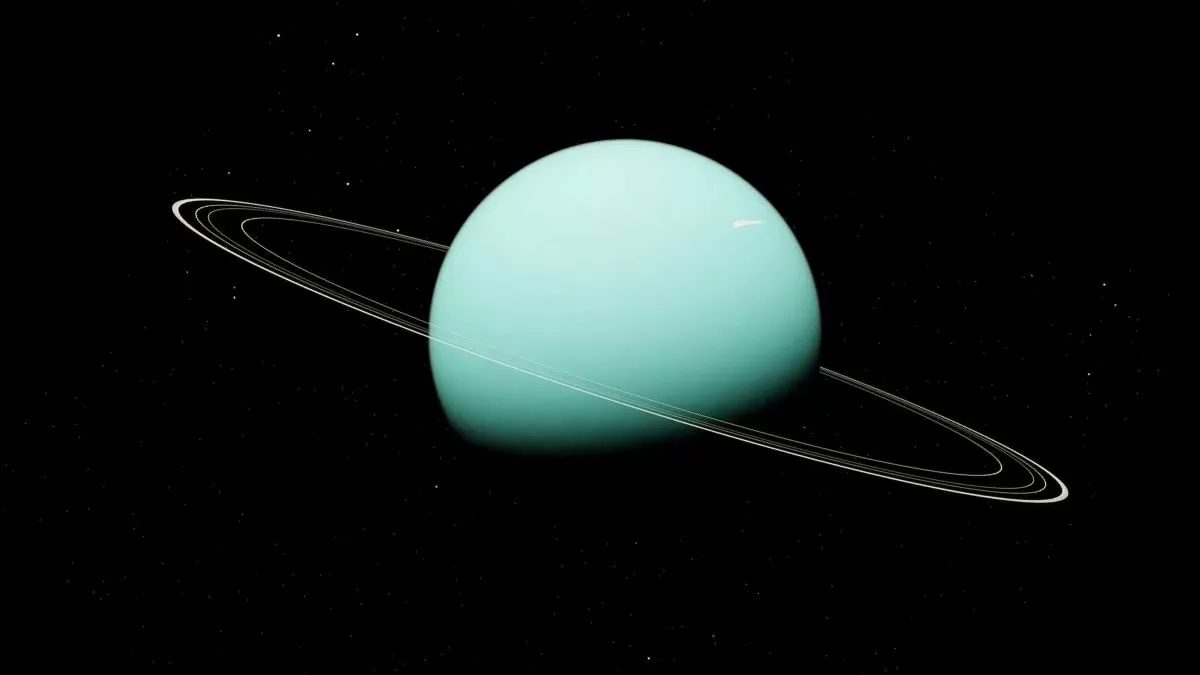
Uranus is a fascinating planet, with its unique blue-green color and its peculiar sideways rotation. Unlike most planets in our solar system, Uranus rotates on its side, making it a challenge for astronomers to accurately determine its rotation period. Previous estimates have ranged from 17 to 18 hours, but now, thanks to the latest research, we have a more precise figure.
Using data from the Voyager 2 spacecraft, which flew by Uranus in 1986, and the Hubble Space Telescope, astronomers were able to create a model of the planet’s internal oscillations. These oscillations are caused by the movement of gases and fluids within the planet, and they can provide valuable information about its rotation.
The team of astronomers, led by Dr. Mark Hofstadter from NASA’s Jet Propulsion Laboratory, used this model to calculate Uranus’ rotation period. They found that a day on Uranus lasts 17 hours and 14 minutes, which is slightly shorter than previous estimates. This new figure has been confirmed by observations of the planet’s magnetic field, which also showed a similar rotation period.
This discovery is a significant breakthrough in our understanding of Uranus. It not only provides us with a more accurate measurement of its rotation but also gives us insights into the planet’s internal structure and dynamics. This information will be crucial for future missions to Uranus, as it will help scientists plan their visits and investigations more effectively.
One of the most exciting aspects of this discovery is the potential for future exploration of Uranus. With a more precise measurement of its rotation period, scientists can now plan missions to the planet with greater accuracy. This will allow us to study Uranus in more detail and unlock the secrets of this enigmatic world.
However, exploring Uranus is no easy feat. Unlike Mars and Earth, which have relatively calm atmospheres, Uranus is known for its fierce windstorms. These storms can reach speeds of up to 560 miles per hour, making it challenging to identify the rotation times of the planet. But with this new information, scientists can now better prepare for these challenges and develop new technologies to withstand the harsh conditions on Uranus.
The confirmation of Uranus’ rotation period is a testament to the incredible advancements in technology and our understanding of the universe. It is a testament to the hard work and dedication of astronomers and scientists around the world who are constantly pushing the boundaries of our knowledge.
This discovery also highlights the importance of continued research and exploration of our solar system. Every new piece of information we gather about our neighboring planets brings us closer to unlocking the mysteries of the universe and our place in it.
In conclusion, the confirmation of Uranus’ rotation period is a significant achievement that will pave the way for future missions to this fascinating planet. It is a testament to the power of science and the human spirit of exploration. With this new knowledge, we are one step closer to unraveling the secrets of Uranus and the universe.
