

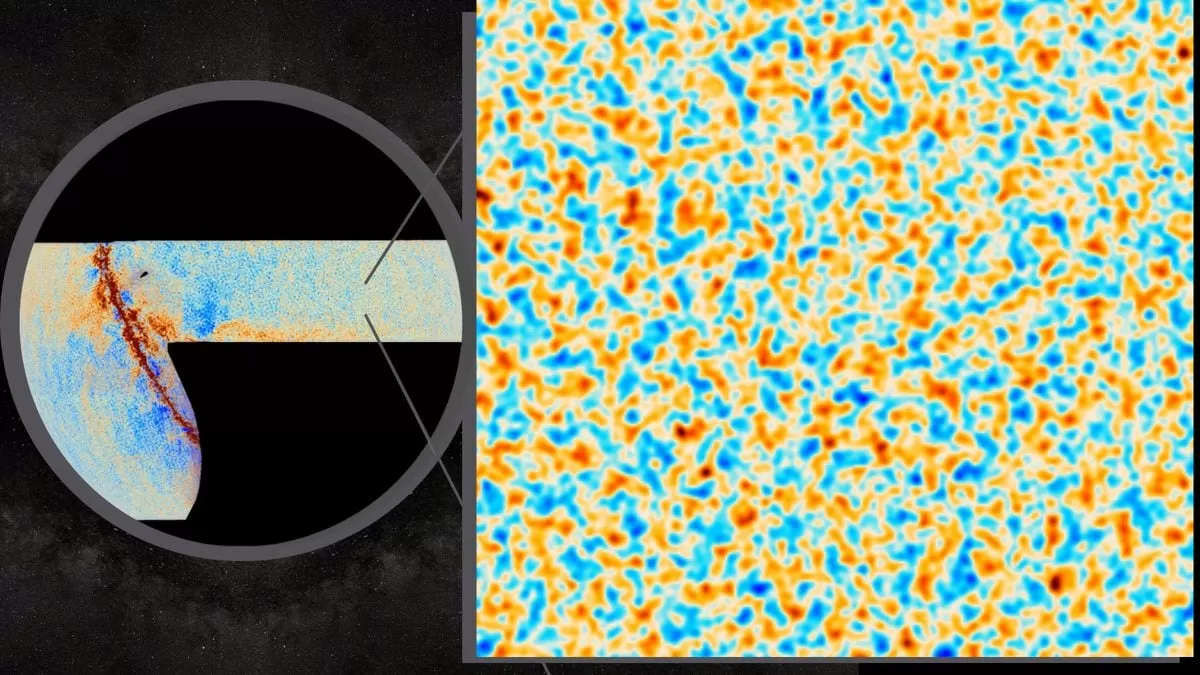
New images from the decommissioned Atacama Cosmology Telescope have recently been released, offering the most detailed view of the cosmic microwave background to date. This groundbreaking data has provided scientists with a wealth of new information about the early universe, including insights into cosmic structures, primordial gas movement, and the universe’s total mass. While these findings support existing models, they do not resolve the Hubble tension, leaving researchers eager to explore further.
The Atacama Cosmology Telescope (ACT) is a 6-meter telescope located in the Atacama Desert in Chile. It was designed to study the cosmic microwave background (CMB), which is the faint radiation left over from the Big Bang that permeates the entire universe. The telescope has been in operation since 2007 and has played a crucial role in advancing our understanding of the universe.
The new images from ACT, which were captured during its final year of operation, have provided scientists with an unprecedented view of the CMB. The data reveals intricate patterns and structures in the early universe, giving us a glimpse into the first moments after the Big Bang. These patterns are the result of tiny fluctuations in the density of matter and energy that existed in the early universe, which eventually led to the formation of galaxies and other cosmic structures.
One of the most exciting discoveries from the new data is the ability to track the movement of primordial gas in the early universe. This gas, which is made up of hydrogen and helium, was the building block for all the stars and galaxies we see today. By studying its movement, scientists can gain a better understanding of how the universe evolved over time.
The data also provides a more accurate estimate of the universe’s total mass. Previous estimates were based on the assumption that the universe is made up of only ordinary matter, such as atoms and particles. However, the new data suggests that there may be other forms of matter, such as dark matter, that make up a significant portion of the universe’s mass. This finding has important implications for our understanding of the universe and its evolution.
While these new findings are groundbreaking, they do not resolve the Hubble tension, which refers to the discrepancy between the rate at which the universe is expanding, as measured by the Hubble Space Telescope, and the rate predicted by the standard model of cosmology. This tension has been a topic of debate among scientists for years, and the new data from ACT does not provide a definitive answer. However, it does offer valuable insights that will help researchers in their quest to solve this mystery.
In light of these new discoveries, scientists are now turning their attention to the upcoming Simon’s Observatory, which is set to begin operations in 2022. This state-of-the-art observatory, located in the Atacama Desert, will have even greater sensitivity and resolution than ACT, allowing scientists to delve even deeper into the mysteries of the early universe.
The new images from ACT have once again demonstrated the power of scientific exploration and the incredible potential of technology. They have provided us with a more detailed and accurate view of the early universe, bringing us one step closer to understanding the origins of our universe. While there is still much to be discovered and understood, these findings have opened up new avenues for research and have reignited our curiosity about the universe and our place in it.
In conclusion, the new images from the decommissioned Atacama Cosmology Telescope have offered a fascinating glimpse into the early universe. The data has revealed intricate cosmic structures, tracked primordial gas movement, and refined our estimates of the universe’s total mass. While the Hubble tension remains unresolved, the new findings have sparked excitement and renewed interest in the scientific community. With the upcoming Simon’s Observatory, we can only imagine what other secrets of the universe will be revealed. The possibilities are endless, and the future of cosmology looks brighter than ever before.
