

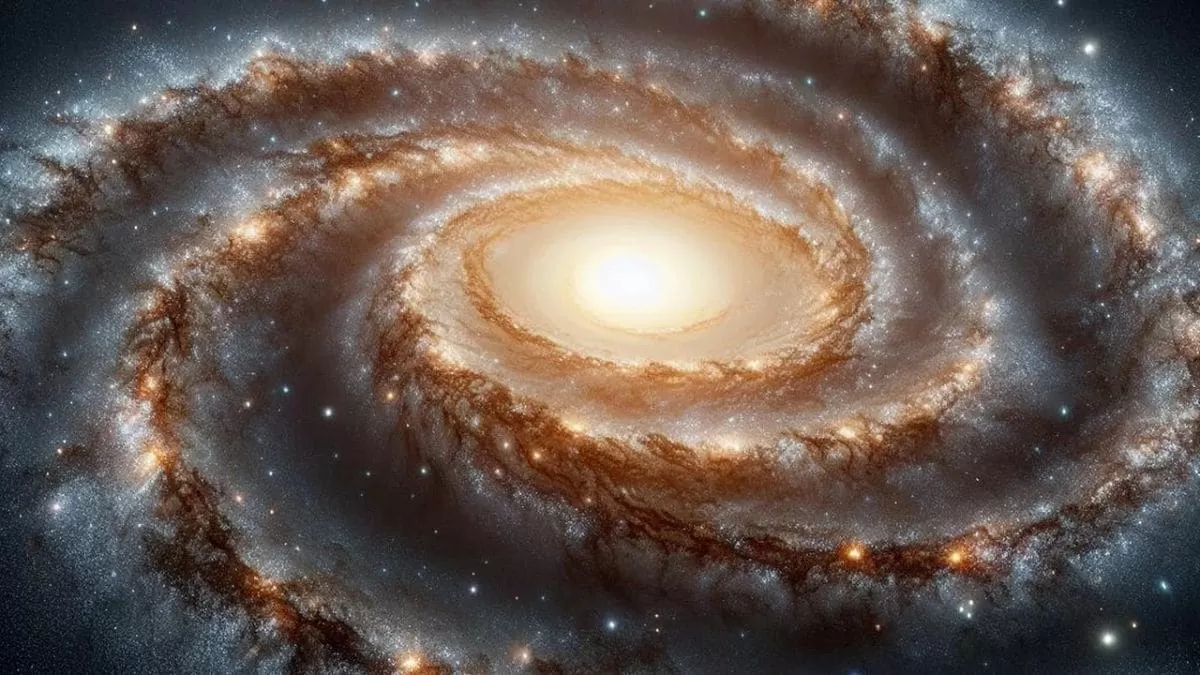
For decades, scientists have been trying to unravel the mysteries of the universe and understand the role of dark matter in our cosmic landscape. Recently, a team of researchers have proposed a new theory that may provide a breakthrough in our understanding of dark matter and its impact on the Milky Way’s Central Molecular Zone (CMZ).
The CMZ is a region located at the center of our galaxy, where dense clouds of gas and dust are constantly colliding, creating new stars and shaping the structure of the Milky Way. However, scientists have noticed some unusual ionisation levels in this region, and until now, the cause was unknown.
But according to the new theory proposed by the researchers, the unusual ionisation levels in the CMZ could be explained by a previously overlooked dark matter candidate. This candidate is a lightweight, self-annihilating dark matter particle that could be interacting with cosmic chemistry and producing electrons and positrons in the CMZ.
Dark matter is a mysterious substance that makes up about 85% of the total matter in the universe. It does not emit, absorb, or reflect light, making it invisible and extremely difficult to detect. This has led scientists to come up with various theories and candidates for dark matter, but so far, there has been no definitive proof of its existence.
The new theory, published in the scientific journal Physical Review Letters, suggests that these lightweight dark matter particles, with masses ranging from 0.1 to 10 GeV (Giga-electron volts), could be responsible for the unusual ionisation levels in the CMZ. This is a significant departure from conventional views which have mainly focused on heavy dark matter particles, with masses of around 100 GeV.
The researchers’ simulations showed that these lightweight dark matter particles could produce a significant number of electrons and positrons in the CMZ through their self-annihilation process. These particles would interact with the dense clouds of gas and dust, creating a cascade of electrons and positrons that would ionize the surrounding gas.
This process would not only explain the unusual ionisation levels but also provide a new way to detect and study dark matter. As co-author of the study, Dr. Dan Hooper, explains, “If this theory is correct, then it would open up a whole new window into the world of dark matter. We could potentially observe and measure the particles responsible for the unusual ionisation levels in the CMZ, giving us a better understanding of dark matter and its role in the universe.”
The implications of this theory are far-reaching. Not only does it challenge conventional views of dark matter, but it also sheds light on the complex interactions between dark matter and ordinary matter in the CMZ. Furthermore, it provides a new perspective on the formation and evolution of galaxies, which could have implications for our understanding of the entire universe.
However, this theory is still in its early stages, and more research and observations are needed to confirm its validity. The researchers are planning to use data from the upcoming Large Hadron Collider (LHC) upgrade to test their theory and gather more evidence.
If this theory is proven to be correct, it could have a profound impact on our understanding of the universe and dark matter. It would not only provide a new way to detect and study dark matter but also open up new possibilities for future research and advancements in cosmology.
The study of dark matter is a constantly evolving field, and this new theory adds another piece to the puzzle. It challenges us to think outside the conventional views and offers a new perspective on the role of dark matter in the universe. As we continue to unravel the mysteries of the universe, we may come closer to understanding the elusive nature of dark matter and its influence on our cosmic neighborhood.
