

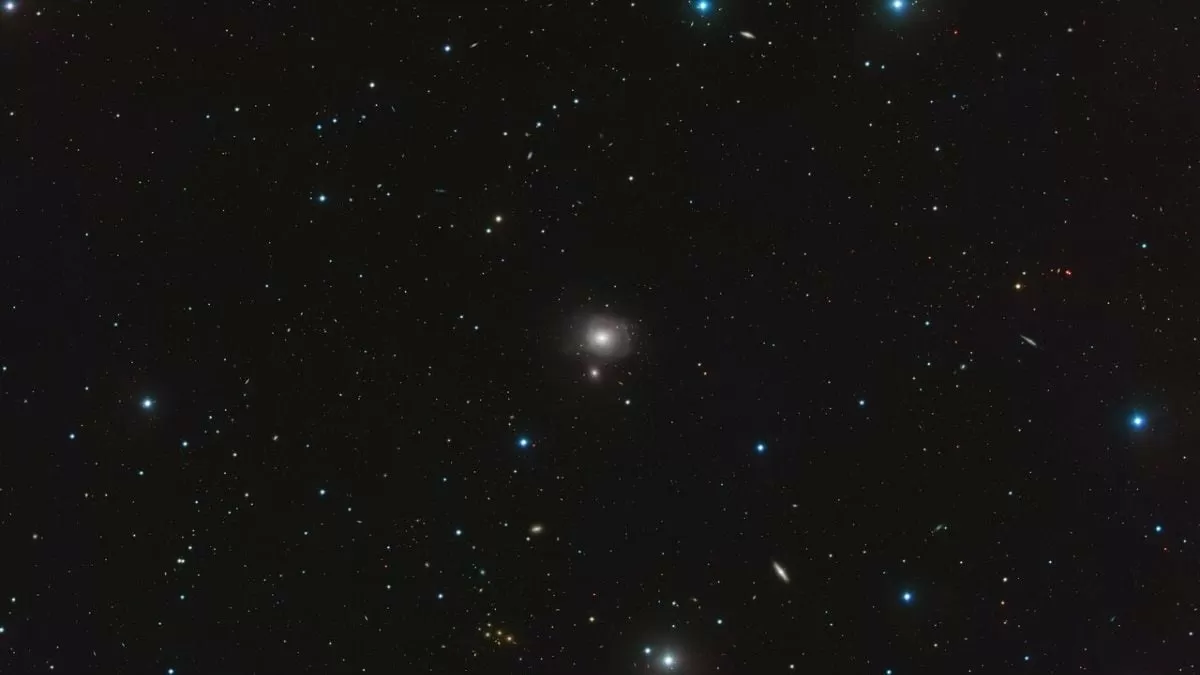
Recent observations of NGC 3640, a distant elliptical galaxy located 88 million light-years away, have revealed an intriguing history of mergers with smaller galaxies. The latest findings, captured by the Very Large Telescope, have shed light on the galaxy’s past and provided valuable insights into its future.
NGC 3640, also known as the “Butterfly Galaxy” due to its distinctive shape, has long been a subject of fascination for astronomers. Its unique structure and location in the Leo constellation make it a prime target for study. However, it was only recently that researchers discovered evidence of its tumultuous past.
Using the powerful capabilities of the Very Large Telescope, a team of international researchers observed structural distortions in NGC 3640, hinting at previous mergers with smaller galaxies. These distortions, also known as tidal tails, are formed when two galaxies collide and their gravitational forces pull at each other, leaving behind a trail of stars and gas.
The team also identified ancient stars within NGC 3640 that act as fossil markers of past collisions. These stars, which are believed to be over 10 billion years old, carry the chemical signatures of the smaller galaxies that merged with NGC 3640 in the distant past. By analyzing these stars, researchers were able to piece together a timeline of the galaxy’s mergers and gain a better understanding of its evolution.
One of the most significant findings of this study is the discovery of a potential future merger between NGC 3640 and another nearby galaxy, NGC 3641. The two galaxies are currently on a collision course and are expected to merge in the next few hundred million years. This impending merger has sparked excitement among astronomers as it presents a rare opportunity to witness a galactic collision in real-time.
The team’s observations also revealed that NGC 3640 has undergone multiple mergers in the past, with smaller galaxies of varying sizes. This suggests that the galaxy has a rich history of interactions with its cosmic neighbors. These mergers have not only shaped the galaxy’s structure but also played a crucial role in its evolution.
The study of galactic mergers is crucial in understanding the formation and evolution of galaxies. By observing the aftermath of these collisions, astronomers can gain insights into the physical processes that govern the growth and development of galaxies. NGC 3640, with its complex history of mergers, provides a unique opportunity for researchers to study these processes in action.
The findings of this study have been published in the journal Astronomy & Astrophysics, and they have already generated a buzz in the scientific community. Dr. Maria Garcia, lead author of the study, expressed her excitement, saying, “The observations of NGC 3640 have given us a glimpse into its past and future. We are thrilled to have discovered evidence of multiple mergers and are eagerly awaiting the upcoming collision with NGC 3641.”
The discovery of NGC 3640’s past mergers and its potential future collision has opened up new avenues for research. Astronomers are now planning to conduct further studies to understand the dynamics of the upcoming merger and its impact on the galaxy. They also hope to uncover more clues about the galaxy’s past by studying the chemical composition of the ancient stars within it.
The recent observations of NGC 3640 have once again highlighted the importance of studying galactic mergers in unraveling the mysteries of the universe. With the advancements in technology and the continuous efforts of researchers, we can expect to uncover more secrets hidden within the vast expanse of space. The Butterfly Galaxy, with its captivating history and promising future, will undoubtedly continue to fascinate and inspire us for years to come.
