

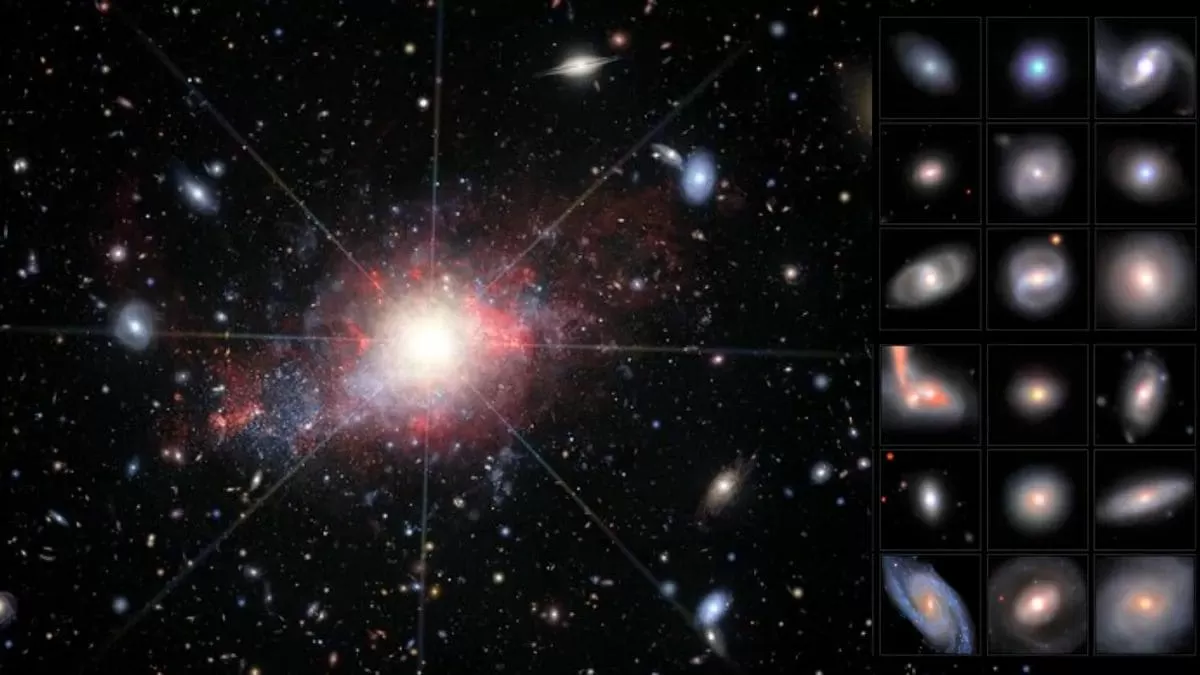
Astronomers have made a groundbreaking discovery that could change our understanding of black holes. Using data from the Dark Energy Spectroscopic Instrument (DESI), they have uncovered a staggering 2,500 dwarf galaxies containing active black holes. This is the largest-ever discovery of intermediate-mass black holes, with 300 new candidates identified. These findings have the potential to revolutionize our understanding of how black holes evolve from stellar-mass to supermassive sizes.
The research, based on 410,000 galaxies, suggests that many of these dwarf galaxies contain black holes with masses ranging from 10,000 to 100,000 times that of our sun. This is a significant finding, as intermediate-mass black holes have been notoriously difficult to detect. They are smaller than supermassive black holes, which can be found at the center of most galaxies, and larger than stellar-mass black holes, which are formed from the collapse of massive stars.
The discovery of these intermediate-mass black holes is a major breakthrough in the field of astronomy. It has long been theorized that black holes grow in size by merging with other black holes. However, until now, there has been little evidence to support this theory. The identification of 300 new candidates for intermediate-mass black holes provides strong evidence that these objects do indeed exist and are actively growing.
One of the most exciting implications of this discovery is the potential to understand how black holes evolve from stellar-mass to supermassive sizes. Supermassive black holes, which can be found at the center of most galaxies, are thought to have formed from the merging of smaller black holes. However, the exact process of how this happens is still a mystery. The identification of these intermediate-mass black holes could provide crucial insights into this process and help us understand the origins of these enigmatic objects.
The DESI data used in this research was collected over a period of six years, from 2014 to 2020. The instrument, located at the Kitt Peak National Observatory in Arizona, is designed to map the universe in three dimensions. It does this by measuring the light from distant galaxies and using this information to determine their distance and velocity. This allows astronomers to create a detailed map of the universe and study the distribution of galaxies and other objects.
The discovery of these 2,500 dwarf galaxies containing active black holes is just the beginning. The DESI team believes that there could be many more intermediate-mass black holes waiting to be discovered. With the instrument’s capabilities, they hope to uncover even more of these elusive objects in the future.
This groundbreaking research has been published in the Astrophysical Journal and has already garnered significant attention from the scientific community. It has been hailed as a major step forward in our understanding of black holes and their role in the evolution of galaxies.
The implications of this discovery go beyond the field of astronomy. Black holes have long captured the imagination of the public, and this discovery will undoubtedly spark even more interest and curiosity. It is a testament to the power of scientific research and the incredible advancements we have made in our understanding of the universe.
The DESI team’s work is a testament to the power of collaboration and the importance of investing in cutting-edge technology. The instrument’s capabilities have allowed astronomers to make this groundbreaking discovery, and it is a testament to the potential of future advancements in technology to unlock even more secrets of the universe.
In conclusion, the discovery of 2,500 dwarf galaxies containing active black holes using DESI data is a monumental achievement in the field of astronomy. It marks the largest-ever discovery of intermediate-mass black holes and has the potential to revolutionize our understanding of these mysterious objects. With this discovery, we are one step closer to unraveling the mysteries of the universe and understanding our place in it.
