

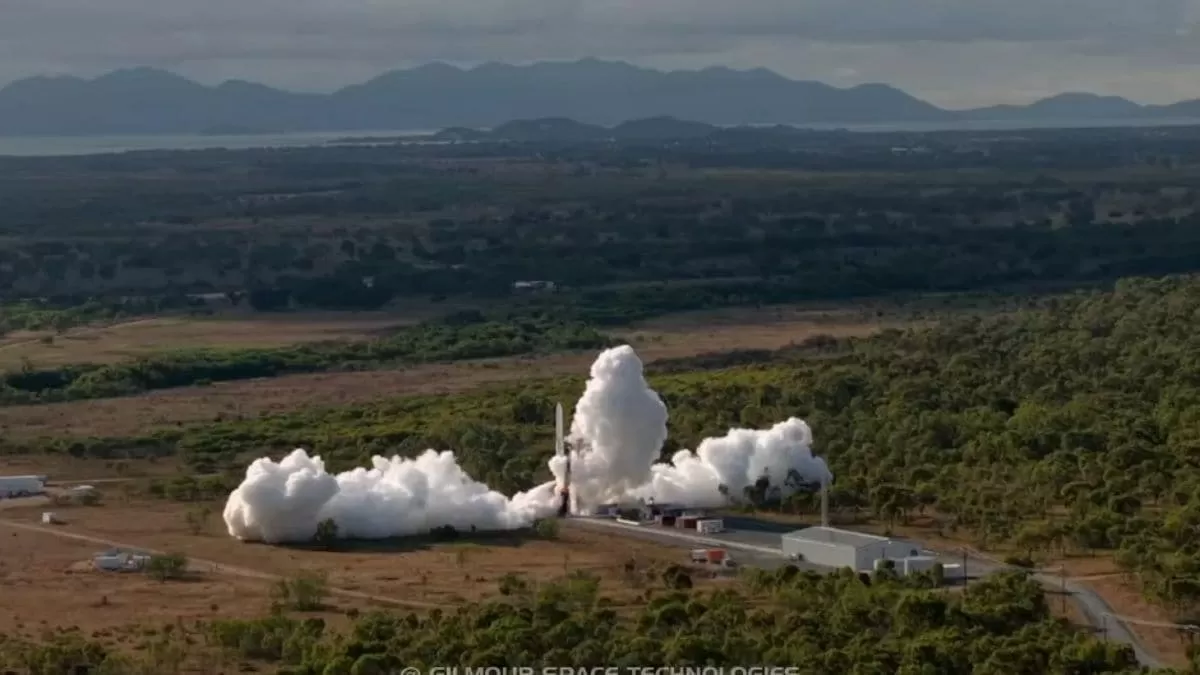
Australia’s space industry has been making headlines recently with the launch of Eris, the country’s first orbital rocket. However, the excitement was short-lived as the rocket failed to reach its intended orbit. The rocket was created by Gilmour Space, a leading space company in Australia. The failure of the launch has been attributed to a possible technical failure, leaving many disappointed and wondering what went wrong.
Eris was set to be launched from the Launch Complex 1 in southern Queensland on Wednesday morning. As the countdown reached the final seconds, the atmosphere was filled with anticipation and hope. However, just moments after liftoff, the rocket suffered an anomaly and was unable to reach its intended orbit. The Gilmour Space team immediately initiated a contingency plan to ensure the safety of the public and the surrounding environment. While no injuries were reported, the disappointment was evident on the faces of the team and the spectators.
The Gilmour Space team has been working tirelessly on Eris for the past few years, with the aim of making Australia a key player in the global space industry. The rocket was designed to carry small satellites into orbit, providing a cost-effective and efficient solution for satellite launches. The failure of the launch has dealt a major blow to the team’s efforts and ambitions. However, the company’s founder and CEO, Adam Gilmour, remains positive and determined to overcome this setback.
In a statement released after the launch, Gilmour expressed his disappointment but also his appreciation for the team’s efforts. He stated, “We are disappointed with the outcome of the launch, but we are grateful for the hard work and dedication of our team. We will continue to analyze the data and work towards our goal of becoming a major player in the global space industry.”
The company has not released any official statement on the possible cause of the technical failure. However, experts speculate that it could be due to a number of reasons such as issues with the rocket’s propulsion system or guidance and control system. Gilmour Space has assured that a thorough investigation will be conducted to determine the exact cause of the failure and to prevent similar incidents in the future.
Despite the setback, the Australian space industry is still in its infancy and has a long way to go. This failure should not be seen as a setback, but rather as a learning opportunity for the industry. Australia has the potential to become a major player in the global space market, and with the continuous efforts and innovation of companies like Gilmour Space, this dream can become a reality.
The failure of Eris also highlights the risks and challenges that come with space exploration. Launching a rocket into orbit is a complex and highly technical process, and even the most experienced space agencies have faced failures in the past. It takes determination, resilience, and a positive mindset to overcome such challenges and continue pushing the boundaries of space exploration.
Despite the disappointment, the launch of Eris has put Australia’s space industry on the global map. It has shown that Australia has the capability and potential to compete with other major players in the space industry. The country has already made significant contributions to the global space sector, such as the development of the world’s first satellite positioning system, the Global Navigation Satellite System (GNSS). Eris was another step towards establishing Australia as a key player in the space industry, and although it may have faltered, it has not diminished the country’s potential and determination.
In conclusion, the failure of Eris’s launch may have been a setback, but it should not discourage the country’s efforts in the space industry. It is a reminder that space exploration is a challenging and risky endeavor, but with determination and perseverance, Australia can overcome any obstacles and reach new heights in the global space market. The Gilmour Space team’s dedication and hard work should be commended, and we look forward to their future successes in the industry. Let us continue to support and encourage the growth of Australia’s space industry towards a brighter and more innovative future.
