

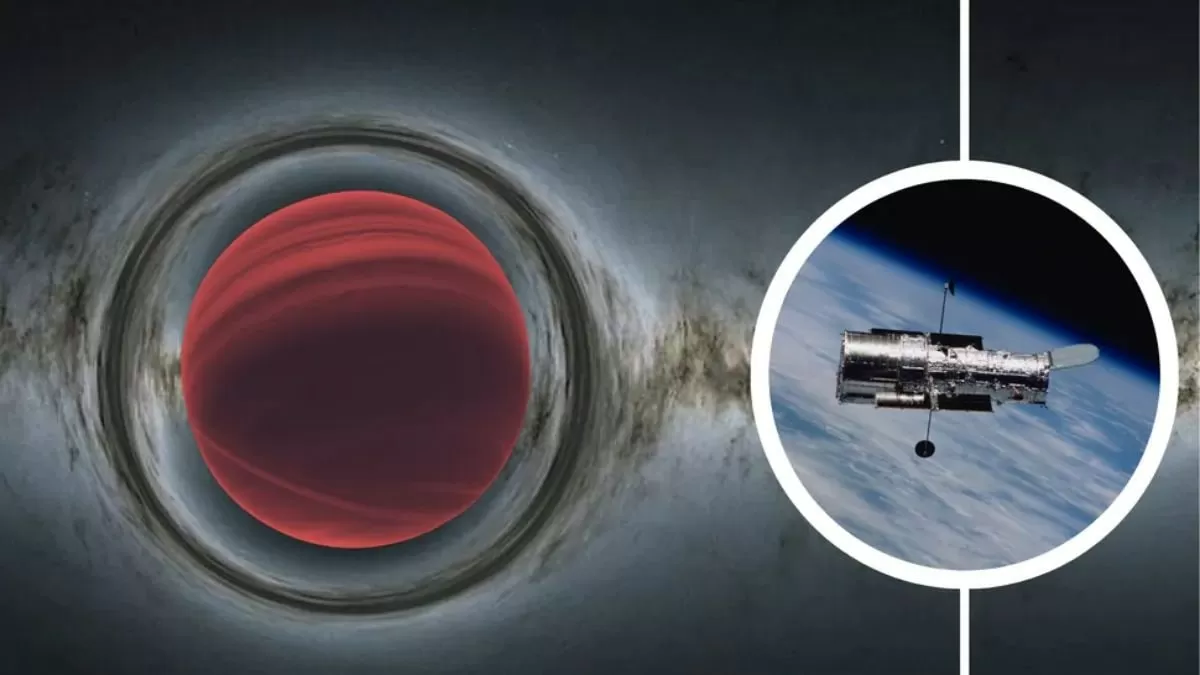
Astronomers have made a groundbreaking discovery that has left the scientific community in awe. Using data from the Hubble Space Telescope, they have found a rogue planet that was hidden in plain sight. This discovery has been made possible by using gravitational microlensing, a technique based on Einstein’s theory of general relativity. The planet, named OGLE-2023-BLG-0524, has no host star and was detected during a short eight-hour event. This finding has opened up new possibilities in the study of planets and their formation. Let us dive deeper into this fascinating discovery and its implications.
Gravitational microlensing is a phenomenon that occurs due to the bending of light by massive objects. In this case, the light from a distant star is bent by the gravitational pull of the rogue planet, allowing us to detect its presence. This technique has been used before to discover exoplanets, but this is the first time it has been used to find a free-floating planet.
The event, OGLE-2023-BLG-0524, was first detected in 2023 by the Optical Gravitational Lensing Experiment (OGLE) collaboration. However, it was not until recently that a team of astronomers led by Dr. David Bennett of the University of Notre Dame, Indiana, discovered the rogue planet hidden in the archival data from the Hubble Space Telescope. The planet is estimated to be about the size of Jupiter and is located in the Milky Way galaxy, approximately 25,000 light-years away from Earth.
What makes this discovery even more intriguing is the lack of a host star. Most planets in our universe orbit around a star, but OGLE-2023-BLG-0524 seems to be truly free-floating. This raises many questions about how this planet formed, and its origins remain a mystery. It is possible that it was once part of a larger system, but was ejected due to gravitational interactions with other planets or stars.
The discovery of this rogue planet has opened up new avenues for research in the field of astronomy. It is the first time that a planet has been found using gravitational microlensing without the presence of a host star. This suggests that there could be many more free-floating planets in our galaxy waiting to be discovered. These planets could provide valuable insights into the formation and evolution of planetary systems.
Moreover, the lack of a host star means that this planet is not bound by any gravitational forces and is free to roam through the galaxy. This opens up the possibility of studying the planet’s atmosphere and composition without the interference of a star’s light. This could provide valuable information about the planet’s history and its environment.
The discovery of OGLE-2023-BLG-0524 is a testament to the advancements in technology and the power of collaboration in the scientific community. It took the combined efforts of multiple teams and the use of sophisticated techniques to find this elusive planet. This discovery also highlights the importance of archival data and the need to revisit old data with new tools and techniques.
This discovery is just the beginning, and there is still much to learn about this rogue planet and others like it. With the advancements in technology and the continuous efforts of astronomers, we can expect to uncover more secrets of the universe. The discovery of OGLE-2023-BLG-0524 is a reminder that the universe is full of surprises, and there is still so much to explore and discover.
In conclusion, the discovery of a free-floating planet using gravitational microlensing based on Einstein’s theory is a significant achievement in the field of astronomy. OGLE-2023-BLG-0524 has opened up new possibilities for research and has challenged our understanding of planetary formation. This discovery has once again shown the power of science and the wonders of our universe. We can only imagine what other mysteries await us in the vast expanse of space.
