

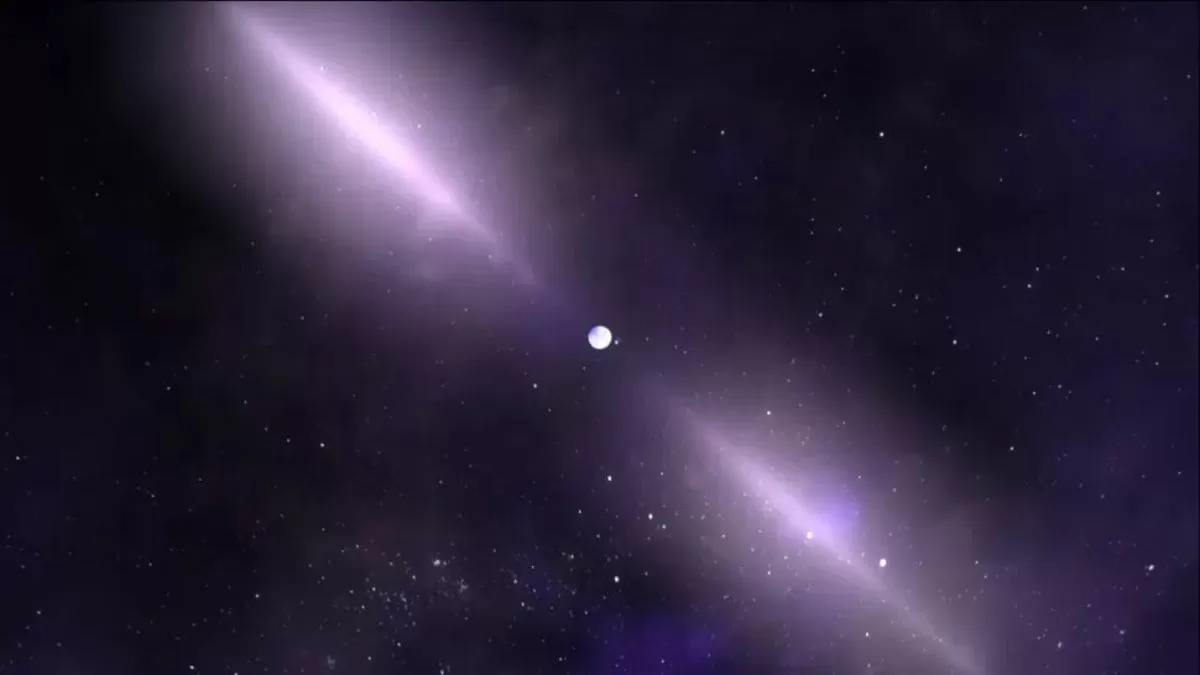
PSR J0922+0638, an ultradense neutron star, has been a subject of fascination for scientists for many years. Located in the constellation of Gemini, this neutron star has been showing puzzling rotational glitches every 550 days. These glitches have been observed through radio data collected over a span of 22 years. The findings of this study have left scientists intrigued and have opened up new avenues for research.
Neutron stars are the remnants of massive stars that have undergone a supernova explosion. They are incredibly dense, with a mass greater than that of our sun, packed into a sphere with a diameter of only about 20 kilometers. This makes them one of the most extreme objects in the universe. PSR J0922+0638 is no exception, with a mass of about 1.4 times that of our sun and a radius of only 10 kilometers.
One of the most fascinating aspects of neutron stars is their rapid rotation. PSR J0922+0638, in particular, rotates at an astonishing rate of 1.4 rotations per second. This rapid rotation is what makes it a pulsar, emitting beams of radiation from its magnetic poles, which can be detected by radio telescopes on Earth.
However, what makes PSR J0922+0638 even more intriguing is its rotational glitches. These glitches are sudden changes in its spin, which have been observed every 550 days. The first glitch was detected in 2002, and since then, scientists have been closely monitoring the star to understand this phenomenon.
In a recent study published in The Astrophysical Journal, scientists have analyzed 22 years of radio data from PSR J0922+0638 and have detected both abrupt and slow changes in its spin. These changes could be linked to magnetic field cycles or superfluid dynamics deep inside the star. However, the exact cause of these glitches remains a mystery, demanding continued long-term study.
The study was led by Dr. Andrea Lommen, an astrophysicist at Franklin & Marshall College in Pennsylvania. She and her team used data from the Arecibo Observatory in Puerto Rico and the Green Bank Telescope in West Virginia to study the rotational behavior of PSR J0922+0638. They found that the glitches were not only abrupt but also showed a gradual increase in the star’s spin rate before and after the glitch.
This finding is significant as it challenges the current understanding of pulsar glitches. According to the current model, pulsar glitches are caused by the sudden release of energy from the star’s interior, which causes a change in its spin. However, the gradual increase in spin rate observed in PSR J0922+0638 suggests that there may be more complex processes at work.
One possible explanation for these glitches could be the star’s magnetic field. Neutron stars have incredibly strong magnetic fields, which can affect their rotational behavior. The glitches observed in PSR J0922+0638 could be a result of changes in its magnetic field, which may be linked to cycles of activity deep inside the star.
Another possible explanation could be the superfluid dynamics within the star. Neutron stars are made up of a superfluid, a state of matter with zero viscosity, which allows it to flow without any resistance. This superfluid may be responsible for the gradual increase in spin rate observed before and after the glitches.
However, these are just theories, and more research is needed to understand the exact cause of these glitches. Dr. Lommen and her team plan to continue their long-term study of PSR J0922+0638 to gather more data and gain a better understanding of this phenomenon.
The study of PSR J0922+0638 and its rotational glitches has opened up new avenues for research in the field of astrophysics. It has also highlighted the importance of long-term studies in understanding the complex behavior of these extreme objects. With advancements in technology and the availability of more powerful telescopes, scientists are now able to gather more data and unravel the mysteries of the universe.
In conclusion, PSR J0922+0638, an ultradense neutron star, continues to amaze and intrigue scientists with its puzzling rotational glitches. The recent study has shed new light on this phenomenon, but the exact cause remains a mystery. With continued long-term study, we hope to gain a better understanding of these glitches and unlock the secrets of this fascinating object in our universe.
