

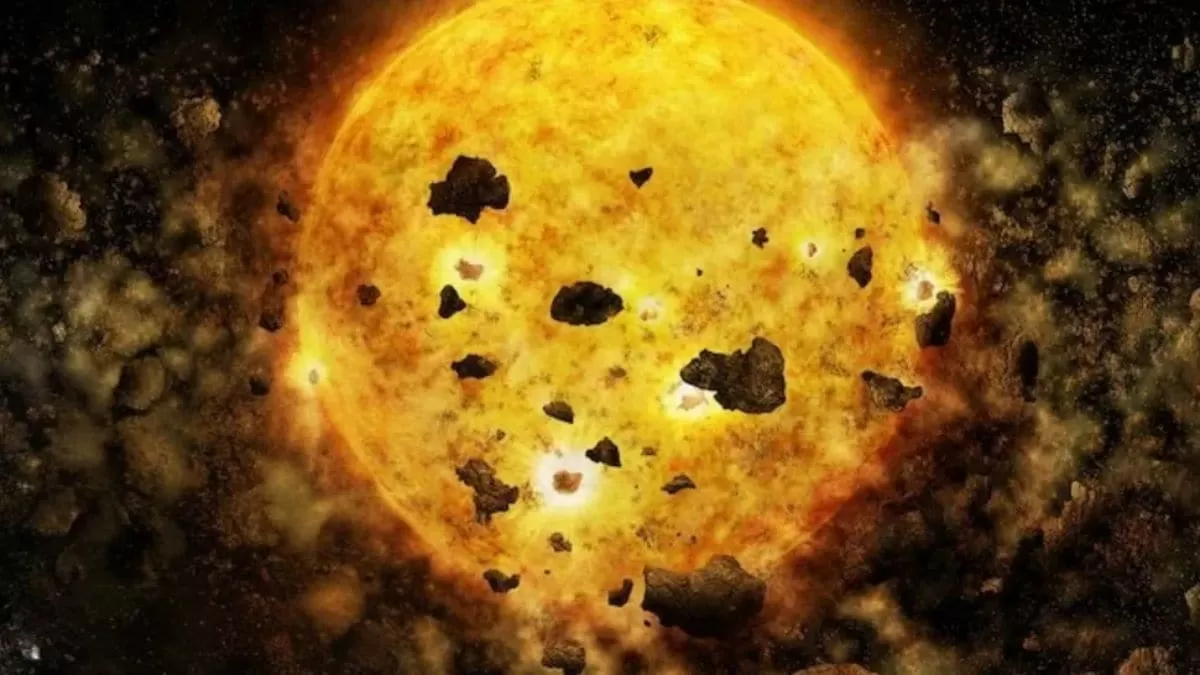
The universe is full of mysteries, and with each new discovery, we are left in awe of the vastness and complexity of the cosmos. One such discovery has recently captured the attention of astronomers and space enthusiasts alike – the gas giant TOI-2109b. Located in a distant solar system, this exoplanet is over five times the mass of our very own Jupiter and is currently in a rare planetary death spiral, hurtling towards its star at an alarming rate. With a 16-hour orbit and scorching heat, the fate of this massive gas giant is uncertain, with various possibilities ranging from its eventual demise to a potential transformation into a rocky super-Earth. This groundbreaking discovery has been made possible thanks to the combined efforts of NASA’s TESS and ESA’s Cheops, and it has left scientists and researchers buzzing with excitement and curiosity.
The discovery of TOI-2109b has shed light on the existence of a planetary death spiral, a phenomenon that was previously only a theoretical possibility. This unique and rare occurrence happens when a massive exoplanet’s orbit decays, causing it to spiral towards its star, with eventual destruction being the most likely outcome. This process is known as photoevaporation, where intense radiation and heat from the star cause the planet’s atmosphere to dissipate, leaving behind a barren and rocky core.
TOI-2109b’s orbit is a mere 16 hours, which is significantly shorter than that of our own Jupiter. This close proximity to its star means that the planet is subjected to intense heat, with temperatures reaching up to 2,000 degrees Celsius. To put this into perspective, our own solar system’s closest planet to the sun, Mercury, has an average temperature of 430 degrees Celsius. This extreme heat and the planet’s massive size make its death spiral a fascinating and unprecedented event to observe.
But what exactly is the fate of TOI-2109b? Will it continue its downward spiral and meet its fiery demise, or is there a chance for it to evolve into something more? The answer to this question lies in the planet’s composition and how it reacts to the intense heat from its star. Scientists believe that there are three possible outcomes for TOI-2109b: it could plunge into its host star, be torn apart by tidal forces, or evolve into a rocky super-Earth.
The first possibility, where the planet plunges into its star, is the most likely outcome. The intense heat from the star will cause TOI-2109b’s atmosphere to evaporate at an accelerated rate, eventually leading to its destruction. However, this process may take millions of years, allowing scientists to observe and gather data on the planet’s evolution.
The second possibility is that the planet may be torn apart by tidal forces as it gets closer to its star. The gravitational pull from the star and the intense heat can cause the planet’s internal structure to break apart, leading to its eventual demise. This outcome is less likely, but it is still a possibility that scientists are considering.
The third and most intriguing possibility is that TOI-2109b may transform into a rocky super-Earth. The intense heat from the star will strip away its atmosphere, leaving behind a solid and rocky core. This process is similar to how Earth’s atmosphere was formed, and it could potentially pave the way for the planet to eventually evolve into a habitable world. This outcome has sparked the interest of scientists, and they are eager to study and gather data on this transformation.
The discovery of TOI-2109b would not have been possible without the combined efforts of NASA’s TESS (Transiting Exoplanet Survey Satellite) and ESA’s Cheops (CHaracterising ExOPlanet Satellite). TESS first detected the presence of the planet, while Cheops confirmed its orbit and provided detailed information on its mass and composition. This collaboration between space agencies has proven to be a successful one, and it has opened the doors for further research and exploration.
TOI-2109b’s discovery is an exciting and significant milestone in our quest to understand the universe and its mysteries. It has provided us with a rare opportunity to witness a planetary death spiral, an event that was once only a theoretical possibility. The data and information gathered from this discovery will undoubtedly contribute to our understanding of planetary formation and evolution, and it could potentially pave the way for future discoveries.
As we continue to explore the vastness of
