

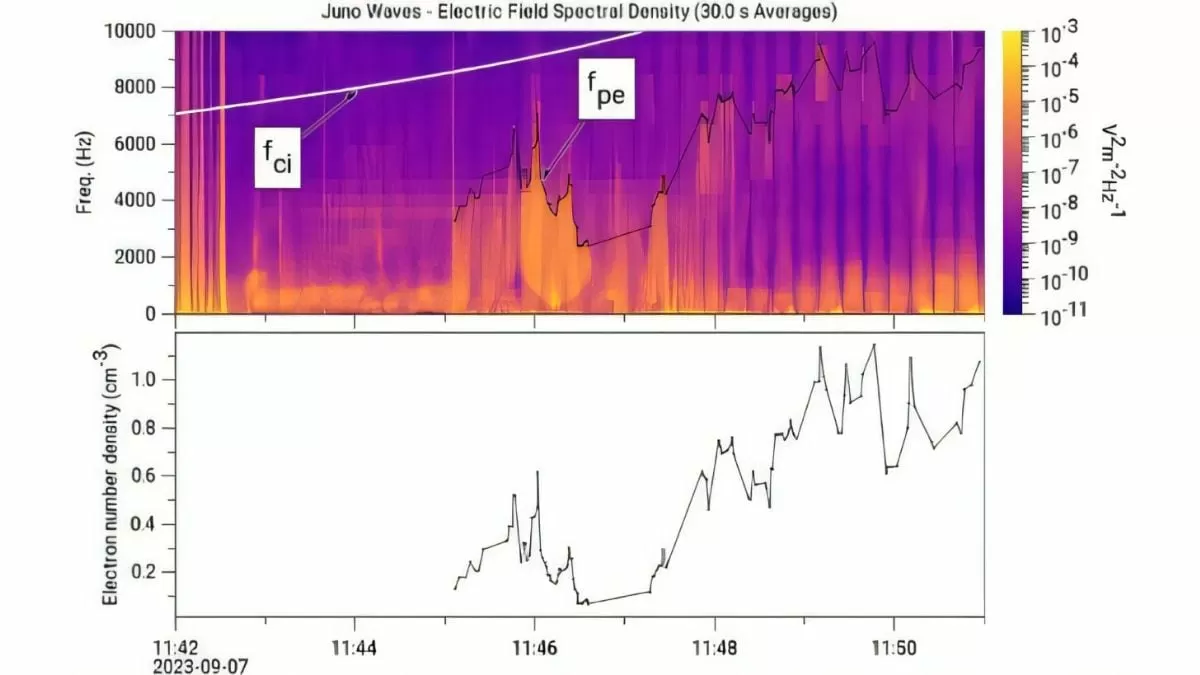
The mysteries of our solar system continue to fascinate and intrigue us, and the latest discovery by NASA’s Juno Spacecraft is no exception. The spacecraft, which has been orbiting Jupiter since 2016, has detected unusual plasma waves at the planet’s North Pole. These waves have puzzled scientists for years, but now a team of researchers from the University of Minnesota has shed light on this phenomenon. Led by Rober Lysak, the team’s findings have resulted in the identification of new types of plasma waves, providing a deeper understanding of Jupiter’s complex magnetic field.
Jupiter, the largest planet in our solar system, is known for its massive size and powerful magnetic field. This magnetic field is created by the planet’s rapid rotation and its metallic hydrogen core. However, the magnetic field at Jupiter’s poles is much more complex and dynamic than previously thought. The Juno Spacecraft, equipped with state-of-the-art instruments, has been able to capture and analyze these plasma waves, providing valuable insights into the planet’s magnetic environment.
The team of scientists from the University of Minnesota, along with their collaborators, have been studying the data collected by Juno since its arrival at Jupiter. They noticed that the plasma waves at the planet’s North Pole were unlike anything they had seen before. These waves were highly structured and had a unique signature, which led the team to believe that they were a new type of plasma wave.
Plasma waves are a type of electromagnetic wave that can be found in space. They are created when charged particles, such as electrons and protons, interact with a magnetic field. These waves are crucial in understanding the dynamics of a planet’s magnetic field and its interaction with the surrounding environment. However, the plasma waves at Jupiter’s North Pole were different from the ones observed at other planets, such as Earth and Saturn.
Rober Lysak, the lead researcher of the team, explains that the plasma waves at Jupiter’s North Pole are created by a process called “cyclotron maser instability.” This process involves the interaction between the planet’s magnetic field and high-energy particles, which are accelerated by the magnetic field. The result is a highly structured and intense plasma wave, which can be detected by Juno’s instruments.
The team’s findings have been published in the journal Nature Communications, and they have already received widespread attention from the scientific community. Dr. Lysak and his team have not only identified a new type of plasma wave, but they have also provided a possible explanation for its formation. This discovery has opened up new avenues for research and has the potential to enhance our understanding of Jupiter’s magnetic field.
The presence of these unusual plasma waves at Jupiter’s North Pole has also raised questions about the planet’s auroras. Auroras, also known as the Northern and Southern Lights, are created when charged particles from the Sun interact with a planet’s magnetic field. The team believes that the newly identified plasma waves could play a significant role in the formation of Jupiter’s auroras. This could lead to a better understanding of the planet’s spectacular light shows and their connection to its magnetic field.
The Juno Spacecraft’s mission at Jupiter is far from over, and scientists are eagerly waiting for more data to be collected. With the new insights provided by the University of Minnesota team, researchers can now focus on studying the plasma waves in more detail. This could lead to a better understanding of not only Jupiter’s magnetic field but also its atmosphere and its interaction with the surrounding environment.
The discovery of these new types of plasma waves is a testament to the power of scientific exploration and collaboration. The Juno Spacecraft, along with the team of scientists from the University of Minnesota, has once again pushed the boundaries of our knowledge and provided us with a deeper understanding of our solar system. This discovery also highlights the importance of continued investment in space exploration and research, as it has the potential to unlock many more mysteries of our universe.
In conclusion, the presence of unusual plasma waves at Jupiter’s North Pole, detected by NASA’s Juno Spacecraft, has been a source of curiosity for scientists for years. Thanks to the team of researchers from the University of Minnesota, we now have a better understanding of these waves and their role in Jupiter’s complex magnetic field. This discovery has opened up new possibilities for research and has once again shown us the wonders of our solar system.
