

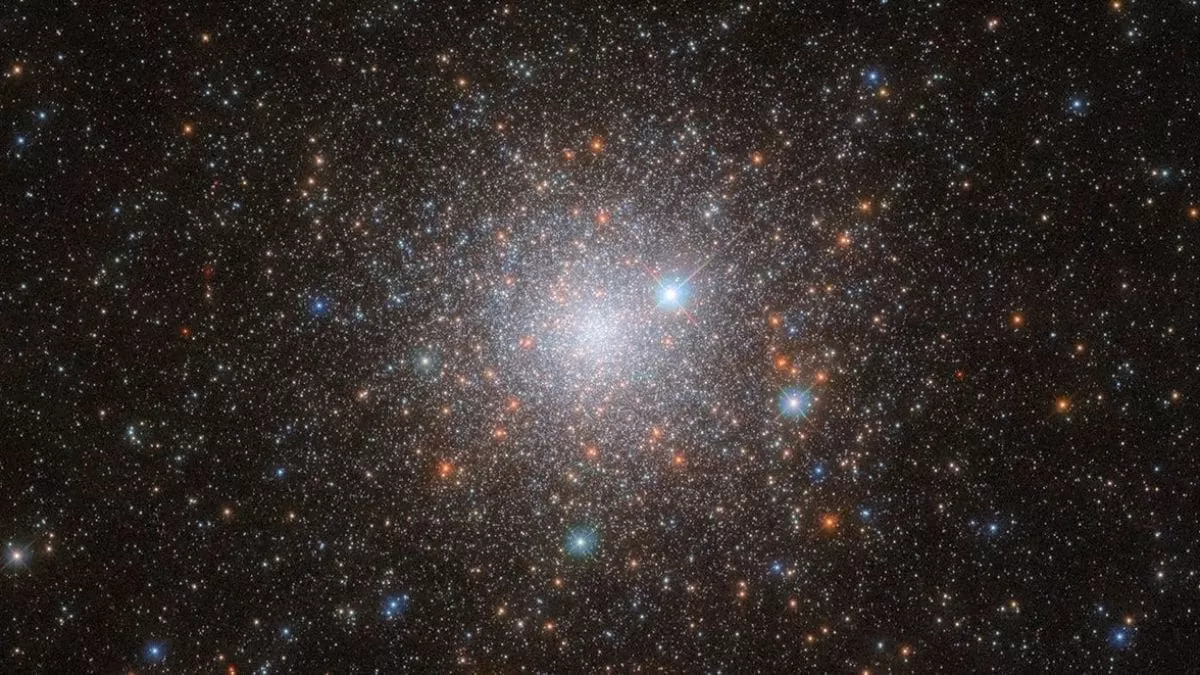
NASA/ESA’s Hubble Space Telescope has once again captured the awe-inspiring beauty of our universe with its latest image of the galaxy cluster Abell 209. Located 2.8 billion light-years away in the constellation of Cetus, this massive cluster is home to over 100 galaxies. But what makes this image truly remarkable is the invisible web of hot gas and dark matter that lies beneath this golden cluster.
The Hubble Space Telescope, launched in 1990, has been instrumental in our understanding of the universe. Its powerful cameras and instruments have allowed us to peer deeper into space and capture breathtaking images of distant galaxies, stars, and other celestial objects. And the latest image of Abell 209 is no exception.
At first glance, the image may seem like a beautiful cluster of galaxies, but there is more to it than meets the eye. Using a technique called gravitational lensing, Hubble has revealed curved arcs of light from background galaxies, which are distorted by the cluster’s immense gravitational pull. This phenomenon occurs due to the bending of light by the cluster’s massive amount of dark matter, an invisible substance that makes up about 85% of the universe’s total mass.
Dark matter is a mysterious substance that does not emit, absorb, or reflect light, making it impossible to detect with traditional telescopes. However, its presence can be inferred by observing its gravitational effects on visible matter, such as stars and galaxies. And in the case of Abell 209, Hubble’s observations have provided us with a glimpse into the hidden world of dark matter.
The curved arcs of light seen in the image are not just random distortions; they are a result of the precise alignment of the background galaxies with the cluster’s gravitational field. This alignment acts as a natural lens, magnifying and distorting the light from the galaxies, giving us a unique view of the universe.
But that’s not all. The image also reveals the presence of hot gas, which fills the space between the galaxies in the cluster. This gas, also known as the intracluster medium, is heated to millions of degrees and emits X-rays, making it visible to telescopes equipped with X-ray detectors. However, Hubble’s observations have allowed us to see this gas in visible light, providing a more comprehensive view of the cluster.
The combination of dark matter and hot gas creates an invisible web that holds the galaxies in the cluster together. Without this web, the galaxies would fly apart due to their high speeds and the cluster’s immense size. This web also plays a crucial role in the formation and evolution of galaxies, as it provides the necessary gravitational pull to bring gas and dust together, allowing new stars to form.
The Abell 209 cluster is just one of the many galaxy clusters that Hubble has observed over the years. Each cluster has its unique characteristics and holds valuable information about the universe’s structure and evolution. By studying these clusters, astronomers can gain a better understanding of the universe’s past, present, and future.
The Hubble Space Telescope’s latest image of Abell 209 is a testament to the power of science and technology. It reminds us of the vastness and complexity of our universe and how much we still have to learn. With every new image, Hubble continues to inspire and amaze us, pushing the boundaries of our knowledge and understanding.
As we look towards the future, we can only imagine the incredible discoveries that await us. With new and advanced telescopes being developed, we can expect even more stunning images and groundbreaking discoveries. But for now, let us marvel at the beauty and mystery of Abell 209, a reminder of the infinite wonders that lie beyond our reach.
