

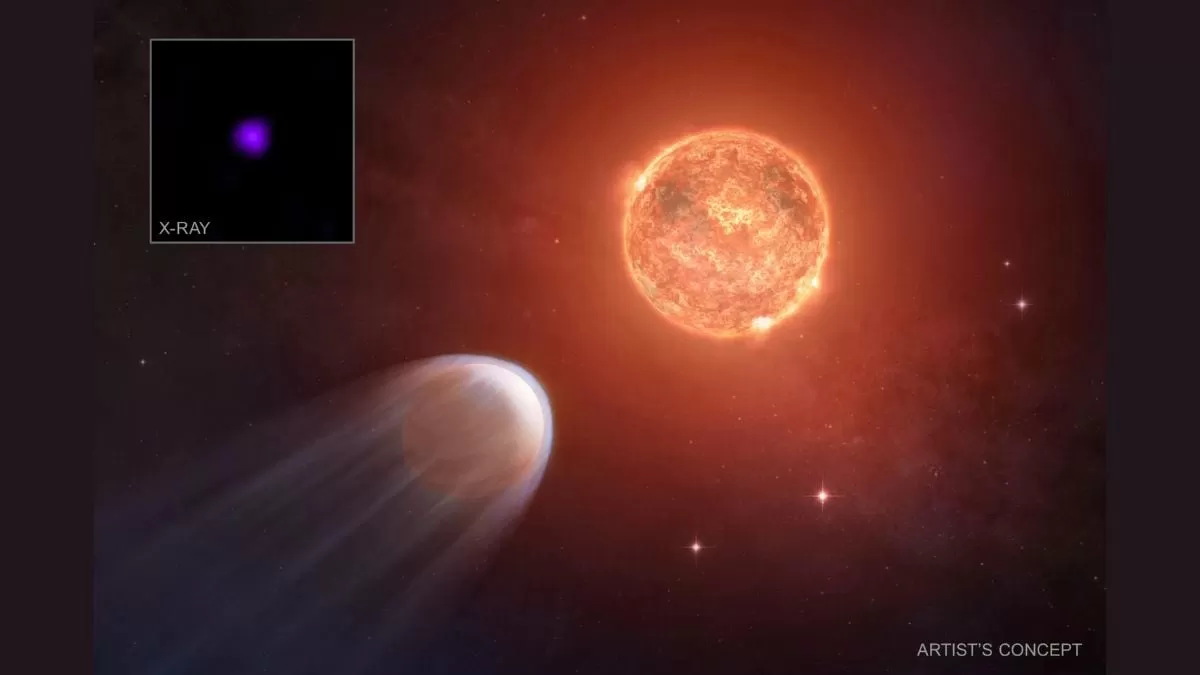
NASA’s Chandra X-ray Observatory and Hubble Space Telescope have once again captured a breathtaking cosmic event, providing us with a glimpse into the fascinating world of exoplanets. This time, the two powerful telescopes have joined forces to observe a baby exoplanet, TOI 1227 b, being stripped of its atmosphere by intense X-rays from its host star.
Located approximately 400 light-years away from Earth, TOI 1227 b is a Jupiter-sized planet that is only 8 million years old. It orbits a red dwarf star, which is smaller and cooler than our Sun. This makes it an ideal candidate for studying the effects of X-rays on a young exoplanet’s atmosphere.
The findings of this study, published in The Astronomical Journal, have left astronomers amazed. They have discovered that TOI 1227 b is losing its atmosphere at a rate equivalent to Earth’s entire atmosphere every 200 years. This is a staggering amount, considering the planet’s young age.
According to the lead author of the study, Dr. Allison Youngblood from the Laboratory for Atmospheric and Space Physics at the University of Colorado Boulder, “This is the first time we have seen a planet losing its atmosphere at such a high rate. It’s a rare and exciting find that sheds light on the complex interactions between a planet and its host star.”
The team of astronomers used data from both the Chandra X-ray Observatory and the Hubble Space Telescope to study the planet’s atmosphere. They found that the intense X-rays from the red dwarf star are heating up the planet’s upper atmosphere, causing it to expand and escape into space. This process is known as photoevaporation.
Dr. Youngblood explains, “The X-rays from the star are so powerful that they are breaking apart the molecules in the planet’s atmosphere, causing it to lose gas at an alarming rate. This is a crucial step in understanding how planets evolve and how their atmospheres are affected by their host stars.”
The Chandra X-ray Observatory, launched in 1999, is a space telescope designed to detect X-rays from high-energy regions of the universe, such as black holes, supernova remnants, and hot gas in galaxy clusters. It has been instrumental in studying the X-ray emissions from stars and their effects on surrounding planets.
On the other hand, the Hubble Space Telescope, launched in 1990, is a powerful instrument that has revolutionized our understanding of the universe. It has captured stunning images of galaxies, stars, and planets, providing us with valuable insights into the mysteries of the cosmos.
The combination of these two telescopes has allowed astronomers to study TOI 1227 b in unprecedented detail. They were able to measure the planet’s X-ray absorption and determine the rate at which its atmosphere is being stripped away.
Dr. Youngblood adds, “The observations from Chandra and Hubble have given us a complete picture of what is happening to TOI 1227 b. This is a remarkable achievement and a testament to the capabilities of these two telescopes.”
The discovery of TOI 1227 b’s atmosphere being stripped away by X-rays has opened up new avenues for research. Astronomers can now use this information to study the evolution of exoplanets and their atmospheres, providing us with a better understanding of the diversity of planets in our galaxy.
Moreover, this study has also highlighted the importance of studying young exoplanets. Dr. Youngblood says, “Young planets are more vulnerable to the effects of X-rays from their host stars. By studying them, we can gain valuable insights into the early stages of planet formation and how planets interact with their environment.”
The findings of this study have also raised questions about the habitability of planets orbiting red dwarf stars. These stars are the most common in our galaxy, and many exoplanets have been discovered orbiting them. However, their intense X-ray emissions could make it challenging for planets to maintain a stable atmosphere, which is crucial for supporting life.
Despite this, the discovery of TOI 1227 b is a significant step forward in our quest to understand the universe and the countless exoplanets that exist beyond our solar system. With the advancements in technology and the continued efforts of astronomers, we can expect to uncover more fascinating cosmic events and unravel the mysteries of the universe.
In conclusion, the joint observations of NASA’s Chandra X-ray Observatory and Hubble Space Telescope have provided us
