

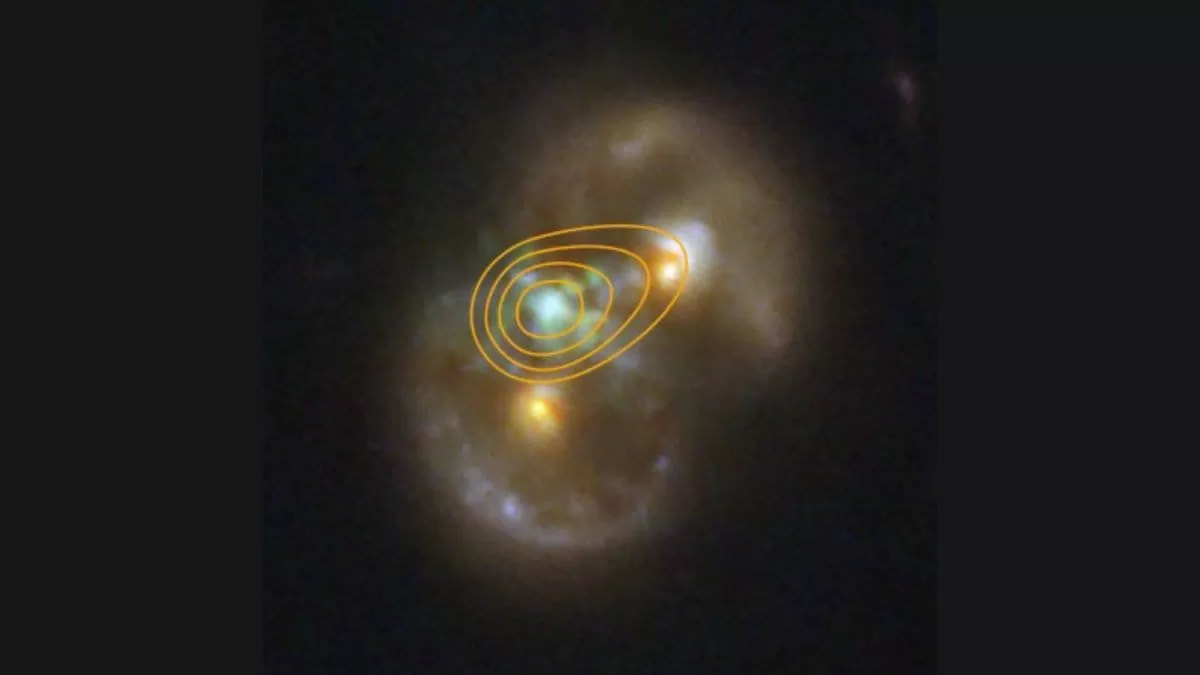
In a groundbreaking discovery, astronomers using the James Webb Space Telescope (JWST) have identified a black hole located between two galaxy cores in the Infinity Galaxy. This remarkable finding could potentially be the first direct evidence of a black hole formed by gas collapse, instead of the usual stellar death. The discovery of this rare “heavy seed” black hole challenges traditional models and offers new insights into how supermassive black holes may have emerged in the early stages of the universe.
The Infinity Galaxy, located approximately 300 million light years away, has always been a source of fascination for astronomers. The galaxy is home to two large, bright cores, each containing billions of stars. These types of galaxy cores are known as active galactic nuclei (AGN) and are often associated with the presence of supermassive black holes. However, until now, the exact origin of these black holes has remained a mystery.
Using the state-of-the-art JWST, a team of international astronomers have been able to peer deep into the heart of the Infinity Galaxy and uncover a black hole with a mass of approximately 100,000 times that of our sun. This may seem like a lot, but compared to other supermassive black holes, this one is relatively small. What makes this discovery truly extraordinary is that this black hole appears to have formed from the collapse of gas, rather than the death of a star.
According to traditional models, black holes are formed when a massive star reaches the end of its life and collapses under its own gravity. However, this new discovery challenges this notion, and suggests that there could be other ways for black holes to form. This is a paradigm shift in our understanding of the formation of supermassive black holes and could change the way we view the evolution of galaxies.
The discovery of this “heavy seed” black hole also has significant implications for our understanding of the early universe. The presence of supermassive black holes in the early stages of the universe has long puzzled astronomers. How did these massive objects form so quickly after the Big Bang? The traditional theory of stellar death as the source of supermassive black holes does not fully explain this phenomenon. However, this new discovery offers a possible explanation – gas collapse.
Gas collapse occurs when a large amount of gas collapses under its own gravity and forms a black hole. This process is much faster than the death of a star, and could potentially explain how supermassive black holes appeared so soon after the Big Bang. It is also possible that this heavy seed black hole grew in size over time, eventually becoming the supermassive black hole that we see in the Infinity Galaxy today.
The discovery of this rare “heavy seed” black hole also has wider implications for our understanding of the universe. It challenges traditional theories and opens up new avenues for research. Astronomers can now expand their search for similar black holes in other galaxies, which could help refine our understanding of the formation and evolution of supermassive black holes.
The James Webb Space Telescope, with its advanced capabilities, played a crucial role in this discovery. Its ability to observe in the infrared spectrum allowed astronomers to see through the dust and gas that typically obscures our view of the center of galaxies. This is not the first time that the JWST has made groundbreaking discoveries, and it certainly won’t be the last.
The discovery of this black hole in the Infinity Galaxy is a testament to the power of technology and the determination of scientists to unravel the mysteries of the universe. It is a reminder that there is still so much to learn and discover, and that there could be countless more surprises waiting for us beyond the stars.
In conclusion, the discovery of a black hole formed by gas collapse in the Infinity Galaxy using the JWST is a truly remarkable achievement. It challenges traditional theories and offers new explanations for the presence of supermassive black holes in the early universe. This rare “heavy seed” black hole is a reminder that there is still so much we do not know about the vastness of space, and it inspires us to continue our quest for knowledge and understanding. The future holds endless possibilities, and with the help of groundbreaking technologies like the JWST, we are getting closer to unraveling the mysteries of the universe.
