

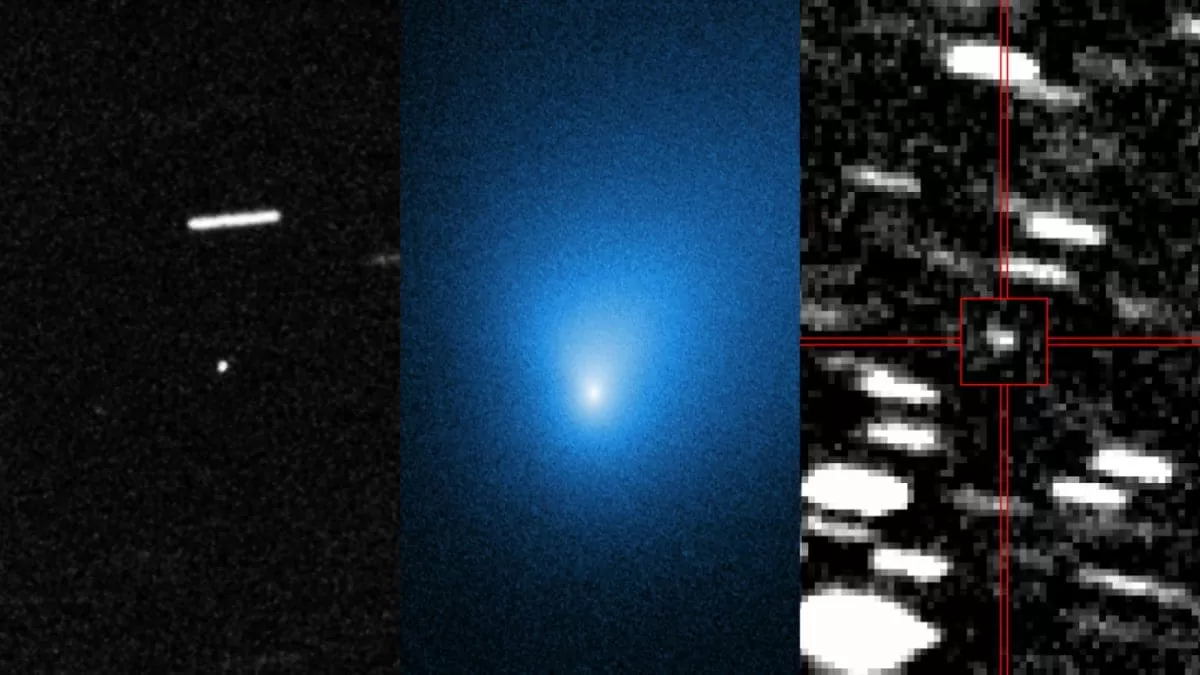
Astronomers have made an exciting discovery as they have detected the third known interstellar comet to enter our solar system. Named 3I/ATLAS, this comet was first spotted by the ATLAS telescope in Chile and is currently racing towards the Sun at a staggering speed of 150,000 miles per hour. With an estimated size of 10-20 kilometers, it is believed to be the largest interstellar object observed so far.
The discovery of 3I/ATLAS has caused a stir among the scientific community as it provides a rare opportunity to study an interstellar object up close. Interstellar objects are objects that originate from outside our solar system and enter it, making them extremely valuable in helping us understand the mysteries of the universe.
The first interstellar object to be discovered was ‘Oumuamua in 2017, followed by 2I/Borisov in 2019. Both of these objects were classified as comets, but 3I/ATLAS is the first one to show clear signs of cometary activity. This means that it has a tail and is releasing gas and dust as it approaches the Sun, just like regular comets in our solar system.
The discovery of 3I/ATLAS was made possible due to the ATLAS (Asteroid Terrestrial-impact Last Alert System) telescope, which is specifically designed to detect and track near-Earth objects. The telescope is equipped with a wide-field camera and powerful computer algorithms, making it capable of scanning the entire sky every two nights. This allows astronomers to quickly identify any new objects that enter our solar system.
The comet was first observed on June 23, 2019, and since then, astronomers have been closely monitoring its trajectory. It is currently located beyond the orbit of Mars and is expected to make its closest approach to the Sun in October. This will be the closest 3I/ATLAS will get to our star, and it is estimated to be about 37 million kilometers away. After that, it will start its journey back to the outer reaches of our solar system, eventually leaving it and continuing on its interstellar journey.
The discovery of 3I/ATLAS has also raised questions about its origin. Astronomers believe that it may have originated from a nearby star system, but the exact location is still unknown. It is estimated that the comet has been traveling through our galaxy for millions, if not billions, of years before entering our solar system. Studying its composition and trajectory can provide valuable insight into the conditions and processes that occur in other star systems.
The detection of interstellar objects like 3I/ATLAS is a testament to the advancements in technology and the dedication of astronomers to explore the vastness of space. With each new discovery, we are getting closer to unraveling the secrets of the universe and understanding our place in it.
The study of 3I/ATLAS will continue even after it has left our solar system. Astronomers will analyze the data collected by various telescopes and spacecraft to learn more about its composition, structure, and behavior. This will not only add to our knowledge of interstellar objects but also help us prepare for future encounters with similar objects.
The discovery of 3I/ATLAS is a reminder that our solar system is not an isolated entity, but a part of a much larger and ever-expanding universe. It also highlights the importance of continued research and exploration in the field of astronomy. Who knows what other fascinating discoveries await us in the vastness of space?
As 3I/ATLAS continues its journey through our solar system, astronomers will be eagerly waiting to see what secrets it holds. This discovery is a testament to the fact that there is still so much to learn and explore beyond our own planet. Let us embrace this opportunity to expand our knowledge and marvel at the wonders of the universe.
