

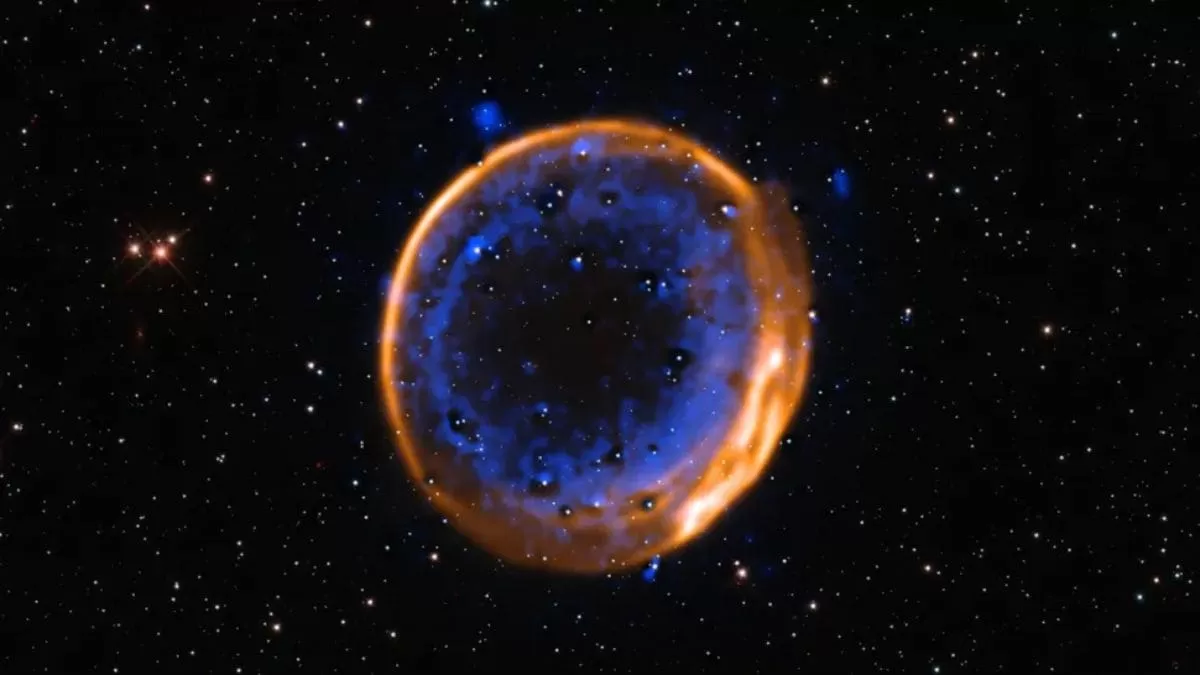
Astronomers have made an astonishing discovery that could change our understanding of the life cycle of stars. For the first time ever, they have captured an image of a white dwarf star undergoing a rare double-detonation supernova. The findings, published in Nature Astronomy, challenge existing theories about stellar death and could lead to new insights into the mysteries of our universe.
Using the powerful Very Large Telescope (VLT) in Chile, the team of international researchers was able to observe the explosion of a white dwarf star located in a nearby galaxy, about 500 million light-years away from Earth. This particular supernova, called SN2019yvq, is unique because it is a double-detonation explosion, meaning that the star underwent two separate explosions instead of one. This is a rare occurrence, as previous supernova observations have only recorded single explosions.
But what makes this discovery even more significant is that the team found that this double-detonation supernova occurred without the star reaching the Chandrasekhar limit, which was previously thought to be the necessary condition for such an explosion to happen. The Chandrasekhar limit is the maximum mass a white dwarf star can attain before it collapses in on itself and explodes. This limit is believed to be around 1.4 times the mass of our sun.
This new observation challenges the long-standing belief that the Chandrasekhar limit is the only way for a white dwarf star to reach a supernova stage. It suggests that these explosions can happen in a different way, perhaps due to interactions with a companion star or a violent merger with another white dwarf.
Dr. Ji-an Jiang, lead author of the study, explains the significance of this discovery, stating, “For the first time, we have a direct and clear observation of a double-detonation supernova. This not only provides valuable insights into the death of stars but also opens up a whole new avenue of research for astronomers.”
The team’s observation was made possible by the VLT’s capabilities, using its advanced instruments to capture high-resolution images of the supernova. The VLT is one of the world’s largest and most sophisticated telescopes, consisting of four telescopes with 8.2-meter mirrors. Its location in the Atacama Desert, one of the world’s driest and darkest places, provides perfect conditions for stargazing and allows for clear and detailed observations like this one.
The discovery of this double-detonation supernova is a significant breakthrough in the field of astronomy. It not only helps us understand the complex processes involved in stellar death but also raises new questions that could lead to further discoveries. In particular, it could shed light on the role of binary star systems in the evolution of stars and the formation of supernovas.
Moreover, this finding could have implications beyond the realm of astronomy. Understanding supernovas is crucial for our understanding of the chemical elements in the universe. Supernovas are responsible for creating and dispersing these elements, essential for the formation of planets, stars, and even life. Therefore, this discovery could have a broader impact on our understanding of the origins of the universe and our place in it.
This incredible discovery also highlights the importance of continued advancements in technology and our ability to observe the vast expanse of our universe. With each new breakthrough, we get closer to unraveling some of the biggest mysteries of the cosmos.
Dr. Stefano Benetti, a co-author of the study, sums it up perfectly, stating, “This discovery is a testament to the power of modern telescopes and the collaborative efforts of scientists from all over the world. It shows us that there is still so much to learn about our universe and that with the right tools and determination, anything is possible.”
The team’s findings pave the way for further research and open up new possibilities for understanding the complex and awe-inspiring nature of our universe. As we continue to explore and push the boundaries of what is possible, who knows what other incredible discoveries await us. This breakthrough in the study of double-detonation supernovas is just another step in our never-ending quest to unlock the secrets of the cosmos.
