

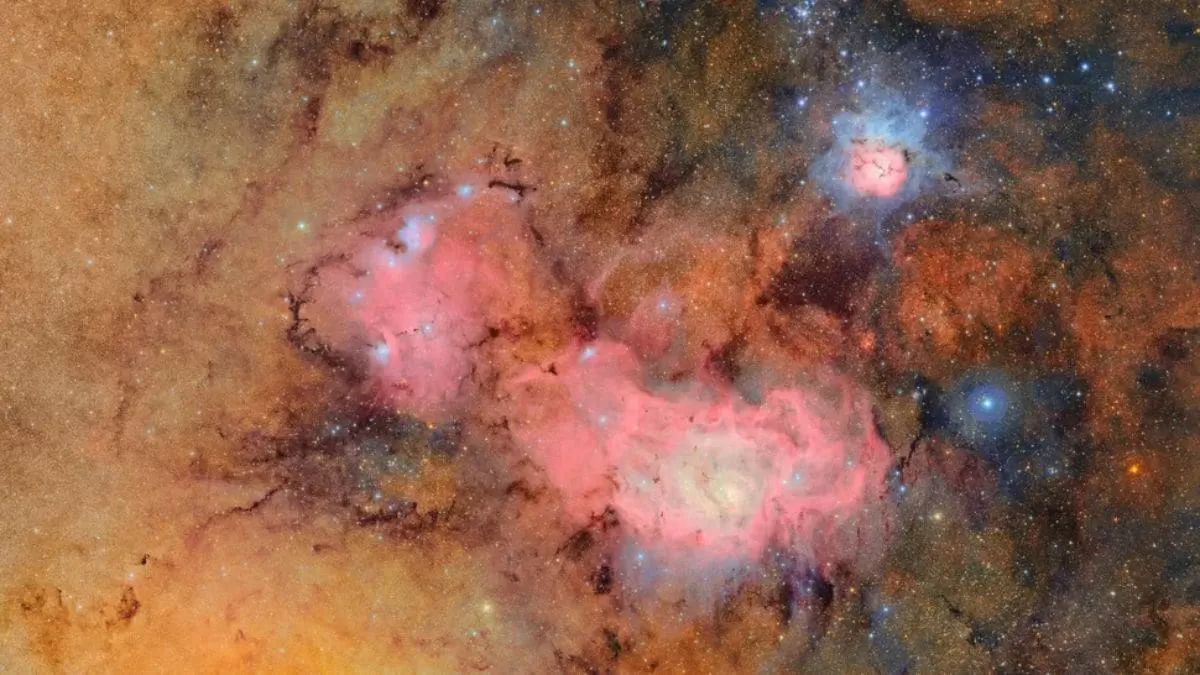
The Rubin Observatory, located in Chile, has recently unveiled its first public images, and they are nothing short of breathtaking. These images, captured by the observatory’s powerful telescope, reveal vivid views of the Lagoon and Trifid Nebulae, located 4,000 light-years away. This marks the beginning of a decade-long sky survey that will not only capture thousands of nightly exposures, but also explore dark matter and transform the way scientists and the public observe the dynamic universe.
The Rubin Observatory, formerly known as the Large Synoptic Survey Telescope (LSST), is a state-of-the-art facility designed to capture the most detailed and comprehensive images of the night sky. Its 8.4-meter telescope, equipped with a 3.2-gigapixel camera, is capable of capturing an area of the sky 40 times the size of the full moon in a single shot. This incredible technology allows the observatory to capture images with unprecedented depth and clarity, providing scientists with a wealth of data to study and analyze.
The first public images released by the Rubin Observatory showcase the Lagoon and Trifid Nebulae, two of the most iconic and beautiful objects in our galaxy. The Lagoon Nebula, also known as Messier 8, is a giant cloud of gas and dust where new stars are constantly being formed. The Trifid Nebula, or Messier 20, is a combination of an emission nebula, a reflection nebula, and a dark nebula, making it a truly unique and stunning sight.
These images not only capture the beauty of these celestial objects, but also provide valuable insights into their composition and structure. By studying these images, scientists can better understand the processes that shape our universe and the formation of stars and galaxies.
But the Rubin Observatory’s mission goes beyond just capturing stunning images. Its decade-long sky survey, known as the Legacy Survey of Space and Time (LSST), will capture thousands of nightly exposures, covering the entire visible sky every few nights. This will create a time-lapse of the night sky, allowing scientists to track changes and movements of objects in the universe over time.
One of the main goals of the LSST is to explore dark matter, a mysterious substance that makes up about 85% of the universe’s total mass. Dark matter does not emit or absorb light, making it invisible to traditional telescopes. However, the LSST’s powerful camera is able to detect the effects of dark matter on the light from distant galaxies, providing valuable clues about its nature and distribution.
The LSST will also play a crucial role in the study of dark energy, another mysterious force that is believed to be responsible for the accelerating expansion of the universe. By observing the movements of galaxies and supernovae, the LSST will help scientists better understand the nature of dark energy and its impact on the universe.
But perhaps one of the most exciting aspects of the Rubin Observatory’s mission is its commitment to making its data and images accessible to the public. The observatory has partnered with Google to create an interactive online platform, allowing anyone to explore the night sky and view the images captured by the LSST. This will not only engage and inspire the public, but also provide opportunities for citizen scientists to contribute to the research and discoveries made by the observatory.
The Rubin Observatory’s first public images are just the beginning of an incredible journey that will revolutionize our understanding of the universe. With its powerful technology and ambitious mission, the observatory is set to transform the way we observe and study the dynamic and ever-changing cosmos. So let us all marvel at these stunning images and look forward to the groundbreaking discoveries that the Rubin Observatory will bring in the years to come.
