

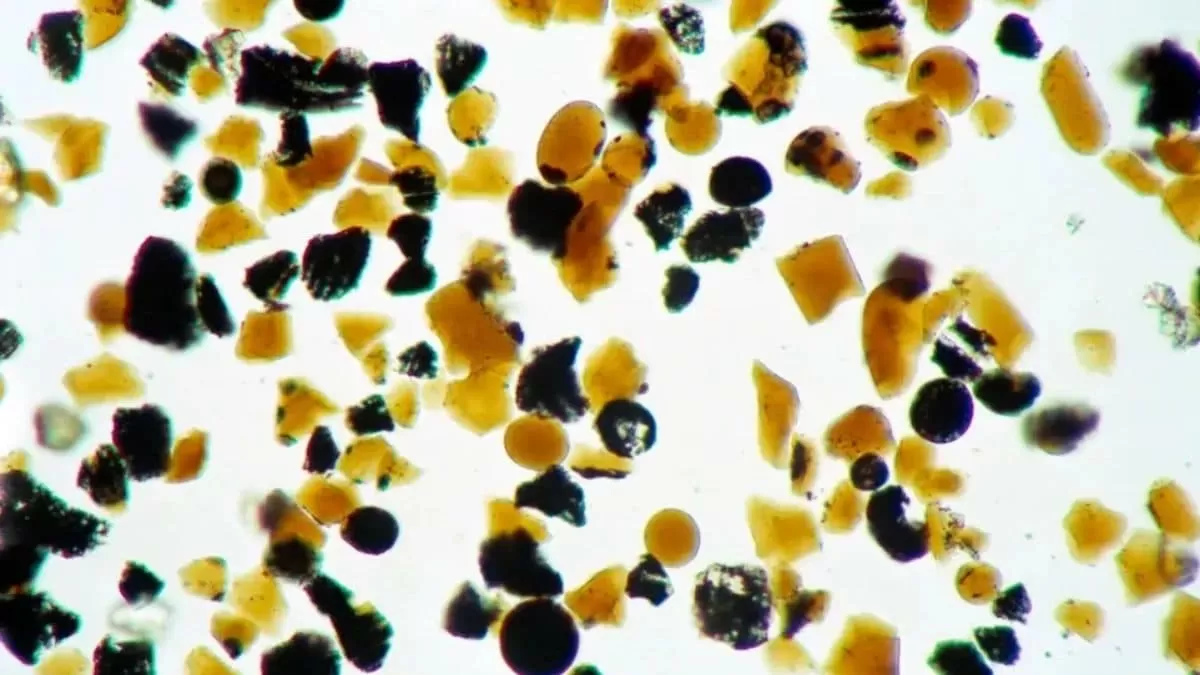
In a groundbreaking discovery, scientists have revealed the volcanic origins of tiny orange glass beads that were collected during the Apollo missions. These small but significant lava droplets have been preserved for over 3.5 billion years and offer crucial insights into the Moon’s fiery past and evolving geology. Through advanced analysis, researchers have been able to uncover changing volcanic activity and deep interior conditions from the Moon’s formative era.
The Apollo missions, which took place between 1969 and 1972, were a series of space missions conducted by NASA that aimed to explore the Moon and bring back samples for further study. These missions were a pivotal point in our understanding of the Moon and its history. Among the various samples collected, the tiny orange glass beads were often overlooked. However, with advancements in technology and research, these seemingly insignificant droplets have now revealed their true significance.
Initially, these beads were thought to be formed from the impact of meteorites hitting the lunar surface. But upon closer examination, the scientists discovered that they were actually formed from volcanic eruptions. These eruptions occurred during the Moon’s early years when it was still a hot and molten mass. As the Moon’s surface cooled and solidified, these lava droplets were trapped and preserved.
The analysis of these beads has shed light on the Moon’s volcanic activity and how it changed over time. By studying the composition and structure of the beads, scientists have been able to determine the type of volcanic eruptions that occurred on the Moon. This information has also allowed them to map out the locations of these eruptions, giving us a better understanding of the Moon’s surface.
Furthermore, the beads have also provided valuable insights into the Moon’s deep interior conditions. Through various techniques such as neutron activation analysis and electron microscopy, scientists have been able to study the chemical makeup of the beads. This has revealed the presence of rare elements such as titanium and zirconium, indicating that the Moon’s interior was rich in these elements during its early years.
By studying the orange glass beads, scientists have also been able to learn more about the Moon’s formation. It is believed that the Moon was formed from debris ejected from a collision between Earth and another celestial body. The presence of these beads and their composition has provided further evidence to support this theory.
The discovery of the volcanic origin of these tiny orange glass beads has opened up a whole new world of possibilities for lunar research. It has allowed scientists to delve deeper into the Moon’s past and understand its geological evolution. This newfound knowledge has also sparked new questions and avenues for further exploration.
With the advancements in technology and research, scientists will continue to push the boundaries of our understanding of the Moon. The study of these beads is just one small piece of the puzzle, but it has provided crucial insights into the Moon’s early years and its volcanic activity. This discovery is a testament to the power of scientific exploration and the endless possibilities it holds.
In conclusion, the tiny orange glass beads collected during the Apollo missions have proven to be a treasure trove of information. Through advanced analysis, scientists have been able to uncover the volcanic origin of these beads and unravel the mysteries of the Moon’s past. This discovery not only adds to our knowledge of the Moon but also inspires us to continue exploring and uncovering the secrets of our universe.
