

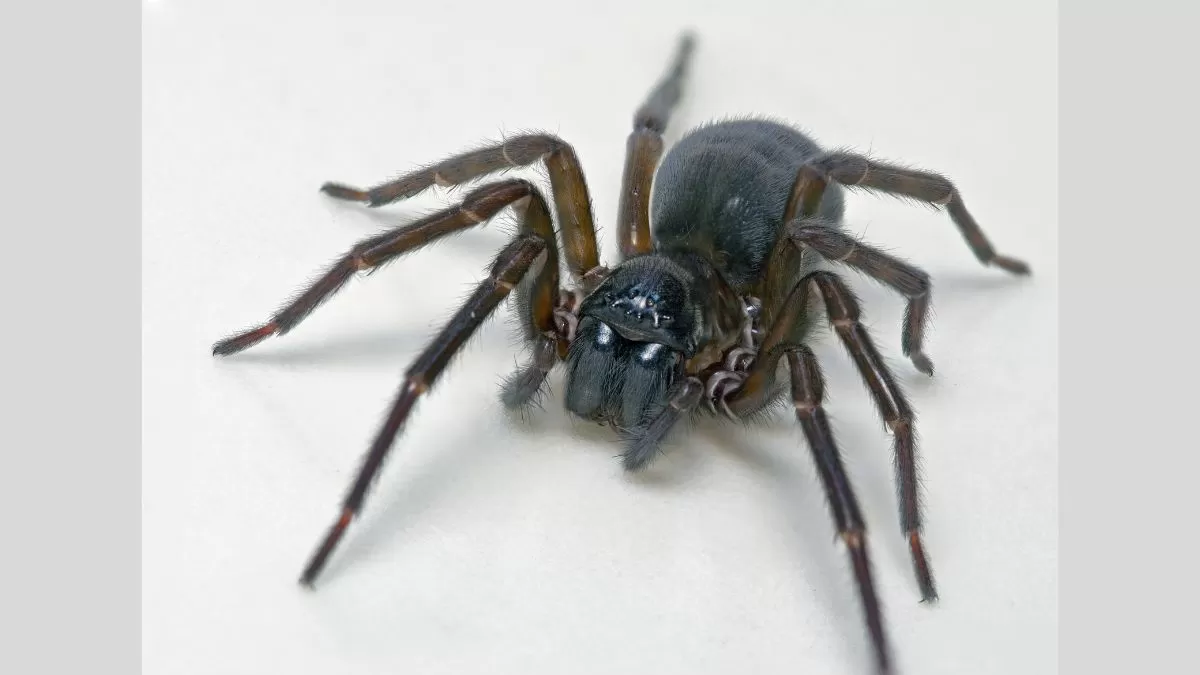
A recent study has uncovered a fascinating discovery about the feather-legged lace weaver spider. Contrary to popular belief, this spider does not inject venom into its prey. Instead, it uses a unique method of coating its prey with regurgitated toxins on silk, proving to be just as lethal as venom. This groundbreaking finding, published in BMC Biology, challenges our understanding of spider evolution and prey capture strategies.
The feather-legged lace weaver spider, also known as Uloborus plumipes, is a small, harmless-looking spider found in many parts of the world. It is known for its intricate webs, which are made of silk and have a distinct feather-like appearance. These spiders have long been considered harmless to humans, as they do not possess venom glands and ducts like other spiders.
However, a team of researchers from the University of Vienna and the University of Greifswald in Germany has discovered that the feather-legged lace weaver spider has a unique way of killing its prey. They observed that the spider would regurgitate digestive enzymes onto its silk, creating a toxic coating. When the prey, such as flies or other insects, get trapped in the web, they would come into contact with this toxic coating, leading to their death.
This method of prey capture is a game-changer in the world of spider biology. It challenges the long-held belief that spiders need venom to kill their prey. It also raises questions about the evolution of spiders and how they have adapted to different environments and prey.
Dr. Stanislav Gorb, one of the researchers involved in the study, explains, “This discovery is significant because it shows that spiders have evolved different strategies for capturing prey. The feather-legged lace weaver spider has found a way to be just as effective as venomous spiders, without actually having venom.”
The researchers also found that the regurgitated toxins on the silk of the feather-legged lace weaver spider are just as potent as venom. They tested the toxicity of the spider’s silk on fruit flies and found that it was just as deadly as venom from venomous spiders.
This finding also has implications for the medical field. The researchers believe that studying the toxins produced by the spider could lead to the development of new drugs or insecticides. The toxins may have properties that could be beneficial in treating diseases or controlling pest populations.
The study also sheds light on the complex and diverse world of spiders. It is estimated that there are over 45,000 species of spiders, each with its unique characteristics and behaviors. This discovery shows that there is still so much to learn about these fascinating creatures and their role in the ecosystem.
The feather-legged lace weaver spider’s unique method of prey capture also has implications for the survival of the species. As the world’s climate changes and habitats are destroyed, spiders, like many other species, are facing threats to their survival. This discovery highlights the importance of protecting and preserving these creatures and their habitats.
In conclusion, the recent study on the feather-legged lace weaver spider has revealed a groundbreaking discovery about its method of prey capture. By coating its prey with regurgitated toxins on silk, this spider has proven to be just as lethal as venomous spiders, challenging our understanding of spider evolution and prey capture strategies. This finding also has implications for the medical field and highlights the importance of protecting these fascinating creatures and their habitats. The world of spiders continues to surprise and amaze us, and this study is just one example of the many discoveries yet to be made.
