

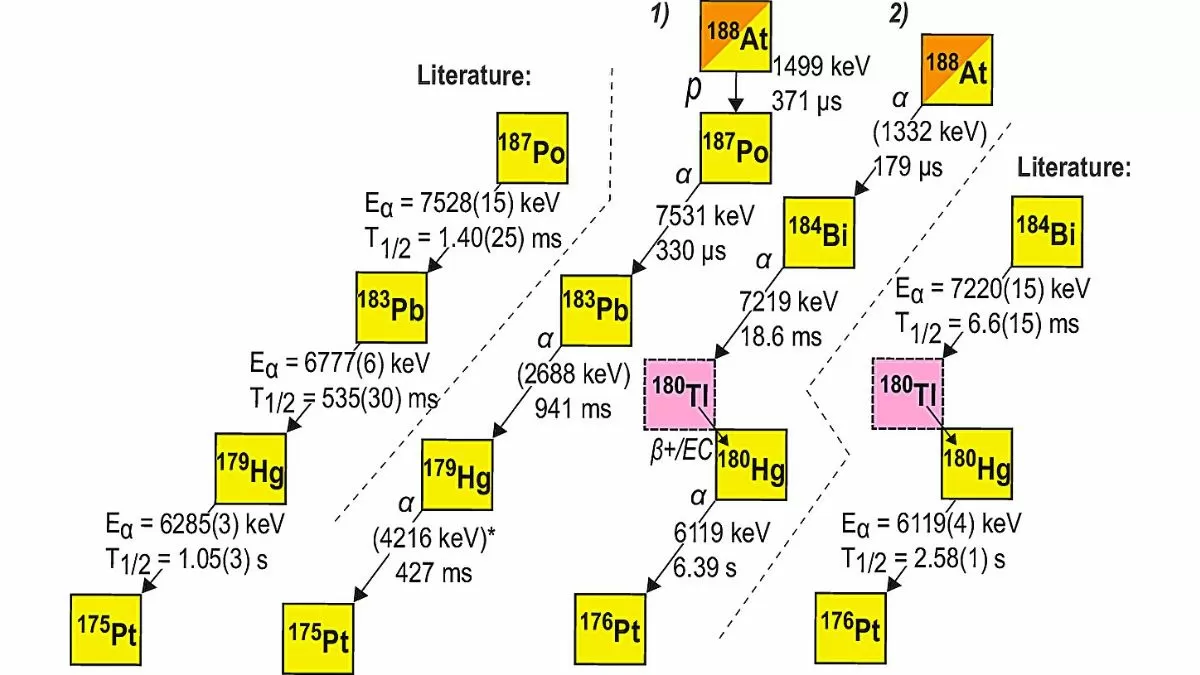
In a groundbreaking discovery, researchers at the University of Jyväskylä in Finland have identified astatine-188, the heaviest atomic nucleus known to undergo proton emission. This rare radioactive decay poses a challenge to established nuclear models and provides new insights into the structure and stability of exotic isotopes. The breakthrough, published in Nature Communications, marks a significant step forward in our understanding of the fundamental building blocks of matter.
Astatine-188, with an atomic number of 85, is a highly unstable element that exists for only a fraction of a second before decaying into other elements. It is one of the rarest and most elusive elements on Earth, with only a few grams produced each year through nuclear reactions. Due to its short half-life and extreme radioactivity, astatine-188 is difficult to study and its properties have been largely unknown.
However, a team of researchers led by Dr. Jari Konki and Dr. Juho Rissanen from the University of Jyväskylä’s Accelerator Laboratory have successfully observed astatine-188 undergoing proton emission, a phenomenon where a proton is released from the nucleus, transforming the element into a lighter one. This is the first time this decay mode has been observed in such a heavy nucleus, challenging previously established theories of nuclear structure and stability.
The discovery was made using a state-of-the-art experimental setup that allowed the team to produce and isolate astatine-188 atoms in a highly controlled environment. By analyzing the emitted protons, the researchers were able to determine the nuclear structure of astatine-188 and its decay properties.
This breakthrough not only sheds light on the behavior of astatine-188, but also has implications for the study of other heavy and unstable elements. The findings challenge the current understanding of nuclear structure and highlight the need for further research in this area.
According to Dr. Konki, “This discovery opens up a whole new avenue of research into the properties of heavy and exotic nuclei. Our findings will help us better understand the forces that hold atomic nuclei together and the mechanisms of radioactive decay.”
The study of exotic nuclei, such as astatine-188, is crucial for advancing our understanding of the universe. These elements play a vital role in the processes that occur within stars, including the production of heavier elements through nuclear fusion. They also have potential applications in fields such as nuclear medicine and energy production.
The identification of astatine-188’s proton emission also has practical implications. This rare decay mode has the potential to be harnessed for medical purposes, particularly in targeted alpha therapy, a type of cancer treatment that uses radioactive isotopes to destroy cancer cells.
The University of Jyväskylä’s research team is now focused on further studying astatine-188 and its decay properties, as well as exploring the potential applications of this discovery.
Commenting on the significance of the discovery, Dr. Rissanen said, “This is a major step forward in our understanding of the nuclear landscape and the properties of exotic nuclei. It is a testament to the dedication and expertise of our team and the cutting-edge technology we have at our disposal.”
The breakthrough at the University of Jyväskylä highlights the importance of continued research and exploration in the field of nuclear physics. With each new discovery, we gain a deeper understanding of the universe and its building blocks, paving the way for new technologies and advancements.
The identification of astatine-188’s proton emission is a remarkable achievement that will have far-reaching implications in the field of nuclear physics. It is a testament to the power of human curiosity and the endless possibilities of scientific exploration. With each new breakthrough, we come one step closer to unlocking the mysteries of the universe.
