

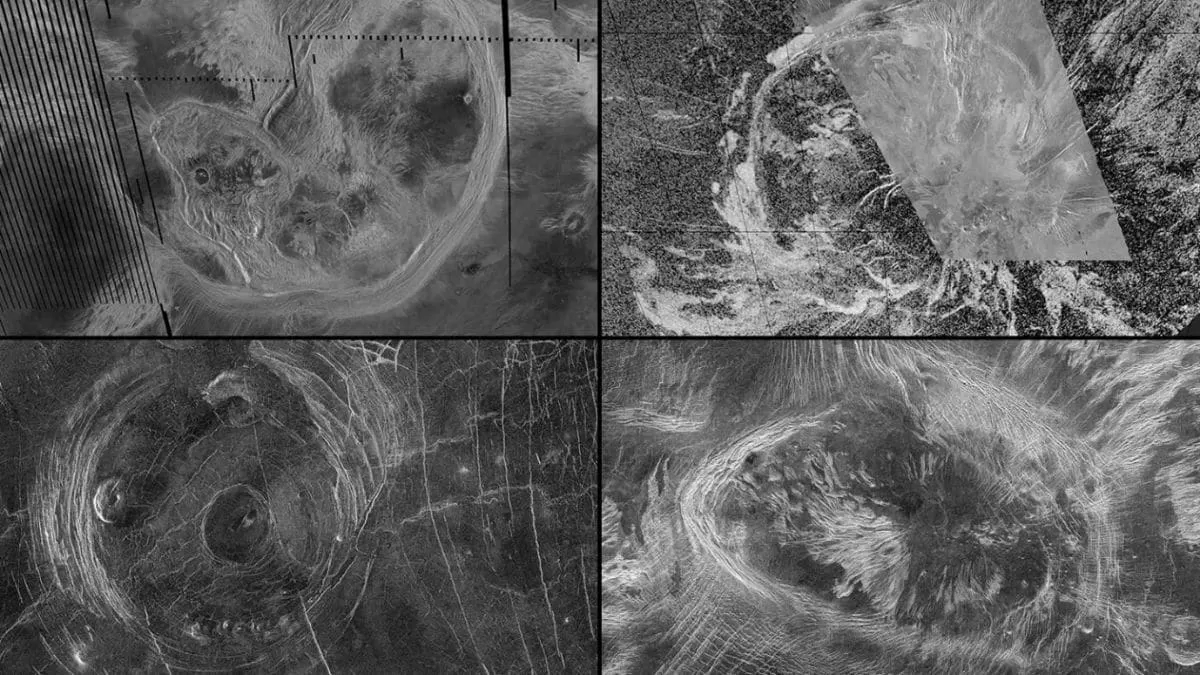
Venus has long been considered Earth’s “sister planet” due to its similar size and proximity to the Sun. However, while Earth is teeming with life and geological activity, Venus has often been thought of as a barren and lifeless world. But new findings using NASA’s Magellan data have challenged this notion, revealing that Venus may still be geologically alive and actively reshaping its surface.
For decades, scientists have debated whether Venus is a geologically active planet or if it has been dormant for billions of years. This debate was fueled by the lack of direct evidence of tectonic activity on Venus’ surface. However, a recent study using data from NASA’s Magellan spacecraft has provided compelling evidence that Venus is not geologically dead.
The Magellan spacecraft, which orbited Venus from 1990 to 1994, used radar to map the planet’s surface in unprecedented detail. This data has been revisited by a team of researchers led by Paul Byrne, a planetary geologist at North Carolina State University, to study the planet’s tectonic activity.
The team focused on a region of Venus known as the “Aphrodite Terra,” which is roughly the size of Africa and is characterized by a complex network of ridges and valleys. These features were previously thought to be the result of ancient tectonic activity, but the new study suggests otherwise.
Using computer simulations, the team found that the ridges and valleys in Aphrodite Terra could not have formed through ancient tectonic processes. Instead, they propose that these features are the result of subsurface plumes, or upwellings of hot material from the planet’s interior, pushing up against the surface.
This discovery is significant because it suggests that Venus may still have active tectonic processes, similar to those found on Earth. This is a groundbreaking finding, as it challenges the long-held belief that Venus is a geologically dead planet.
But what does this mean for future planetary exploration? The implications are immense. If Venus is indeed geologically active, it opens up a whole new realm of possibilities for studying the planet and its potential for habitability.
For one, it means that there may be a chance for liquid water to exist on Venus’ surface. This is a crucial factor in determining a planet’s potential for hosting life. With the discovery of subsurface plumes, there is a possibility that these plumes could bring heat and nutrients to the surface, creating a habitable environment for microbial life.
Furthermore, the presence of active tectonic processes on Venus could also explain the planet’s mysterious “missing water.” Venus is believed to have once had oceans, but they seem to have disappeared. The new findings suggest that the water may have been absorbed into the planet’s interior through these subsurface plumes, providing a possible explanation for its absence on the surface.
The study also has implications for our understanding of planetary evolution. If Venus is still geologically active, it means that the planet has not reached a state of “planetary death,” as previously thought. This challenges our current understanding of how planets evolve and raises questions about the future of our own planet.
The discovery of active tectonic processes on Venus also highlights the importance of continued exploration of our solar system. With each new mission, we gain a deeper understanding of our neighboring planets and their potential for life. This new finding on Venus is a testament to the power of scientific exploration and the need for continued investment in space exploration.
In conclusion, the new study using NASA’s Magellan data has provided compelling evidence that Venus is not a geologically dead planet. The discovery of subsurface plumes and their role in shaping the planet’s surface has challenged our previous understanding of Venus and opened up new possibilities for future exploration. This groundbreaking finding not only sheds light on the mysteries of Venus, but also has implications for our understanding of planetary evolution and the search for life beyond Earth. The future of Venus exploration is bright, and we can’t wait to see what other secrets this “sister planet” has in store for us.
