

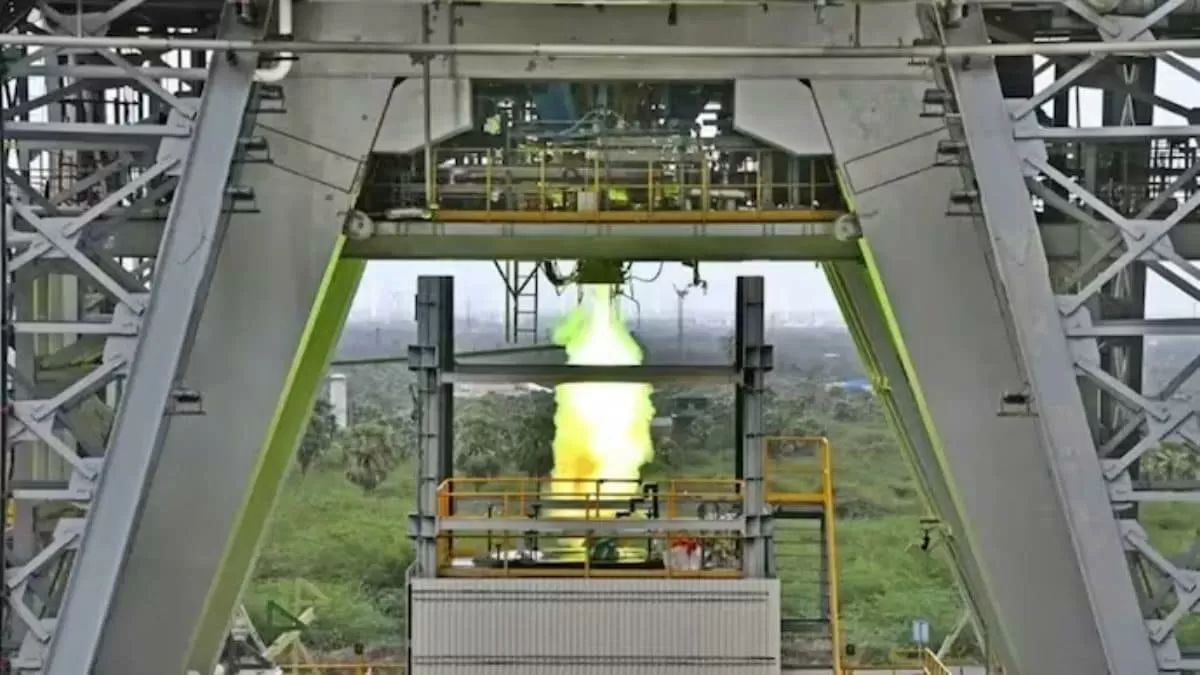
ISRO (Indian Space Research Organisation) has once again proven its mettle in the field of space technology with the successful third hot test of its SE2000 semi-cryogenic engine on May 28, 2025. The test was conducted at the ISRO Propulsion Complex in Mahendragiri, Tamil Nadu, and marked the final phase of a three-part series, validating the start-up sequence of the engine.
The SE2000 engine is a major breakthrough for ISRO as it uses liquid oxygen and kerosene in a staged combustion cycle, making it more efficient and powerful than its predecessors. This engine will power the upcoming SC120 stage of the LVM3 (Launch Vehicle Mark 3), which is set to enhance India’s capabilities in the field of space exploration.
The successful hot test of the SE2000 engine is a significant milestone for ISRO as it paves the way for the launch of the LVM3 and puts India on the global map as a major player in the space industry. The engine has been under development for the past few years and has undergone rigorous testing to ensure its reliability and performance.
The hot test, also known as the ‘static test’, is a crucial step in the development of any rocket engine. It involves firing the engine for a specific duration to simulate the conditions it will experience during an actual launch. The test is conducted in a controlled environment to gather data on the engine’s performance, stability, and efficiency.
The SE2000 engine performed flawlessly during the hot test, validating its start-up sequence and demonstrating its capability to handle extreme temperatures and pressures. The engine’s staged combustion cycle, which involves burning the fuel in two stages, proved to be highly efficient, resulting in better fuel consumption and increased thrust.
The SE2000 engine is a significant upgrade from the Vikas engine, which has been the workhorse of ISRO for decades. The Vikas engine uses a gas generator cycle, which is less efficient and has limited capabilities compared to the staged combustion cycle of the SE2000. With the successful hot test, ISRO has taken a giant leap towards developing more advanced and powerful rocket engines.
The SE2000 engine is a crucial component of the LVM3, which is ISRO’s most powerful launch vehicle to date. The LVM3 has a payload capacity of 8,000 kg to geostationary transfer orbit (GTO) and 10,000 kg to low Earth orbit (LEO), making it capable of launching heavier satellites and spacecraft into space. This will not only reduce India’s dependence on foreign launch services but also open up new opportunities for commercial launches.
The LVM3 is also a crucial step towards India’s ambitious Gaganyaan mission, which aims to send Indian astronauts to space by 2022. The SE2000 engine will power the SC120 stage of the LVM3, which will be responsible for the orbital insertion of the spacecraft. This will be a proud moment for India as it will become the fourth country in the world to send humans to space on its own.
The successful hot test of the SE2000 engine is a testament to the hard work and dedication of the scientists and engineers at ISRO. It is a result of years of research, development, and testing, which has put India at the forefront of space technology. The engine’s success is a reflection of ISRO’s commitment to continuously push the boundaries and achieve new milestones in the field of space exploration.
The SE2000 engine is a game-changer for ISRO and will play a crucial role in the future of India’s space program. Its advanced technology and enhanced capabilities will not only boost India’s space capabilities but also open up new avenues for research and development. With this engine, ISRO has taken a giant leap towards becoming a global leader in the space industry.
In conclusion, the successful third hot test of the SE2000 semi-cryogenic engine is a proud moment for India and ISRO. It marks a significant milestone in the development of advanced rocket engines and puts India on the path to becoming a major player in the space industry. With this engine, ISRO has once again proven its capabilities and reaffirmed its position as one of the leading space agencies in the world. The future looks bright for ISRO, and we can’t wait to see what they have in store for us next.
