

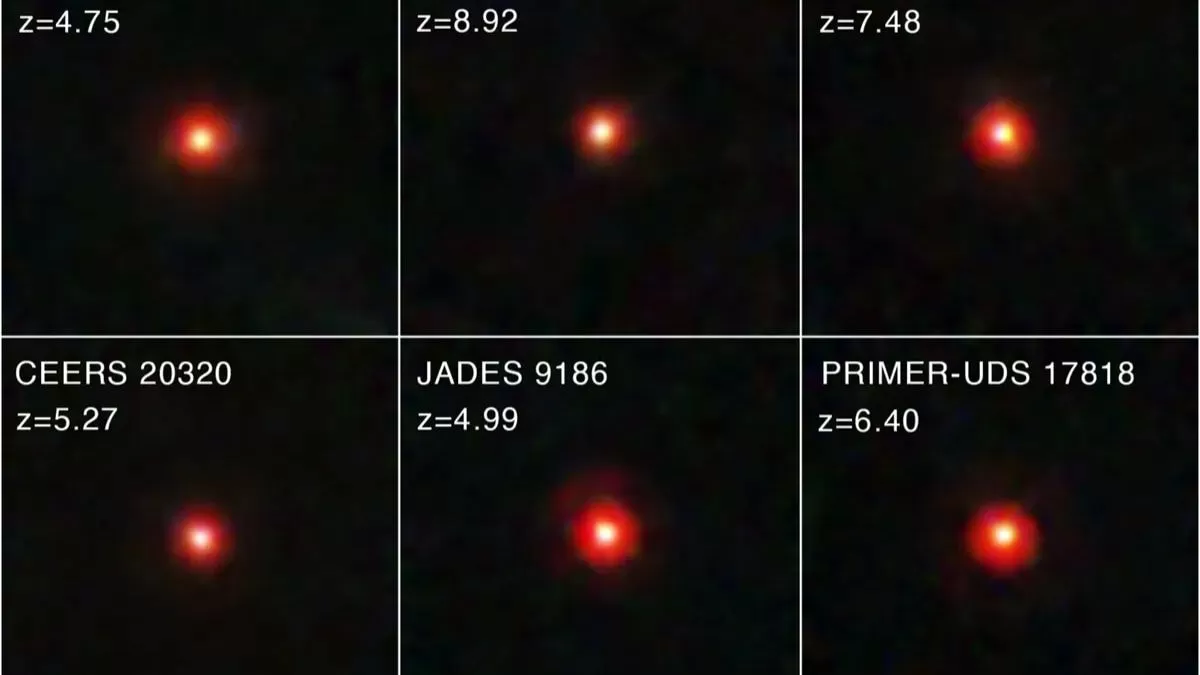
The universe is full of mysteries that continue to baffle scientists and astronomers. One of these mysteries involves the relationship between quasars and Little Red Dots, two cosmic phenomena that have long been studied and debated. However, thanks to new research using the James Webb Space Telescope, this cosmic mystery may soon be solved.
A study published on May 7, 2025, in arXiv has revealed a population of dust-obscured supermassive black holes in the early universe. This groundbreaking discovery was made possible by the advanced capabilities of the James Webb Space Telescope, which has been hailed as the most powerful and sophisticated telescope ever built.
Quasars are some of the brightest and most distant objects in the universe. They are believed to be powered by supermassive black holes at the center of galaxies, which are surrounded by a disk of hot gas and dust. As this material falls into the black hole, it emits intense radiation that can be seen across the entire universe.
On the other hand, Little Red Dots, also known as Lyman-alpha emitters, are small and distant galaxies that emit a specific type of light called Lyman-alpha radiation. These galaxies are thought to be in the early stages of formation and may eventually evolve into larger galaxies like our own Milky Way.
For years, scientists have been trying to understand the connection between quasars and Little Red Dots. Some theories suggest that quasars may be responsible for triggering the formation of Little Red Dots, while others propose that they are completely unrelated. But with the discovery of a population of dust-obscured supermassive black holes in the early universe, we may finally have an answer.
The study, led by a team of international astronomers, used the James Webb Space Telescope to observe a region of the sky known as the COSMOS field. This area, which is about 10 times the size of the full moon, contains thousands of galaxies, including quasars and Little Red Dots.
By analyzing the data collected by the telescope, the researchers were able to identify a group of galaxies that emit both Lyman-alpha radiation and infrared light, a telltale sign of dust-obscured supermassive black holes. This discovery suggests that quasars and Little Red Dots may indeed be connected, as the presence of these black holes could be responsible for the formation of both types of galaxies.
But what makes this study even more significant is that it provides a glimpse into the early universe, a time when galaxies were just beginning to form. By studying these dust-obscured supermassive black holes, we can gain a better understanding of how galaxies evolved and how they continue to evolve today.
The James Webb Space Telescope played a crucial role in this discovery, as its advanced instruments allowed astronomers to see further and with more clarity than ever before. It is equipped with a 6.5-meter primary mirror, which is three times larger than the Hubble Space Telescope’s mirror, and has the ability to observe in the infrared spectrum, making it ideal for studying dust-obscured objects.
This groundbreaking research has opened up a whole new avenue of study for astronomers, and it is just the beginning. With the James Webb Space Telescope now in operation, we can expect even more remarkable discoveries in the coming years.
The implications of this study go beyond just understanding the relationship between quasars and Little Red Dots. It also sheds light on the elusive nature of supermassive black holes and their role in shaping the universe. These black holes are believed to be the engines that drive the growth and evolution of galaxies, and by studying them, we can gain a better understanding of our own place in the universe.
The James Webb Space Telescope has proven to be an invaluable tool for unraveling the mysteries of the cosmos, and this latest discovery is a testament to its capabilities. As we continue to explore the vastness of space, we can only imagine what other secrets and wonders await us.
In conclusion, the cosmic mystery of how quasars and Little Red Dots relate may soon be solved, thanks to the groundbreaking research using the James Webb Space Telescope. This study has revealed a population of dust-obscured supermassive black holes in the early universe, providing a crucial piece of the puzzle in understanding the relationship between these two cosmic phenomena. With the James Webb Space Telescope at our disposal, we can look forward to many more exciting discoveries that will expand our knowledge and