

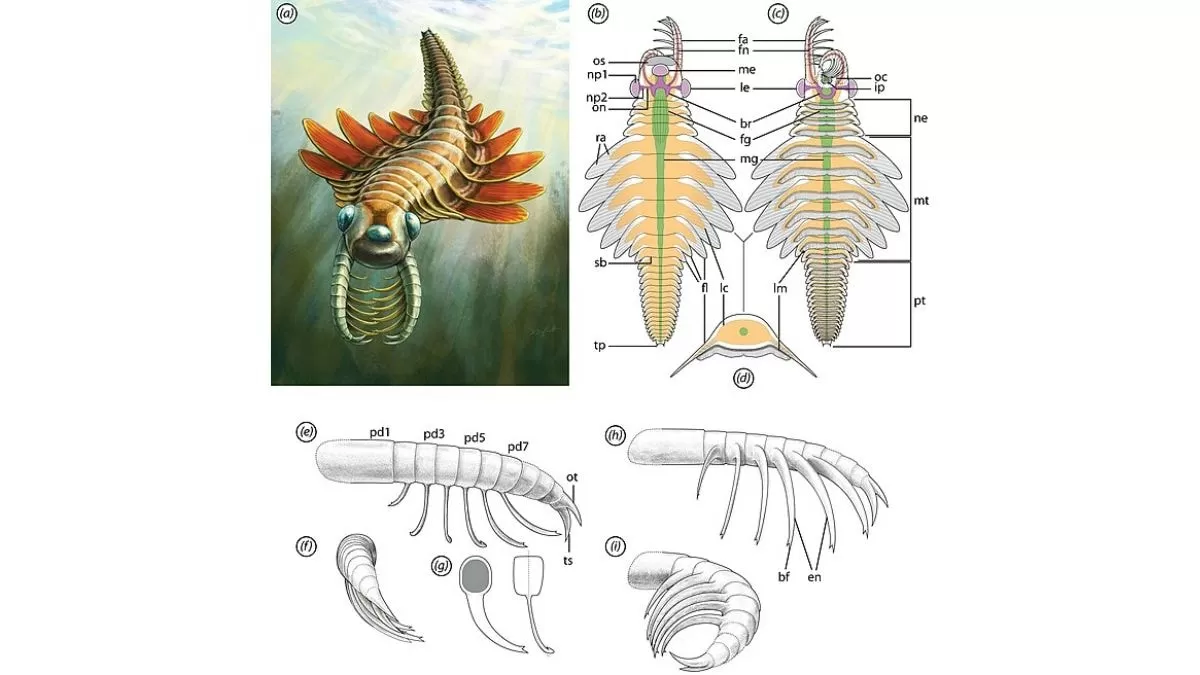
Paleontologists have made an exciting new discovery in the world of prehistoric creatures – the Mosura fentoni. This three-eyed, finger-sized marine predator lived half a billion years ago and has been found in museum fossil collections in Canada. Named after the Japanese monster Mothra, this ancient radiodont is shedding new light on the diversity of life during the Cambrian period.
The Mosura fentoni is a fascinating creature that has captured the attention of scientists and the public alike. Its unusual appearance and features make it stand out from other known species from that time period. This discovery is a testament to the importance of museum collections, which hold a wealth of information waiting to be uncovered.
This tiny predator was first discovered by a team of paleontologists from the Royal Ontario Museum and the University of Toronto. They were examining fossil collections from the Burgess Shale in Canada, a famous site known for its abundance of Cambrian fossils. The team was surprised to find a small, segmented creature with three eyes, which they had never seen before.
After careful examination and analysis, the team identified the creature as a new species and named it Mosura fentoni. The name is a nod to the Japanese monster Mothra, known for its similar segmented body and three eyes. The discovery of this new species is a testament to the creativity and imagination of scientists, who often draw inspiration from popular culture.
The Mosura fentoni is a member of the radiodonts, a group of arthropods that lived during the Cambrian period. These creatures were some of the earliest predators on Earth and played a crucial role in shaping the marine ecosystem during that time. What makes the Mosura fentoni unique is its highly segmented body, which gives it a worm-like appearance. It also has long gills on its rear, a feature that has not been seen in any other radiodont species.
One of the most intriguing theories about the Mosura fentoni is its adaptation to low-oxygen environments. During the Cambrian period, the Earth’s atmosphere had a significantly lower oxygen level compared to today. As a result, many creatures evolved unique ways to survive in these conditions. The long gills on the Mosura fentoni’s rear could have helped it breathe in these low-oxygen environments, giving it an advantage over other predators.
The discovery of the Mosura fentoni also sheds light on the diversity of life during the Cambrian period. This period, also known as the “Cambrian explosion,” was a time of rapid evolution and diversification of life on Earth. The discovery of a new species like the Mosura fentoni adds to the growing list of unique and fascinating creatures that lived during this time.
The Mosura fentoni’s discovery also highlights the importance of museum collections in scientific research. These collections hold a vast amount of information and specimens that can provide valuable insights into the Earth’s history. Without these collections, this tiny predator may have never been discovered, and our understanding of the Cambrian period would have been incomplete.
The Mosura fentoni is a testament to the resilience and adaptability of life on Earth. It also serves as a reminder that there is still so much more to be discovered and learned about our planet’s past. This discovery has sparked excitement and curiosity among scientists and the public, and it will undoubtedly lead to further research and discoveries in the future.
In conclusion, the Mosura fentoni is a fascinating and significant discovery in the world of paleontology. Its unique features and adaptation to low-oxygen environments make it a valuable addition to the list of known Cambrian creatures. This discovery also highlights the importance of museum collections and serves as a reminder that there is still so much more to uncover about our planet’s history. The Mosura fentoni is a true testament to the wonders of the natural world and the endless possibilities of scientific exploration.
