

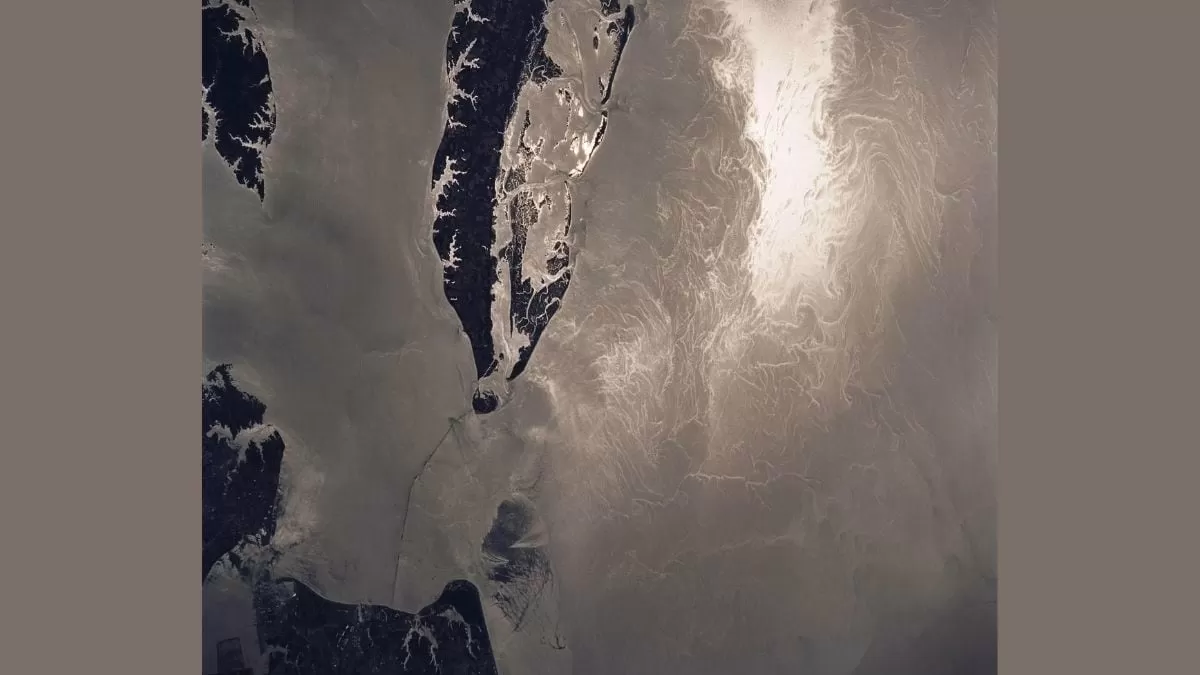
NASA’s SWOT satellite, in collaboration with CNES, has recently made a groundbreaking discovery that is reshaping our understanding of the ocean and its impact on our planet. The satellite, equipped with advanced technology, has revealed how submesoscale ocean features, as small as just a mile wide, play a crucial role in driving vital vertical circulation. These tiny currents, previously unnoticed, are responsible for transporting heat, carbon, and nutrients, and have a profound influence on marine ecosystems and climate systems.
The SWOT (Surface Water and Ocean Topography) mission, a joint effort between NASA and CNES, was launched in 2020 with the aim of providing high-resolution data on the world’s oceans. The satellite uses a state-of-the-art radar system to measure the height of the ocean’s surface, allowing scientists to map the intricate details of the ocean’s topography. This data has already proven to be a game-changer in our understanding of the ocean’s dynamics.
One of the most significant findings of the SWOT mission is the role of submesoscale ocean features in driving vertical circulation. These features, which were previously thought to be insignificant, are now recognized as crucial players in the ocean’s complex circulation patterns. The satellite’s high-resolution data has revealed that these small currents, just a mile wide, are responsible for transporting heat, carbon, and nutrients from the surface to the deep ocean and vice versa.
This discovery has far-reaching implications for our understanding of marine ecosystems and climate systems. The ocean is a vital component of our planet’s climate, and any changes in its circulation patterns can have a significant impact on the Earth’s climate. The SWOT mission’s data is providing scientists with a better understanding of how these submesoscale features influence ocean-atmosphere interactions, which will help in developing more accurate climate models.
The satellite’s data has also shed light on the role of these small currents in the ocean’s carbon cycle. Carbon is a crucial element in regulating the Earth’s climate, and the ocean plays a significant role in absorbing and storing carbon. The SWOT mission’s data has revealed that these submesoscale features are responsible for transporting carbon from the surface to the deep ocean, where it is stored for long periods. This finding has significant implications for our understanding of the ocean’s role in mitigating the effects of climate change.
Moreover, the SWOT mission’s data is also providing valuable insights into the ocean’s nutrient transport. Nutrients are essential for the growth and survival of marine organisms, and the ocean’s circulation patterns play a crucial role in distributing these nutrients. The satellite’s high-resolution data has revealed that these submesoscale features are responsible for transporting nutrients from the deep ocean to the surface, where they support the growth of phytoplankton, the base of the marine food chain.
The SWOT mission’s findings have opened up new avenues for research and have challenged previous assumptions about the ocean’s dynamics. Scientists are now working to incorporate this new data into their models to develop a more accurate understanding of the ocean’s role in the Earth’s climate system. This will not only improve our understanding of the ocean but also help in predicting and mitigating the effects of climate change.
The SWOT mission’s high-resolution data is also proving to be a valuable tool for oceanographers and marine biologists. The detailed maps of the ocean’s topography are providing a better understanding of the distribution of marine life and their habitats. This data is crucial for the conservation and management of marine resources, as well as for understanding the impact of human activities on the ocean.
In addition to its scientific significance, the SWOT mission is also a testament to the power of international collaboration. The joint effort between NASA and CNES has resulted in groundbreaking discoveries that would not have been possible without their combined expertise and resources. This mission serves as a reminder of the importance of global cooperation in tackling complex scientific challenges.
In conclusion, NASA’s SWOT satellite, in collaboration with CNES, has revealed the critical role of submesoscale ocean features in driving vital vertical circulation. These small currents, just a mile wide, transport heat, carbon, and nutrients, and have a profound influence on marine ecosystems and climate systems. The mission’s high-resolution data is reshaping our understanding of the ocean and its impact on our planet, and is providing valuable insights for future research. The SWOT mission is a testament to the power of technology and international collaboration, and its
