

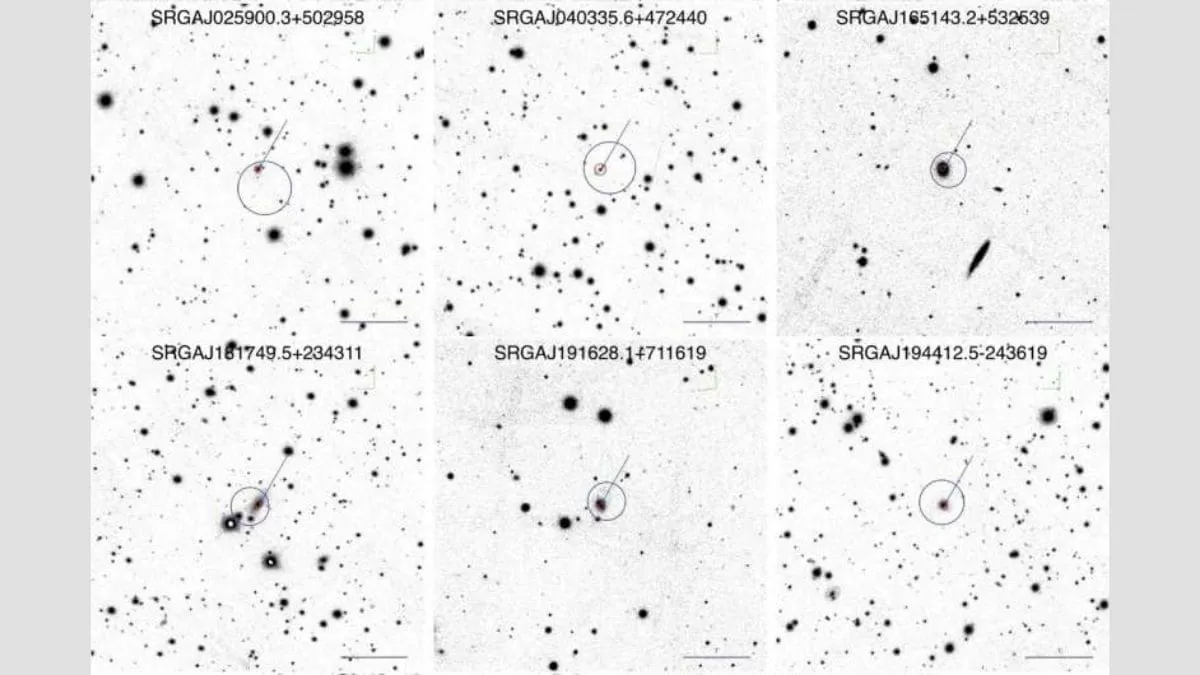
In a major breakthrough for extragalactic astronomy, a team of researchers from the Russian Academy of Sciences has discovered 11 new active galactic nuclei (AGNs) using the ART-XC telescope aboard the Spektr-RG space observatory. These findings are a significant contribution to our understanding of the universe and its evolution.
Active galactic nuclei are some of the most energetic and luminous objects in the universe. They are powered by a supermassive black hole at the center of a galaxy, which accretes matter and emits powerful radiation. AGNs come in various forms, with Seyfert galaxies being one of the most common types. These galaxies are characterized by their strong emission lines, indicating the presence of an active nucleus.
The team used the ART-XC telescope, which is designed to detect X-rays from space, to study a sample of Seyfert galaxies. The telescope is part of the Spektr-RG space observatory, a joint mission between Russia and Germany. Launched in July 2019, the observatory is designed to survey the entire sky in X-rays, providing a wealth of information about the universe.
The researchers focused on the X-ray emission from these Seyfert galaxies, as it is a crucial indicator of the presence of an active nucleus. They found that all 11 galaxies displayed X-ray luminosities typical for the present cosmic epoch, indicating that they are actively accreting matter onto their central black holes. This is an exciting discovery, as it confirms that the universe is still evolving and that these AGNs are a crucial part of this process.
Furthermore, the team found that the redshifts of these newly identified AGNs range from 0.028 to 0.258. Redshift is a measure of the expansion of the universe, and a higher redshift indicates that the object is farther away and therefore, observed at an earlier stage in the universe’s history. This means that these AGNs were more active in the past and have now entered a quiescent phase. This finding provides valuable insights into the evolution of these galaxies and their central black holes.
The discovery of these 11 new AGNs is a testament to the capabilities of the ART-XC telescope and the Spektr-RG observatory. The telescope’s high sensitivity and wide field of view allowed the researchers to detect these faint objects and study them in detail. This achievement highlights the importance of international collaborations and the advancement of cutting-edge technology in pushing the boundaries of scientific research.
The team’s findings have been published in the journal Astronomy Letters, and Dr. Alexander Lutovinov, the lead author of the study, expressed his excitement, saying, “This is a significant step forward in our understanding of active galactic nuclei and their role in the evolution of the universe. The ART-XC telescope has enabled us to study these objects in great detail, and we hope to make many more exciting discoveries in the future.”
The discovery of these 11 new AGNs opens up a whole new window into the universe, allowing us to study these powerful objects and their influence on their host galaxies. These findings will pave the way for further research and help unravel the mysteries of the universe.
With the Spektr-RG observatory and the ART-XC telescope, we have only just scratched the surface of what lies beyond our own galaxy. As we continue to explore and learn more about the universe, we are sure to make many more groundbreaking discoveries that will advance our understanding of the cosmos. This is an exciting time for extragalactic astronomy, and we can’t wait to see what the future holds.
