

Neutron stars are some of the most fascinating and mysterious objects in our universe. These incredibly dense remnants of stellar explosions are packed with matter, yet they are only the size of a city. But despite their small size, neutron stars have a huge impact on the cosmos, and scientists have been studying them for decades in order to unlock their secrets.
Recently, a new study has shed light on a previously unknown aspect of neutron stars – their magnetic fields. This study, conducted by a team of researchers at the University of Illinois at Urbana-Champaign, has revealed that these magnetic fields may play a much bigger role in neutron star mergers than previously thought. In fact, their influence could potentially change our understanding of these cosmic events and open new doors for future research.
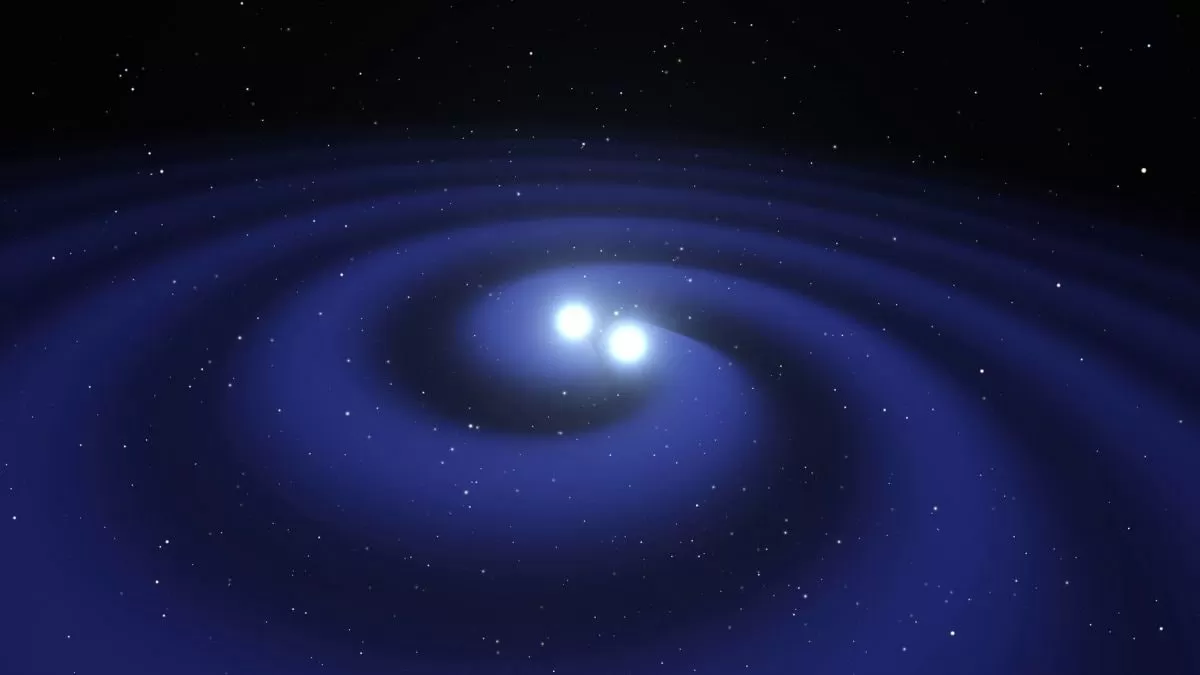
Neutron star mergers occur when two of these incredibly dense objects come together, either through a collision or by spiraling into each other. These events are incredibly violent, releasing vast amounts of energy in the form of gravitational waves – ripples in the fabric of spacetime predicted by Albert Einstein’s theory of general relativity.
Until now, scientists have mostly focused on studying the gravitational wave signals emitted during these mergers in order to better understand the properties of neutron stars. But this new study has revealed that magnetic fields may also have a significant impact on the post-merger signals and could provide valuable insights into the internal structure and evolution of neutron stars.
Using advanced simulations, the researchers were able to show that the magnetic fields in neutron stars can shift or suppress the oscillation frequencies of the merged object. These oscillation frequencies are like the “heartbeats” of the merged neutron star, and they produce gravitational waves that can be detected by instruments on Earth. By altering these frequencies, the magnetic fields can change the gravitational wave signatures, making it more challenging for astronomers to decode them.
This discovery has significant implications for our understanding of neutron stars and their mergers. It means that scientists may have to take into account the influence of magnetic fields when analyzing gravitational wave signals from these events. This could also lead to refinements in our models of neutron star interiors, mass, and evolution.
One of the lead researchers, Professor Stuart Shapiro, explains the significance of this discovery: “Neutron stars are incredibly complex objects, and we are only scratching the surface of understanding them. This study shows that magnetic fields play a crucial role in these mergers and can significantly affect the gravitational wave signals. It’s like finding a missing piece of the puzzle and realizing that it changes the whole picture.”
The findings of this study not only have implications for neutron star mergers but also for other astrophysical phenomena involving strong magnetic fields, such as black hole mergers and supernovae explosions. They also highlight the importance of using advanced simulations to study these events, as they allow scientists to explore complex physical processes that cannot be observed directly.
The results of this study have been published in the prestigious scientific journal, Physical Review Letters, and have already received praise from the scientific community. Dr. Tanja Hinderer, a gravitational wave astrophysicist at the Max Planck Institute for Gravitational Physics, commented, “This is a very exciting discovery that could have far-reaching implications for our understanding of neutron stars and the universe as a whole.”
As we continue to push the boundaries of our knowledge and technology, studies like this one remind us that there is still so much to learn about the vast and mysterious cosmos. With each new discovery, we get closer to unraveling the mysteries of the universe and understanding our place within it.
In conclusion, the new study on the role of magnetic fields in neutron star mergers has opened up a whole new avenue of research and has the potential to revolutionize our understanding of these cosmic events. It serves as a reminder of the power and complexity of the universe and the endless possibilities for discovery that lie ahead.
