

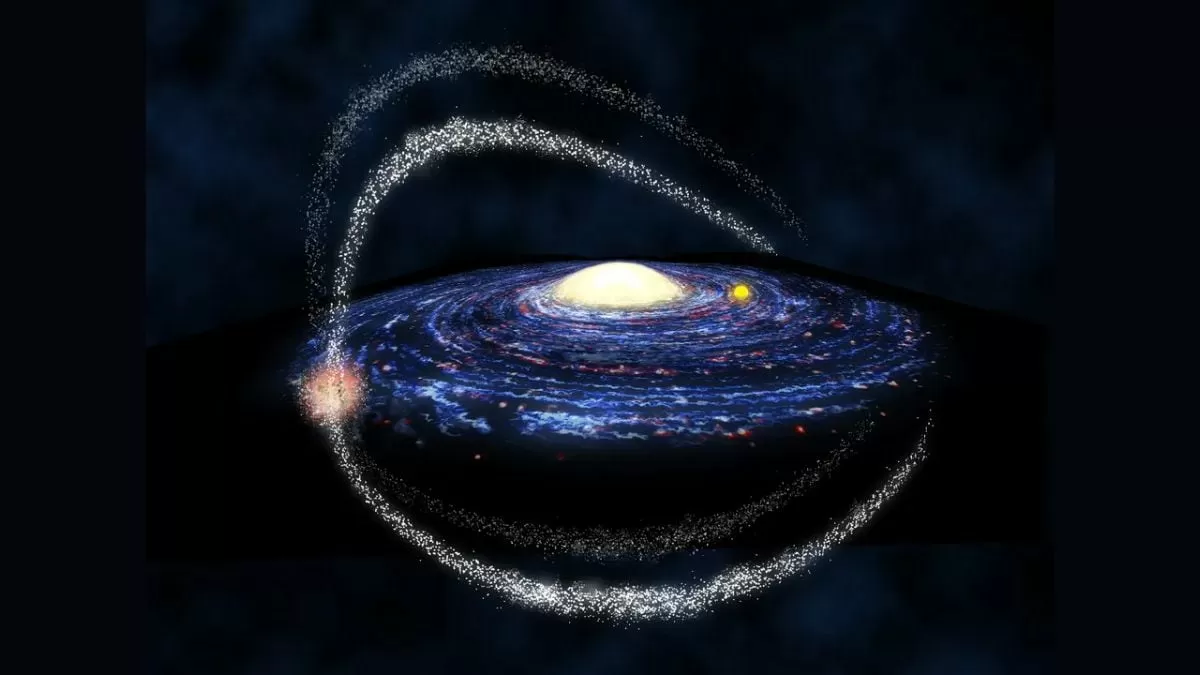
Astronomers have made an incredible discovery that could change our understanding of the universe. Using powerful radio telescopes, they have spotted a massive hydrogen cloud near the Milky Way that may be a rare dark galaxy. This object is composed of gas and dark matter, but unlike traditional galaxies, it lacks stars and light. This finding challenges conventional astronomy and has the potential to reveal hidden phases of galaxy formation and dark matter interaction in the local universe.
The discovery of this dark galaxy was made by a team of astronomers from the University of California, Irvine, and the University of California, Los Angeles. They were conducting a survey of the Milky Way’s outskirts when they stumbled upon this mysterious cloud of gas. At first, they thought it was just a regular gas cloud, but upon further investigation, they realized it was something much more intriguing.
Dark galaxies are a relatively new concept in the world of astronomy. They were first proposed in the 1970s, but it wasn’t until the 1990s that the first one was discovered. These objects are thought to be made up of dark matter, a mysterious substance that makes up about 85% of the universe’s mass but cannot be directly observed. Dark matter is believed to play a crucial role in the formation and evolution of galaxies, but its exact nature is still a mystery.
What makes this discovery even more exciting is that this dark galaxy is located in our own cosmic backyard. It is only 30 million light-years away from Earth, making it one of the closest dark galaxies ever detected. This proximity gives astronomers a unique opportunity to study this object in detail and gain a better understanding of its properties.
One of the most intriguing aspects of this dark galaxy is its size. It is estimated to be about the same size as the Milky Way, which is about 100,000 light-years across. However, unlike our galaxy, which is filled with billions of stars, this dark galaxy appears to be devoid of any stars. This raises the question of how such a massive object can exist without any visible light sources.
The team of astronomers believes that this dark galaxy may have gone through a phase of intense star formation in the past, but for some reason, it stopped. This could be due to a lack of gas or some other unknown factor. Whatever the reason may be, this discovery challenges our current understanding of galaxy formation and evolution.
Furthermore, this dark galaxy could also provide valuable insights into the nature of dark matter. By studying its properties and interactions with regular matter, astronomers may be able to shed light on the elusive nature of dark matter. This could have significant implications for our understanding of the universe and its evolution.
The discovery of this dark galaxy also highlights the importance of using different techniques and instruments in astronomy. While traditional telescopes can only detect objects that emit light, radio telescopes can pick up signals from objects that do not emit any visible light. This allows astronomers to study a whole new realm of the universe and make groundbreaking discoveries like this one.
The team of astronomers is now planning to conduct further observations of this dark galaxy to gather more data and insights. They also hope to find more dark galaxies in the future, which could provide even more clues about the nature of dark matter and its role in the universe.
In conclusion, the discovery of this massive hydrogen cloud near the Milky Way that may be a rare dark galaxy is a significant breakthrough in the field of astronomy. It challenges our current understanding of galaxy formation and could potentially reveal hidden phases of galaxy evolution and dark matter interaction. This discovery highlights the importance of pushing the boundaries of our knowledge and using innovative techniques to explore the vastness of the universe. With further research and observations, we may finally unravel the mysteries of dark matter and gain a deeper understanding of our place in the cosmos.
