

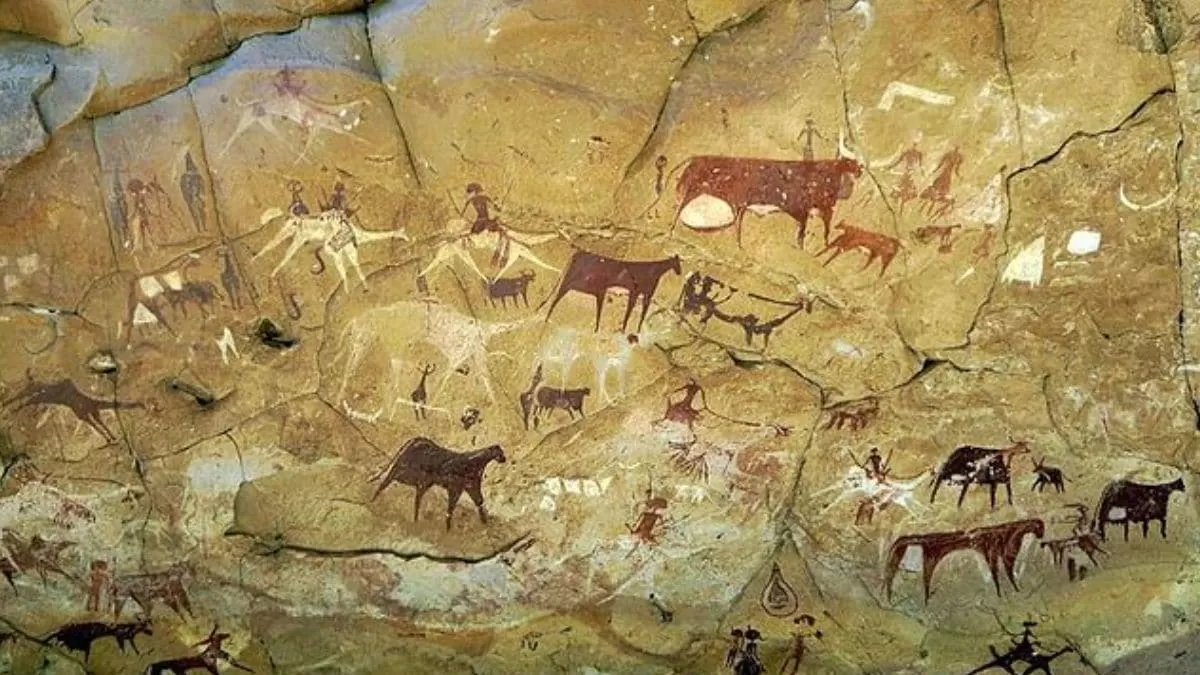
The Sahara desert, known for its vast expanse of arid land and scorching temperatures, has always been considered a harsh and uninhabitable place. However, recent findings have challenged this notion and shed light on the existence of a lush green habitat in the Sahara, dating back 7000 years. This discovery, made possible through the analysis of ancient DNA, has provided evidence of a thriving savannah in the Sahara, during what is known as the African humid period. Not only does this discovery change our perception of the Sahara, but it also gives us a glimpse into the lives of our ancestors and their connection to this once green landscape.
The African humid period, also known as the African green period, was a time in the Earth’s history when the Sahara was transformed into a fertile and humid region due to changes in the Earth’s orbit and tilt. This period lasted for about 7000 years, from 11,000 to 4,000 years ago, and was characterized by increased rainfall and vegetation growth in the Sahara. It is during this time that the ancient DNA, recently analyzed, was found in the Sahara, providing valuable insight into the lives of the people who inhabited this region.
The analysis of the DNA, which was extracted from human remains found in the Sahara, revealed that the individuals belonged to a group of people who practiced pastoralism. Pastoralism is a form of agriculture where people rely on the rearing of livestock for their livelihood. This discovery is significant as it not only gives us an understanding of the lifestyle and practices of these ancient people but also establishes a clear link between them and the modern-day North Africans who still practice pastoralism.
The DNA analysis also revealed that these individuals had a genetic affinity with modern-day populations in North Africa, further solidifying the connection between these ancient people and their descendants. This suggests that the people who inhabited the Sahara during the African humid period were not isolated, but rather had contact and possibly even interbred with other populations in the region. This finding challenges the long-held belief that the Sahara acted as a barrier, separating different populations in Africa.
Moreover, the discovery of pastoralism in the Sahara during this period also has implications for our understanding of the spread of agriculture in Africa. It has long been believed that agriculture originated in the fertile regions of the Nile and the Near East and then spread to other parts of Africa. However, the presence of pastoralism in the Sahara during the African humid period suggests that agriculture may have developed independently in different regions of Africa, including the Sahara.
The existence of a lush green habitat in the Sahara during the African humid period not only changes our perception of the region but also has broader implications for our understanding of human history. It shows that our ancestors were adaptable and resilient, able to thrive in even the most challenging environments. It also highlights the importance of studying ancient DNA as it provides valuable insights into our past and helps us piece together the puzzle of human evolution.
This discovery also has important implications for the present and the future. It serves as a reminder of the impact that climate change can have on our planet and the potential for drastic changes in landscapes and ecosystems. It also emphasizes the resilience of nature and the possibility of life adapting and flourishing in unexpected places.
In conclusion, the analysis of the old DNA found in the Sahara, dating back 7000 years, has provided clear evidence of a lush green habitat in the Sahara during the African humid period. This discovery challenges our perception of the Sahara as an uninhabitable desert and sheds light on the lives of our ancestors who lived in this region. It also establishes a clear link between these ancient people and their modern-day descendants, providing valuable insight into human history. This discovery serves as a reminder of the resilience of nature and the importance of studying our past to understand our present and shape our future.
