

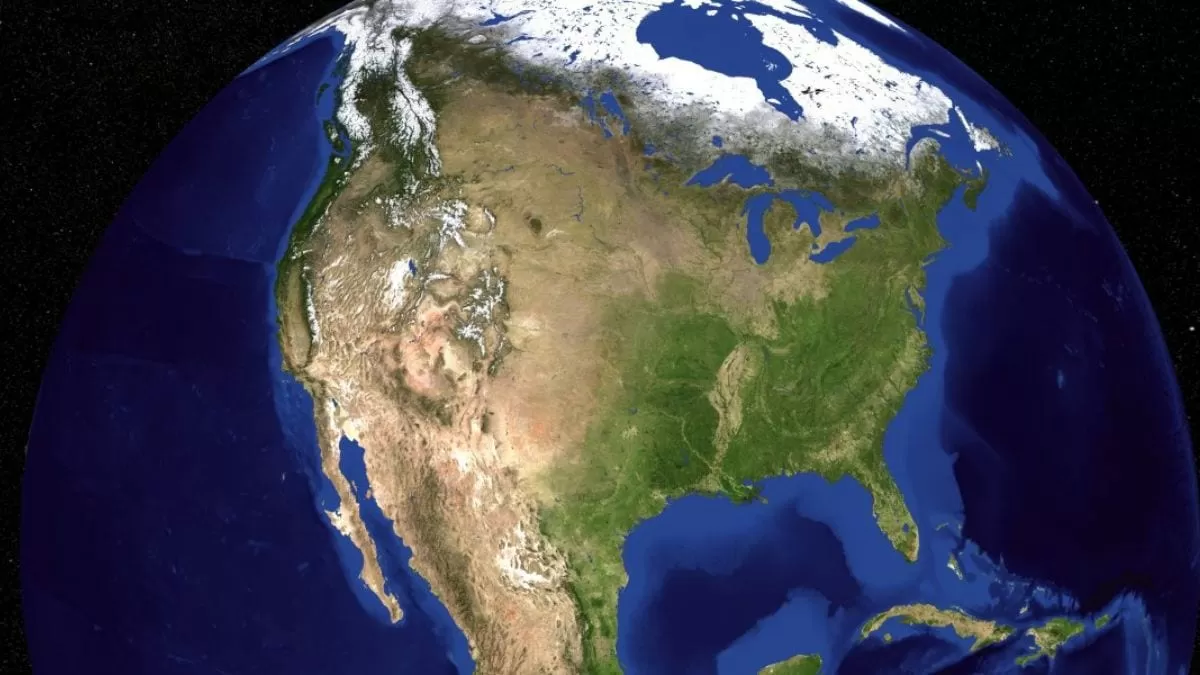
A recent discovery by researchers has shed light on a fascinating geological phenomenon occurring deep beneath the surface of the central United States. A tectonic slab, buried 660km below the Earth’s crust, has been found to be pulling surface materials downward, causing the crust to thin across a wide region. This discovery has not only provided a better understanding of the Earth’s structure, but also has implications for the future of the Midwest and beyond.
The slab in question is a remnant of the Farallon plate, which was once a large oceanic plate that existed between the Pacific and North American plates. As the Farallon plate subducted beneath the North American plate millions of years ago, it left behind fragments of itself, including this particular slab buried deep beneath the central US.
Through the use of advanced seismic imaging and simulations, researchers have been able to identify this underground movement and its effects on the Earth’s crust. The results have been astounding, with the slab’s downward pull causing the crust to thin over a wide area. This has led to changes in the landscape and has even affected the movement of tectonic plates in the region.
But the impact of this discovery extends far beyond the Midwest. The movement of the tectonic slab has been found to be reshaping the Earth’s crust in other parts of the world as well. This has significant implications for our understanding of plate tectonics and the forces that shape our planet.
One of the most interesting aspects of this discovery is the fact that the slab is buried so deep beneath the surface. At a depth of 660km, it is almost impossible to directly observe or study. However, through the use of advanced technology and techniques, researchers have been able to gain a better understanding of this hidden geological activity.
The findings of this study have also raised questions about the future of the Midwest and other regions affected by this underground movement. Will the thinning of the crust lead to increased seismic activity? Will it have an impact on the stability of the region? These are important questions that will need to be addressed in the coming years.
But for now, this discovery is a testament to the power of scientific research and the advancements in technology that allow us to delve deeper into the mysteries of our planet. It is a reminder that there is still so much to learn about the Earth and its complex systems.
The researchers involved in this study are excited about the potential for further discoveries and the impact it could have on our understanding of the Earth’s structure. They hope that this will inspire others to continue exploring and uncovering the secrets of our planet.
In conclusion, the discovery of a tectonic slab buried 660km beneath the central US is a significant breakthrough in the field of geology. It has provided valuable insights into the Earth’s structure and has the potential to shape our understanding of plate tectonics. This underground movement has far-reaching effects and has the potential to reshape the landscape in the Midwest and beyond. It is a testament to the power of scientific research and the endless possibilities that lie beneath the surface of our planet.
