

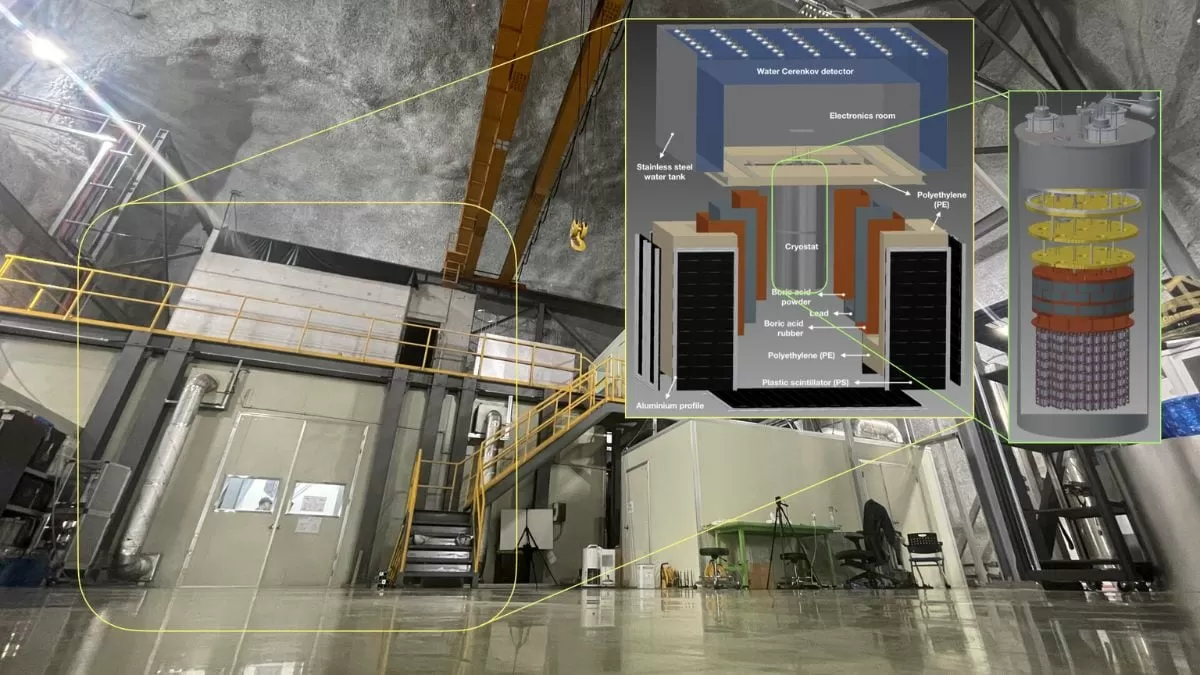
The study of neutrinos, the elusive and mysterious particles that make up much of the universe, has long been a source of fascination for scientists. Neutrinoless double beta decay, a rare nuclear process that could shed light on the nature of neutrinos, has been the focus of intense research for decades. The AMoRE (Advanced Mo-based Rare process Experiment) collaboration, comprised of scientists from around the world, has made significant progress in advancing our understanding of this intriguing phenomenon.
The latest breakthrough from the AMoRE experiment comes in the form of refined limits on neutrinoless double beta decay using molybdenum-100. This is a huge milestone for the AMoRE collaboration, as it represents a major step towards unlocking the secrets of neutrinos and their role in the universe.
The first phase of the AMoRE experiment, AMoRE-I, was completed at the Yangyang Underground Laboratory (YUL) in South Korea. This phase utilized a molybdenum-100-based detector to search for signs of neutrinoless double beta decay. The results were impressive; AMoRE-I set a new upper limit on the decay halflife, pushing the boundaries of our knowledge in this field. However, no clear signal of the decay was observed.
Undeterred by this outcome, the AMoRE collaboration has continued to push forward. The next phase, AMoRE-II, is now being developed at the Yemilab facility in South Korea. This phase will build upon the success of AMoRE-I, utilizing enhanced detection systems to further explore this rare nuclear process.
One of the key improvements in AMoRE-II is the use of molybdenum crystals enriched to 97% with molybdenum-100. This will increase the sensitivity of the detector, allowing for even more precise measurements. In addition, new light detection systems and a larger number of detectors will be implemented, providing an unprecedented level of accuracy and control in the study of neutrinoless double beta decay.
The advancements in the AMoRE-II experiment are not limited to technical improvements. The Yemilab facility, located 700 meters below the Earth’s surface, offers an ideal environment for conducting this type of research. The depth of the laboratory shields the detectors from cosmic rays and other background radiation, providing a clean and controlled environment for the experiment to take place.
The AMoRE-II experiment is expected to begin taking data in 2022 and will run for approximately two years. This data will then be analyzed to search for any signs of neutrinoless double beta decay. The ultimate goal is to observe the decay and measure its half-life, which could provide valuable clues about the nature of neutrinos and their role in the universe.
The AMoRE collaboration is not working in isolation; they are part of a larger worldwide effort to unlock the mysteries of neutrinos and neutrinoless double beta decay. This includes collaborations with other underground laboratories such as Gran Sasso in Italy and SNOLAB in Canada. By pooling their resources and expertise, scientists from around the world are coming together to tackle one of the most intriguing puzzles in the field of particle physics.
The AMoRE-II experiment represents a significant step forward in our understanding of neutrinos and their role in the universe. The enhanced detection systems, combined with the ideal environment at Yemilab, offer a unique opportunity to make groundbreaking discoveries in this field. The collaboration’s dedication and determination to push the boundaries of scientific knowledge are truly commendable, and we can only imagine the exciting discoveries that await us.
In conclusion, the AMoRE experiment has made significant progress in refining the limits of neutrinoless double beta decay using molybdenum-100. The next phase, AMoRE-II, holds great promise for unlocking the secrets of neutrinos and their role in the universe. With the collaboration’s unwavering efforts and the advanced technology at their disposal, we can only look forward to a future filled with groundbreaking discoveries and a deeper understanding of the mysteries of our universe.
