

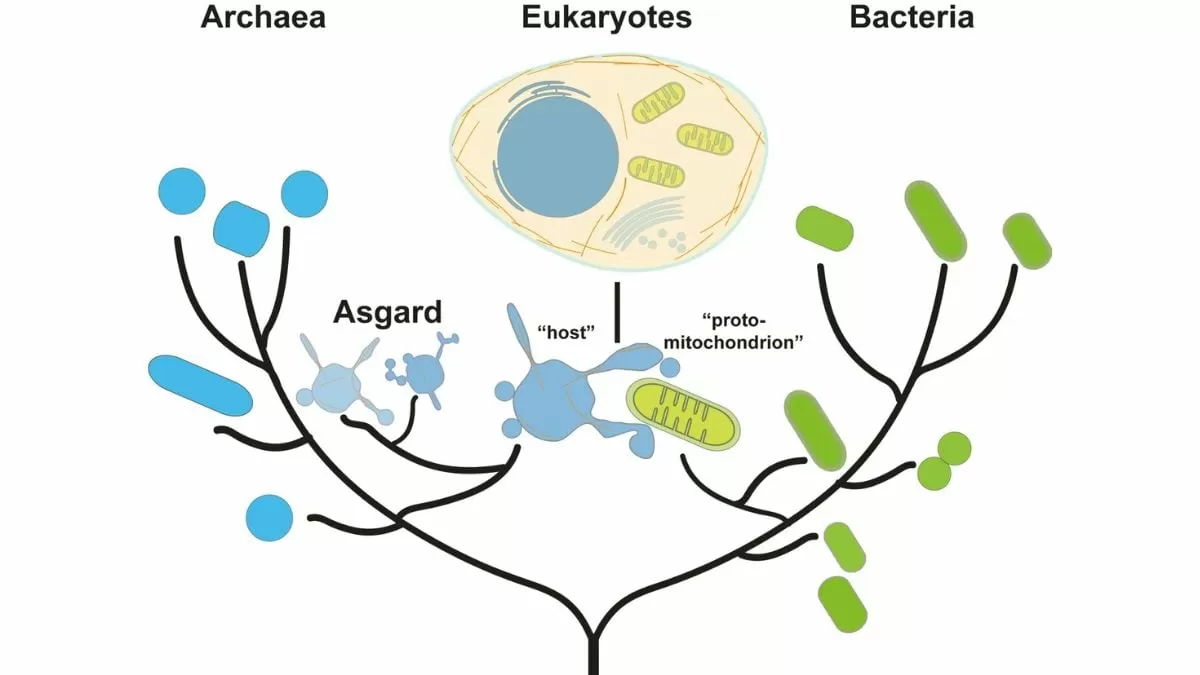
Scientists have long been fascinated by the origins of complex life forms on Earth. The evolution of eukaryotic cells, which make up the majority of living organisms on our planet, has been a subject of intense research and speculation. And now, a group of single-celled organisms called Asgard archaea, might hold some crucial clues to understanding this complex process.
Asgard archaea were first discovered in 2015, in sediments collected from the deep sea floor of the Arctic Ocean. These microbes belong to the archaea domain, a group of single-celled organisms that are genetically distinct from bacteria and eukaryotes. They have been termed ‘Asgard’ after the mythological realm of the Norse gods, as they were found near Loki’s Castle, another group of archaea named after the Norse god of mischief.
At first glance, these microbes may seem insignificant, but recent research by a team led by scientists at ETH Zurich has made an astonishing discovery – Asgard archaea possess cytoskeletal proteins similar to those found in eukaryotes. This finding challenges the traditional three-domain model of life, which classifies all living organisms into three domains – bacteria, archaea, and eukarya.
This breakthrough discovery was made by analyzing the genome of one particular Asgard archaeon known as Thorarchaeota. The researchers identified a set of genes encoding proteins that are crucial for the formation of cytoskeletons – the structural framework that gives cells their shape and enables them to move and divide. These proteins, called actin and tubulin, are found in all eukaryotic cells and are essential for their survival.
The presence of these cytoskeletal proteins in Asgard archaea raises an intriguing possibility – that these microbes might have played a key role in the evolution of eukaryotic cells. It has long been believed that eukaryotic cells evolved from a symbiotic relationship between bacteria and archaea. However, the exact nature of this relationship and the mechanisms that led to the development of complex life forms have remained a mystery.
But now, with the discovery of these cytoskeletal proteins in Asgard archaea, scientists have a potential missing link that could help unravel the mystery of eukaryotic evolution. The team at ETH Zurich believes that these microbes may have formed a symbiotic relationship with early eukaryotes, providing them with important cellular functions like cell division and movement.
Furthermore, the presence of these proteins challenges the traditional three-domain model of life, as Asgard archaea seem to possess characteristics of both bacteria and eukaryotes. This finding suggests a more complex and interconnected tree of life, with eukaryotes possibly branching off from Asgard archaea.
The potential significance of this discovery cannot be overstated. It opens up new avenues of research and raises exciting questions about the origins of complex life forms. It also highlights the importance of studying and understanding these microscopic organisms, which may hold vital clues to our own existence.
But the implications of this discovery go beyond just scientific curiosity. It also has practical implications for fields like biotechnology and biomedicine. The cytoskeletal proteins found in Asgard archaea have important functions in cell division and movement, which are essential processes in both fields. This means that these microbes could potentially be used in various applications, from developing new drugs to improving industrial processes.
However, there is still much to be learned about Asgard archaea and their role in the evolution of eukaryotic cells. The team at ETH Zurich is continuing their research, hoping to uncover more clues and answers about these fascinating microorganisms.
In conclusion, the discovery of cytoskeletal proteins in Asgard archaea is a groundbreaking achievement that challenges our understanding of the evolution of life on Earth. It highlights the importance of delving into the microscopic world and studying these often-overlooked organisms. With further research, we may unlock even more secrets about our own origins and the incredible diversity of life on our planet.
