

New research from the Dark Energy Spectroscopic Instrument (DESI) project has revealed groundbreaking findings about the mysterious force known as dark energy. For years, scientists have believed that dark energy is a constant force that has been driving the expansion of the universe. However, the latest data from DESI suggests that this may not be the case.
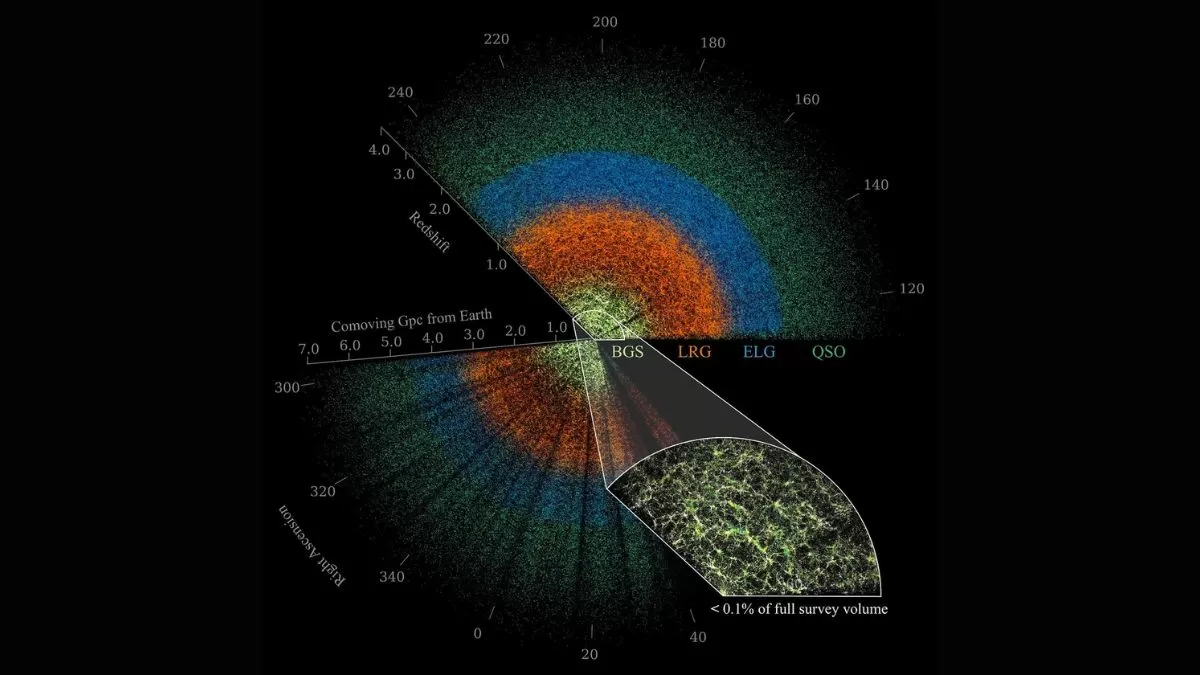
DESI is an international collaboration of over 500 scientists from 75 institutions, working together to map the universe in unprecedented detail. Using the world’s largest optical telescope, the 4-meter Mayall Telescope at Kitt Peak National Observatory in Arizona, DESI has been able to map 15 million galaxies in just one year. This massive dataset has provided new insights into the nature of dark energy and its role in the evolution of the universe.
One of the most surprising findings from DESI’s data is that dark energy may not be a constant force after all. Instead, it appears to be changing over time, challenging long-held cosmological models that have assumed a stable influence of dark energy on the expansion of the universe. This discovery has raised new questions about the evolution of the cosmos and has left scientists scrambling to revise their theories.
Dark energy was first proposed in the late 1990s to explain the observed acceleration of the universe’s expansion. It is believed to make up about 70% of the universe, with the remaining 30% being made up of dark matter and ordinary matter. However, despite its significant presence, dark energy has remained a mystery to scientists. Its exact nature and how it affects the universe’s expansion have been the subject of intense research and debate.
The DESI project aims to shed light on this enigmatic force by creating the most detailed map of the universe to date. By measuring the light from distant galaxies, DESI can determine their distance and how fast they are moving away from us. This information can then be used to study the effects of dark energy on the expansion of the universe.
The latest findings from DESI have revealed that dark energy may be evolving over time, with its strength increasing as the universe expands. This challenges the widely accepted theory that dark energy is a constant force that has remained unchanged since the beginning of the universe. It also raises questions about the future of the universe and whether this changing dark energy will eventually lead to a collapse or a never-ending expansion.
The discovery of changing dark energy has left scientists excited and intrigued. It opens up new avenues for research and could potentially lead to a better understanding of the fundamental laws of the universe. Dr. Daniel Eisenstein, the director of DESI, says, “This is a very exciting time for cosmology. We are finally starting to understand the true nature of dark energy, and it’s not what we expected.”
The DESI project has also highlighted the importance of international collaboration in scientific research. With scientists from all over the world working together, DESI has been able to achieve groundbreaking results in a relatively short period. This serves as a reminder that the pursuit of knowledge knows no boundaries and that great things can be achieved when we work together towards a common goal.
The new findings from DESI have also sparked a debate among scientists about the implications of changing dark energy. Some believe that it could lead to a complete overhaul of our current understanding of the universe, while others argue that it may just be a small deviation from the existing models. Regardless, it is clear that this discovery has opened up a new chapter in our quest to understand the mysteries of the universe.
In conclusion, the DESI project’s latest findings have challenged our long-held beliefs about dark energy and its role in the expansion of the universe. By mapping 15 million galaxies, DESI has provided new insights into the nature of this mysterious force and its evolution over time. This discovery has raised new questions and sparked a debate among scientists, highlighting the importance of continued research and collaboration in unraveling the secrets of the universe. As we continue to explore and learn more about dark energy, we are one step closer to understanding the true nature of our vast and ever-expanding universe.