

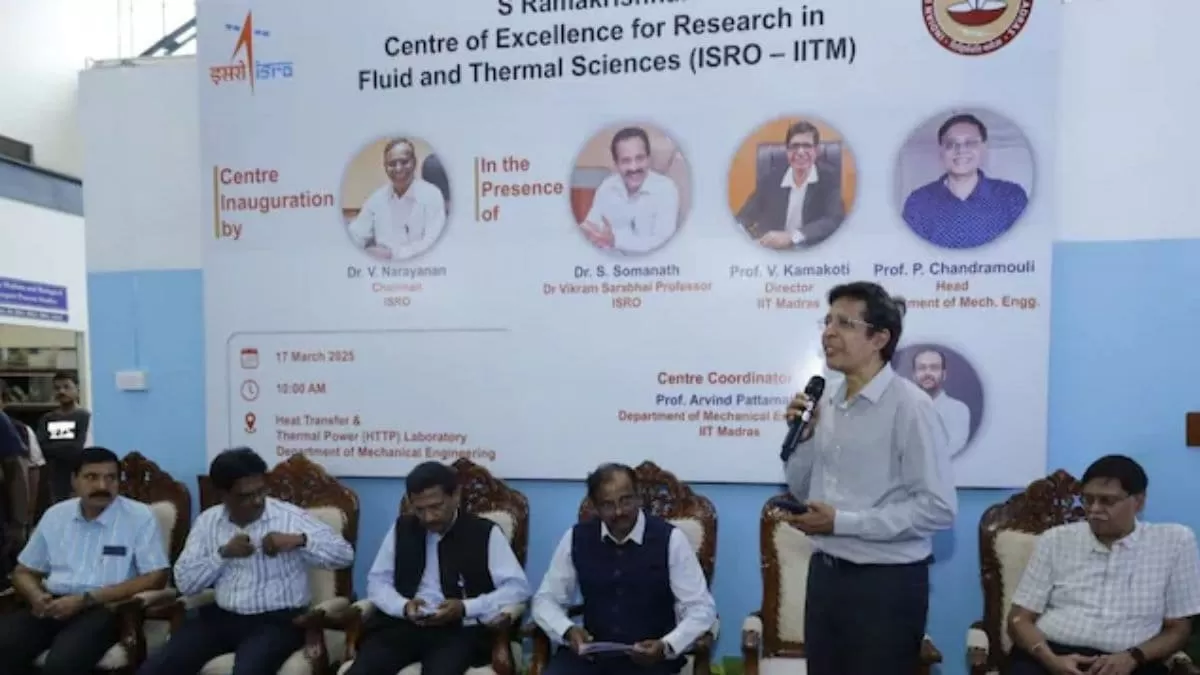
ISRO and IIT Madras have joined hands to launch the S Ramakrishnan Centre of Excellence for Research in Fluid and Thermal Sciences. This state-of-the-art facility, inaugurated on 17 March 2025, is set to become a hub for cutting-edge research in spacecraft cooling, fluid dynamics, and cryogenic engine advancements. The centre, housed in IIT Madras’ Department of Mechanical Engineering, aims to foster collaboration between ISRO scientists and students of IIT Madras, paving the way for groundbreaking discoveries and innovations in the field of space technology.
The launch of this centre marks a significant milestone in the partnership between ISRO and IIT Madras, two premier institutions of India. The centre is named after the late Dr. S Ramakrishnan, a renowned scientist and former Director of Vikram Sarabhai Space Centre, who played a crucial role in the development of India’s first satellite launch vehicle, SLV-3. This centre is a fitting tribute to his contributions and will continue his legacy of excellence in the field of space research.
The S Ramakrishnan Centre of Excellence for Research in Fluid and Thermal Sciences is equipped with state-of-the-art facilities and cutting-edge technology, making it one of the most advanced research centres in the country. It boasts of a dedicated cryogenic engine testing facility, which will enable scientists to conduct experiments and simulations to improve the performance of cryogenic engines used in space missions. This will not only enhance the efficiency of ISRO’s spacecraft but also reduce the cost of space missions.
One of the primary areas of focus of this centre is spacecraft cooling. With the increasing complexity and demands of space missions, the need for efficient cooling systems has become crucial. The centre will conduct research on developing advanced cooling systems that can withstand extreme temperatures and harsh conditions in space. This will not only benefit ISRO’s missions but also have applications in other industries such as aviation and defense.
The centre will also focus on fluid dynamics, a field that plays a crucial role in the design and development of spacecraft. With the help of advanced simulation tools and experiments, scientists will be able to study the behavior of fluids in microgravity and develop new techniques to improve the performance of spacecraft. This will not only enhance the capabilities of ISRO’s missions but also contribute to the overall understanding of fluid dynamics.
The S Ramakrishnan Centre of Excellence for Research in Fluid and Thermal Sciences will also serve as a platform for collaboration between ISRO scientists and students of IIT Madras. This will provide students with an opportunity to work on real-world problems and gain hands-on experience in the field of space technology. It will also give them exposure to the latest advancements in the field and inspire them to pursue a career in space research.
The launch of this centre is a testament to the commitment of ISRO and IIT Madras towards pushing the boundaries of space technology. It is a step towards achieving self-reliance in the field of space research and reducing our dependence on other countries for critical technologies. The centre will also contribute to the government’s vision of making India a global leader in space technology.
The S Ramakrishnan Centre of Excellence for Research in Fluid and Thermal Sciences is a significant addition to the already impressive research facilities at IIT Madras. It will not only benefit ISRO but also other industries and academic institutions in the country. The centre will serve as a beacon of hope and inspiration for future generations of scientists and engineers, motivating them to push the boundaries of science and technology.
In conclusion, the launch of the S Ramakrishnan Centre of Excellence for Research in Fluid and Thermal Sciences is a momentous occasion for both ISRO and IIT Madras. It is a testament to the unwavering commitment of these institutions towards advancing the frontiers of space technology. With this centre, India is poised to make significant strides in the field of space research and cement its position as a global leader in the space industry.
