

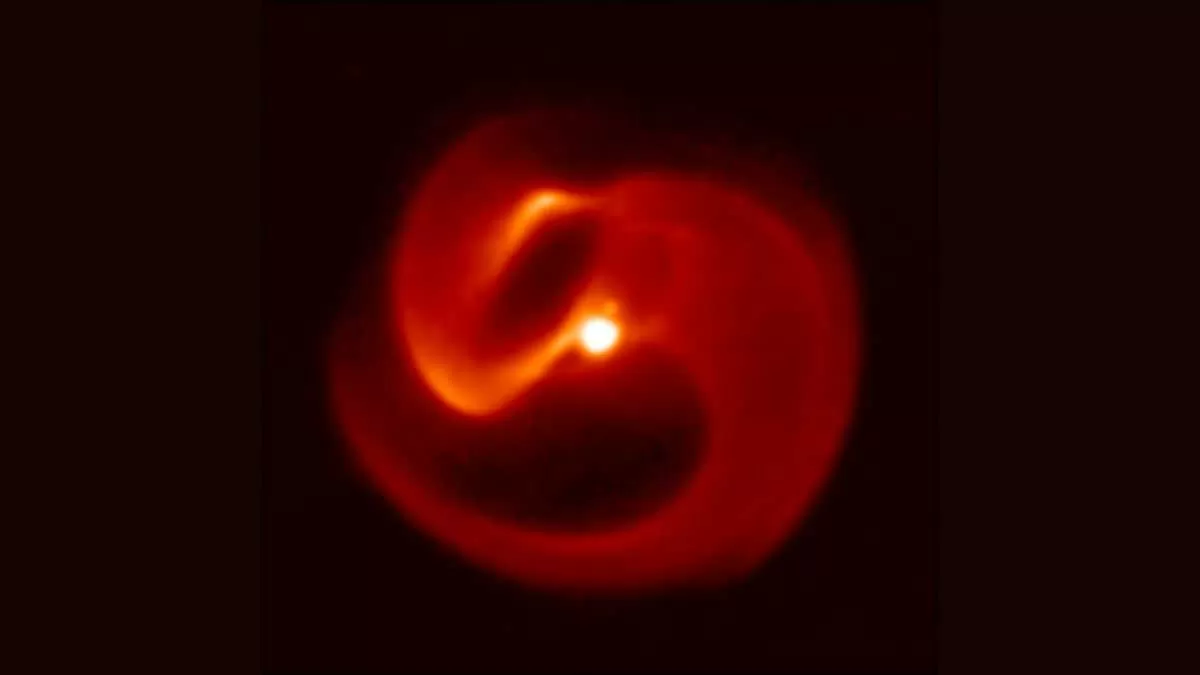
New research using Keck Observatory’s instruments has shed new light on the orbit of Wolf-Rayet 104, a massive star system that has long been a source of fascination for astronomers. The findings, published in a recent study, confirm that the star’s orbit is tilted 30-40 degrees away from Earth, lowering concerns about a possible gamma-ray burst. This discovery has challenged previous assumptions and raised new questions about the behavior of this enigmatic star.
Wolf-Rayet 104, located in the constellation of Sagittarius, is a binary star system consisting of two massive stars orbiting each other. The primary star, known as the Wolf-Rayet star, is a hot and luminous star that is rapidly losing mass through powerful stellar winds. The secondary star is a smaller and less massive star that is in the process of evolving into a red giant.
For many years, astronomers have been intrigued by the possibility of a gamma-ray burst occurring in this system. Gamma-ray bursts are some of the most energetic events in the universe, releasing huge amounts of radiation in just a few seconds. It was believed that the alignment of Wolf-Rayet 104’s orbit with Earth’s could potentially result in a gamma-ray burst directed towards our planet, posing a potential risk to life on Earth.
However, the latest research using Keck Observatory’s instruments has revealed that the orbit of Wolf-Rayet 104 is actually tilted away from Earth, significantly reducing the chances of a gamma-ray burst occurring in our direction. This discovery has come as a relief to many astronomers who have been closely monitoring this star system.
The research team used spectroscopy data from Keck Observatory’s High-Resolution Echelle Spectrometer (HIRES) to measure the radial velocity of the Wolf-Rayet star. This technique involves analyzing the light emitted by the star to determine its speed and direction of motion. By comparing the radial velocity of the star with the orbital motion of the system, the team was able to accurately determine the tilt of the star’s orbit.
The results showed that the orbit of Wolf-Rayet 104 is tilted at an angle of 30-40 degrees away from Earth. This means that the chances of a gamma-ray burst being directed towards our planet are extremely low. This finding has put to rest any concerns about the potential risks posed by this star system.
The new research has also raised new questions about the behavior of the Wolf-Rayet star. It was previously believed that the star’s powerful stellar winds were responsible for shaping the orbit of the secondary star. However, the tilted orbit suggests that there may be other factors at play. This has sparked further interest among astronomers who are now eager to delve deeper into the mysteries of this fascinating star system.
The findings of this study have significant implications for our understanding of the evolution and behavior of massive stars. It also highlights the importance of continued research and observation using advanced instruments like those at Keck Observatory. With these tools, we are able to unravel the secrets of the universe and gain a deeper understanding of the world around us.
The team behind this groundbreaking research is hopeful that their findings will pave the way for further studies on Wolf-Rayet 104 and other massive star systems. By continuously pushing the boundaries of scientific knowledge, we can continue to unravel the mysteries of the universe and expand our understanding of the cosmos.
In conclusion, the latest research using Keck Observatory’s instruments has confirmed that the orbit of Wolf-Rayet 104 is tilted away from Earth, significantly reducing concerns about a potential gamma-ray burst. This discovery has not only put to rest any fears about the risks posed by this star system, but it has also opened up new avenues for further exploration and understanding of this enigmatic star. With continued advancements in technology and research, we can look forward to uncovering more secrets of the universe and expanding our knowledge of the vast and mysterious cosmos.
