

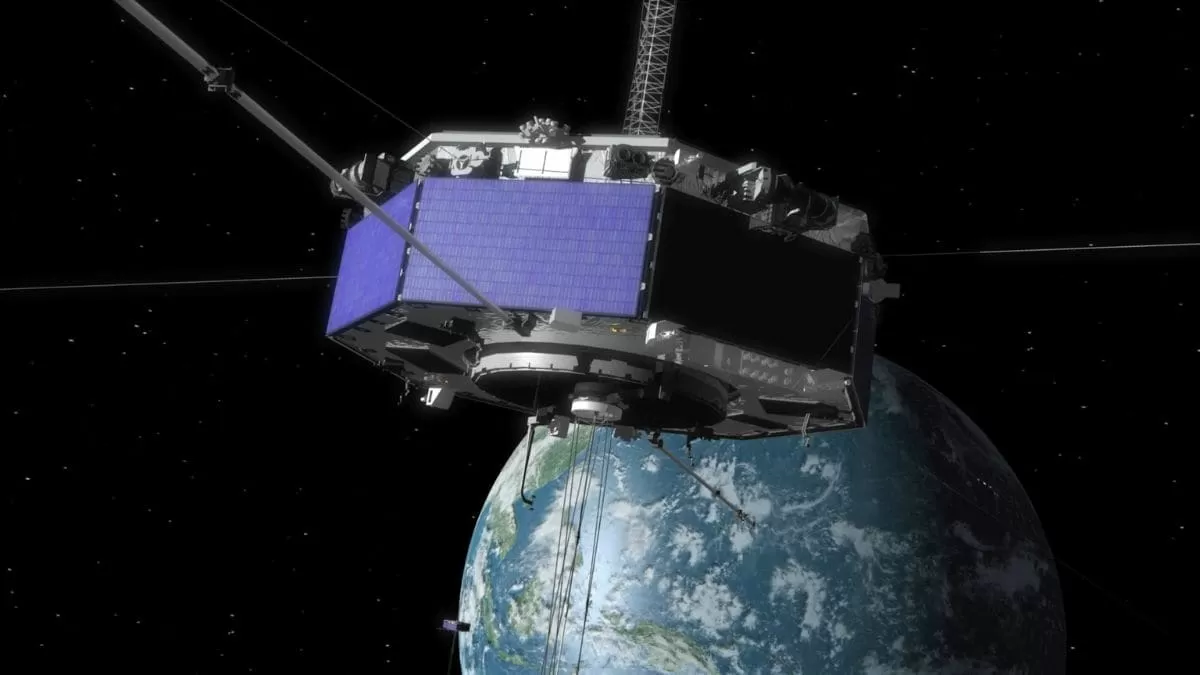
NASA’s Magnetospheric Multiscale (MMS) mission has been making groundbreaking discoveries for over a decade, revolutionizing our understanding of magnetic reconnection and its role in space physics. The four-satellite fleet has not only advanced our knowledge of this crucial process, but also set records for GPS tracking at extreme altitudes. With over 1,500 research papers published, the MMS mission has truly been a game-changer in the field of space exploration.
Magnetic reconnection is a process that occurs when magnetic fields collide and release energy, causing particles to accelerate and creating spectacular displays such as solar flares and northern lights. This process is not only important for understanding the dynamics of our own planet’s magnetosphere, but also has implications for other planets and even distant galaxies. The MMS mission was specifically designed to study this phenomenon and has exceeded all expectations in its findings.
Over the past decade, the MMS mission has provided us with an unprecedented view of magnetic reconnection in action. By using four identical spacecraft flying in a tetrahedral formation, the mission has been able to capture 3D images of this process, providing scientists with a more complete understanding of its mechanisms. This has led to over 1,500 research papers being published, refining existing theories and revealing unexpected locations where magnetic reconnection occurs.
One of the most significant discoveries of the MMS mission has been the identification of magnetic reconnection in the Earth’s magnetotail, the region of space behind our planet where the solar wind interacts with Earth’s magnetic field. This finding has challenged previous assumptions and opened up new avenues for research. The mission has also observed magnetic reconnection at the boundary between the Earth’s magnetosphere and the solar wind, providing valuable insights into the complex interactions between these two regions.
In addition to its scientific achievements, the MMS mission has also broken records for GPS tracking at extreme altitudes. The satellites have flown as close as 6 miles above Earth’s surface, navigating through the harsh conditions of the magnetosphere. This has required cutting-edge technology and precise control, making the MMS mission a testament to the ingenuity and skill of NASA’s engineers and scientists.
The success of the MMS mission has not gone unnoticed, with the fleet receiving numerous accolades and awards for its groundbreaking research. The mission has also inspired future generations of scientists and engineers, with its innovative approach and groundbreaking discoveries serving as a source of motivation and inspiration.
Looking to the future, the MMS mission is set to continue its groundbreaking research, with plans to extend its mission until at least 2022. This will allow for further exploration and discoveries in the field of magnetic reconnection, paving the way for new technologies and advancements in space physics. The mission has also opened up opportunities for collaboration with other space agencies, fostering international cooperation and advancing our understanding of the universe.
In conclusion, the Magnetospheric Multiscale (MMS) mission has completed a decade of remarkable achievements, pushing the boundaries of our knowledge and transforming our understanding of magnetic reconnection. With its four-satellite fleet, the mission has enabled over 1,500 research papers, refining theories and revealing unexpected reconnection locations. The MMS mission has also set records for GPS tracking at extreme altitudes, showcasing the ingenuity and determination of NASA’s scientists and engineers. As we continue to unravel the mysteries of space, the MMS mission will undoubtedly play a crucial role in shaping our understanding of magnetic reconnection and its impact on our universe.
