

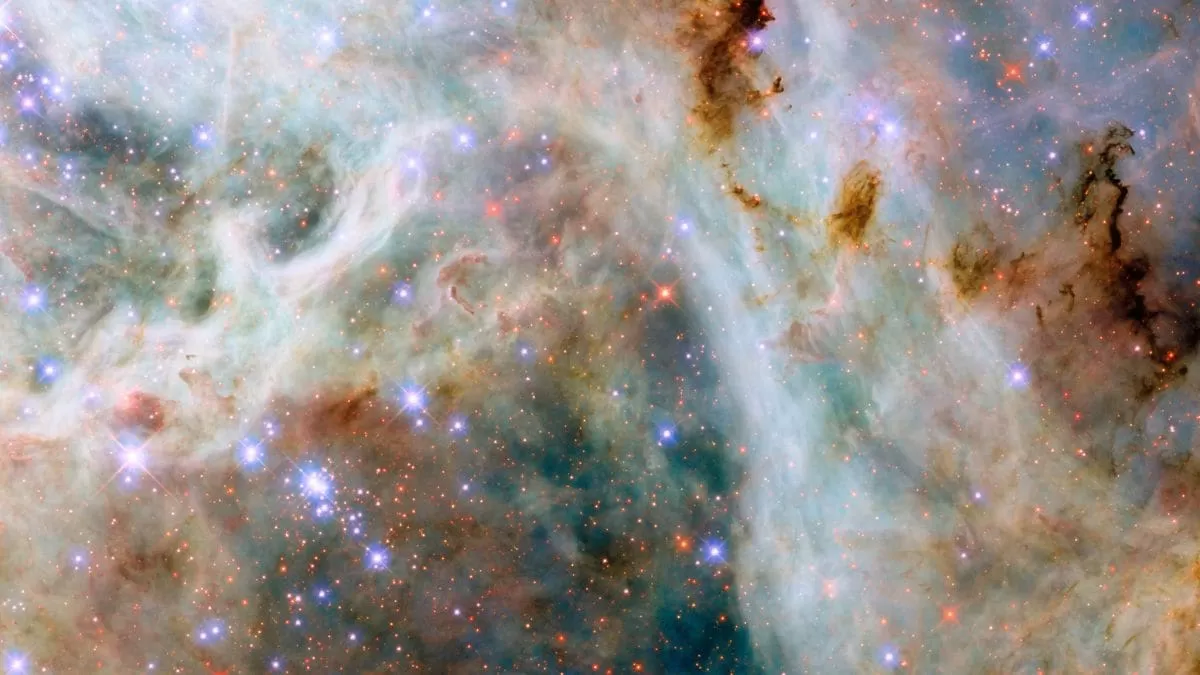
The Hubble Space Telescope, known for capturing stunning images of our vast and mysterious universe, has once again astounded us with its latest discovery. A new image from the telescope has revealed the intricate and complex structure of the Tarantula Nebula, a cosmic wonder located 160,000 light-years away. This image not only showcases the beauty of the nebula, but also provides valuable insights into the process of stellar evolution.
The Tarantula Nebula, also known as 30 Doradus, is a massive star-forming region in the Large Magellanic Cloud, a satellite galaxy of our own Milky Way. It is one of the largest and most active regions of star formation in our local group of galaxies. The new image from the Hubble Space Telescope captures the nebula in stunning detail, highlighting its dense cosmic dust clouds and vibrant star-forming regions.
The Tarantula Nebula has long been a subject of fascination for astronomers and astrophysicists. Its unique structure and intense star formation make it a crucial area for studying the process of stellar evolution. The captured details in the new image offer valuable insights into how cosmic dust, a key component in the formation of stars and planets, contributes to this process.
Cosmic dust, also known as interstellar dust, is made up of tiny particles of carbon, silicon, and other elements. These particles play a vital role in the formation of stars and planets by providing the necessary material for their growth. The new image from the Hubble Space Telescope shows how these dust particles are distributed throughout the Tarantula Nebula, creating a complex web of structures.
One of the most striking features of the Tarantula Nebula is the presence of dark, dense dust clouds. These clouds are so thick that they block the light from the stars behind them, creating a stark contrast against the bright, glowing regions of the nebula. These dust clouds are crucial in the process of star formation as they act as nurseries for the birth of new stars.
The new image also reveals numerous bright, young stars scattered throughout the nebula. These stars are formed when the dense dust clouds collapse under their own gravity, creating a chain reaction of nuclear fusion that ignites the birth of a new star. The Tarantula Nebula is a hotbed for this process, with thousands of new stars being born every year.
Another intriguing feature captured in the new image is the presence of glowing gas clouds. These clouds, made up of ionized hydrogen, emit a reddish glow and are a sign of intense star formation. The Tarantula Nebula is home to some of the most massive stars in the known universe, with some reaching up to 200 times the mass of our sun. These massive stars emit powerful winds and intense radiation that shape the surrounding gas clouds, creating the stunning structures we see in the new image.
The Tarantula Nebula is not only a breathtaking sight, but it also holds valuable information about the evolution of stars and planets. By studying this cosmic wonder, scientists can gain a better understanding of the processes that shape our universe and the role of cosmic dust in the formation of stars and planets.
The Hubble Space Telescope continues to amaze us with its ability to capture such detailed and awe-inspiring images of our universe. Its latest image of the Tarantula Nebula is a testament to the incredible advancements in technology and our never-ending curiosity to explore the unknown.
As we continue to unravel the mysteries of our vast and complex universe, the Tarantula Nebula will undoubtedly play a vital role in our understanding of stellar evolution. This new image from the Hubble Space Telescope serves as a reminder of the endless possibilities and wonders that await us in the vast expanse of space.
